
RH Saga Chapter 5.5: A Tannakian category?

It was an audacious proposal. As far as I know, nothing of the sort had ever been imagined before.
(James Arthur, describing the Tannakian proposal of Langlands made around 1977)
We are now at the heart of the search for $\mathbb{F}_1$. We can say quite precisely what L-functions are (either via the automorphic approach, or via some axiomatic approach, like the Selberg class, or the Farmer-Pitale-Ryan-Schmidt paper, or the Booker variant). We also know (quite well) how to "add" L-functions, "multiply" them, take their scalar product, and perform lambda-ring operations. In other mathematical contexts where such operations appear naturally, it is usually the case that there is an underlying category, with objects and morphisms, such that the algebraic operations correspond to functorial operations like direct sum, tensor product, and Schur functors. In other words, the algebraic structure under consideration is the Grothendieck ring of an underlying category.
In our case, L-functions form an algebraic structure (more precisely, a lambda-ring). You may want to review the lambda-ring theory from Chapter 5.2, but all you really need for a quick reading of this post is that the data of a lambda-ring structure consists of addition, multiplication, and a series of unary operations $\lambda^k$ for $k = 1, 2, 3, \ldots$. These operations were called exterior powers in Chapter 5.2, but here I will simply say lambda-operations. This sequence of operations can be used to define other unary operations too, like the symmetric powers.
I like to write $\mathbb{L}$ for the "lambda-ring of all L-functions", to emphasize that it plays a fundamental role in number theory just like $\mathbb{Z}$ or $\mathbb{Q}$ (which by the way are also lambda-rings, where the lambda-operations are defined as binomial coefficients: $\lambda^k(n) = \binom{n}{k} $).
The question (one of the most fundamental questions in all of mathematics!) is whether $\mathbb{L}$ is the Grothendieck ring of some category, and if so, how to describe and understand this category.
How this category might look is a great mystery indeed. In the most recent talk of Sarnak, he refers to this as we have no idea what's there. Here is the full quote in context, from 2:42 in the video (and note that I recently posted a transcript of this brilliant talk, as an experiment).
So of course I'm going to focus on the analytic side, naturally, and I'm going to push it to the limit, as I said. And not only the analytic side but the automorphic side. In the background there will sometimes be Galois representations. Other times, and that's the theme of this talk, we have no idea what's there. There's something there that's much more transcendental, that's critical to understand the full theory.
The "audacious proposal" made by Langlands around 1977 is that the category should be a Tannakian category, meaning that it should be the category of finite-dimensional representation of a group. I want to explain this idea, using the most elementary example I can think of. Let's dive into it!
The most elementary nontrivial analogy
Suppose you were given the (commutative and unital) ring
\[ R = \mathbb{Z}[X] / \langle X(X-2)(X+1) \rangle \]
meaning the ring of polynomials in $X$, with integer coefficients, modulo the relation saying that $X^3 = X ^2 + 2 X$ (expand the parantheses to see this relation). Concretely, the elements of this ring are polynomials of degree at most $2$, like $5 X ^2 - 3 X + 4$, with multiplication carried out under the rule that $X ^3 $ can always be replaced by $X ^2 + 2X$.
In addition to addition and multiplication, this ring is also equipped with lambda-ring operations, defined by
- $\lambda ^1(X) = X$ (actually, $\lambda ^1$ is always the identity operator, by the axioms for a lambda-ring).
- $\lambda ^2(X) = X ^2 - X - 1$.
- $\lambda ^k(X) = 0$ for all $k \geq 3$.
It is enough to specify $\lambda ^k$ on the generator $X$, since by the lambda-ring axioms this determines $\lambda ^k$ on the entire ring (these details are skipped here).
Now suppose also that you were given the unreasonable task of determining whether there exists a group $G$, such that the representation ring of the group is precisely $R$. How on earth would you go about this process?
In so happens that I very deliberately set up the example so that a group $G$ exists, and it is the group $S_3$ with six elements encountered as the finite group example back in Chapter 5.2. Using the notation set up there, the group has three irreducible representations $V_1$ (the trivial one), $V_2$ (the sign representation), and $V_3$ (the two-dimensional "standard" representation). In any lambda-ring, the notion of dimension of an object $V$ means the largest $k$ such that $\lambda^k(V) \neq 0$. So you see that our generator $X$ has dimension 2. Indeed, if we identify $V_3$ with $X$, and $V_2$ with $X ^2 - X - 1$, then the representation ring (or "Grothendieck ring") of $S_3$ is precisely the ring $R$! Here the trivial representation $V_1$ must be identified with the element $1$ in $R$. It takes a little bit of work (but not much) to verify this correspondence from the character table of $S_3$. In fact, if we use a kind of "extended" character table listing all the eigenvalues rather than simply their sum, you can check for yourself (following the algebraic instructions from Chapter 5.2) that $X ^3$ equals $X ^2 + 2X$ and also that $\lambda ^2(X)$ equals $X ^2 - X - 1$.
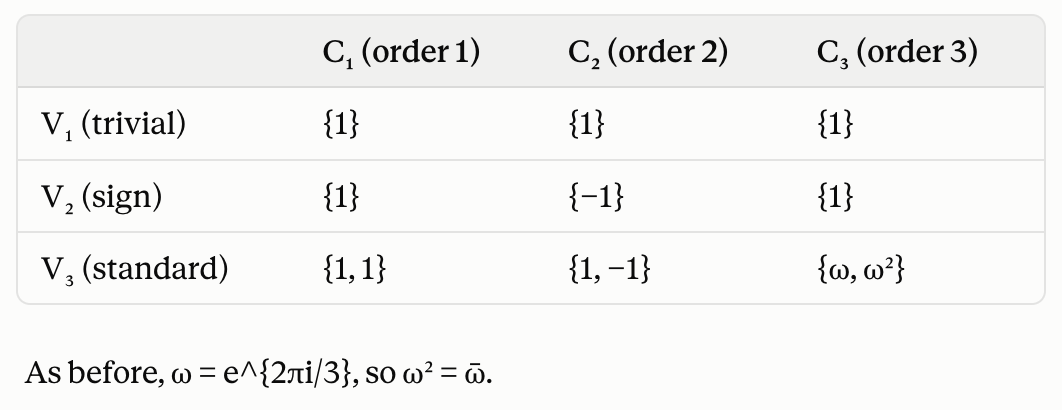
Of course, in this example, I "prepared the cake" in advance. But note how difficult it would be to find the group $S_3$ if you were given only the commutative ring $R$!! Still this is the problem facing us now, but with vastly more complicated ring - we are given the ring of all L-functions, and not even Langlands or Sarnak are able to "see" clearly whether a group exists and if so, what it might be.
I will add a few more comments on the analogy between the ring $R$ and the ring $\mathbb{L}$ of L-functions. In the toy universe of $R$, there are only three primitive (i.e. irreducible) "L-functions": The "Riemann zeta function" $V_1$, a "Dirichlet L-function" $V_2$, and one "elliptic curve L-function" $V_3$. There are also three "prime numbers", namely the identity element of $S_3$ ("keeping the triangle fixed"), the set of 2-cycles (transpositions, i.e. "flips of the triangle"), and the set of 3-cycles (i.e. "rotations of the triangle"). The set of "primes" is really the set of conjugacy classes in the finite group. In this setting the "L-functions" are dual to the "primes" in the sense of linear algebra, and the orthogonality of the "Selberg inner product" is just the basic character orthogonality in finite group theory, which concretely means that the scalar product of two rows of the character table is zero (when weighted by the size of each conjugacy class). For example, the scalar product $V_3 \bullet V_2$ is $[2, 0, -1] \bullet [1, -1, 1] = \underline{1} \cdot 2 \cdot 1 + \underline{3} \cdot 0 \cdot (-1) + \underline{2} \cdot (-1) \cdot 1 = 0$, where I have underlined the weights. The "Satake parameters" of $V_3$ at the prime $C_3$ are $\omega$ and $\omega^2$ (the 3rd roots of unity), so the "Euler factor" would be
\[ \frac{1}{(1-\omega T)(1-\omega ^2 T)} \]
At this point, the analogy breaks down, since there is no way to make sense of substituting $T$ for $p^{-s}$, and hence no meaning can be given to the "Euler product" over all "primes". In other words, the toy universe $R$ has no actual L-functions, but it does share many of the structural features that L-functions have!
The dreams of Grothendieck and Langlands
Recall that there are two kinds of L-functions - algebraic and transcendental. In the world of Grothendieck's writings, only algebraic L-functions are considered, and the dreams developed by Grothendieck was that there should be an underlying category, that this category should be Tannakian, i.e. representations of a group, called the motivic Galois group. In fact, there are two versions of this largely conjectural category, the abelian category of pure motives, and the abelian category of mixed motives, requiring two different versions of the group. We shall return to mixed motives in the future, in connection with special values of L-functions.
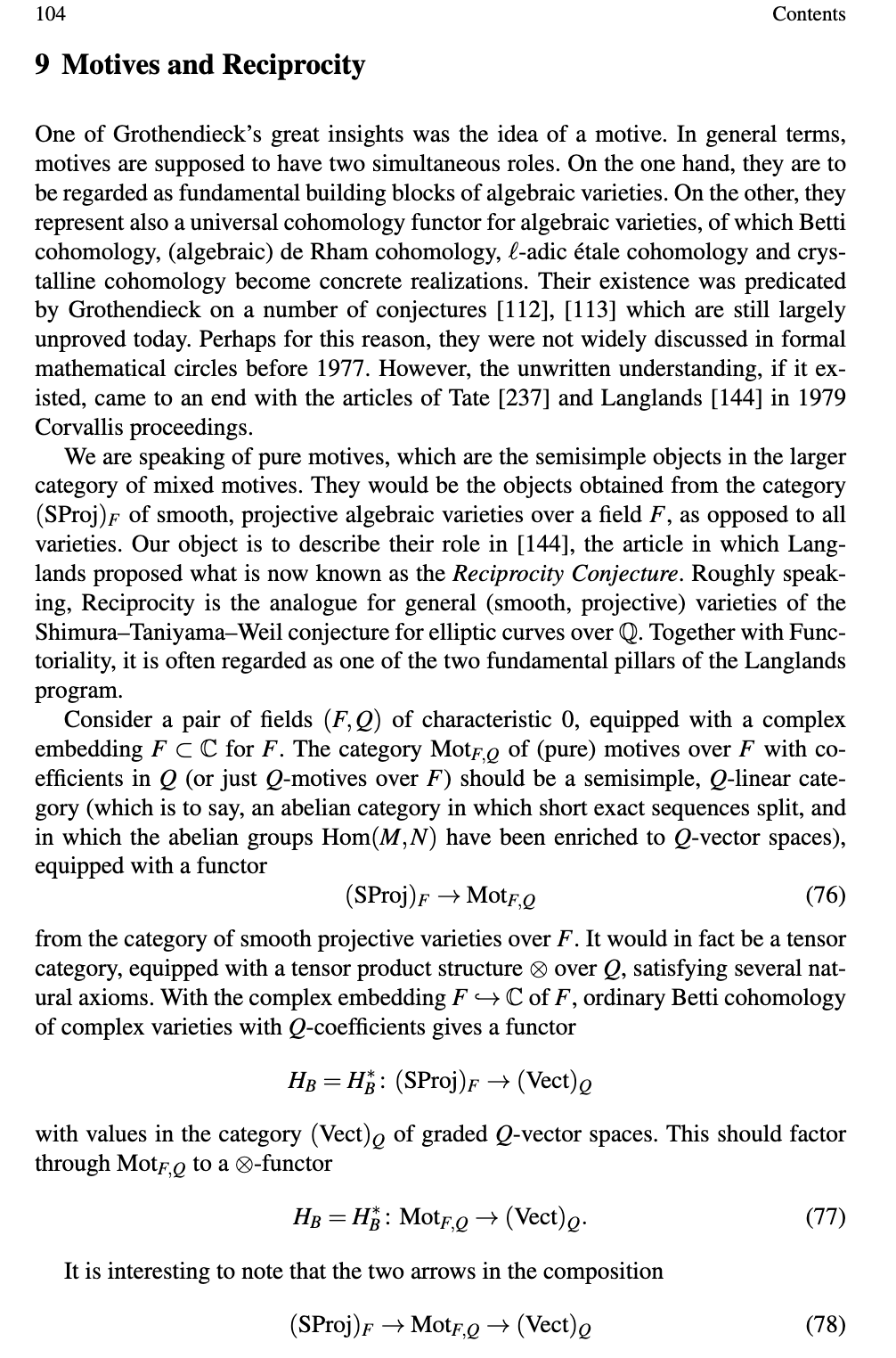
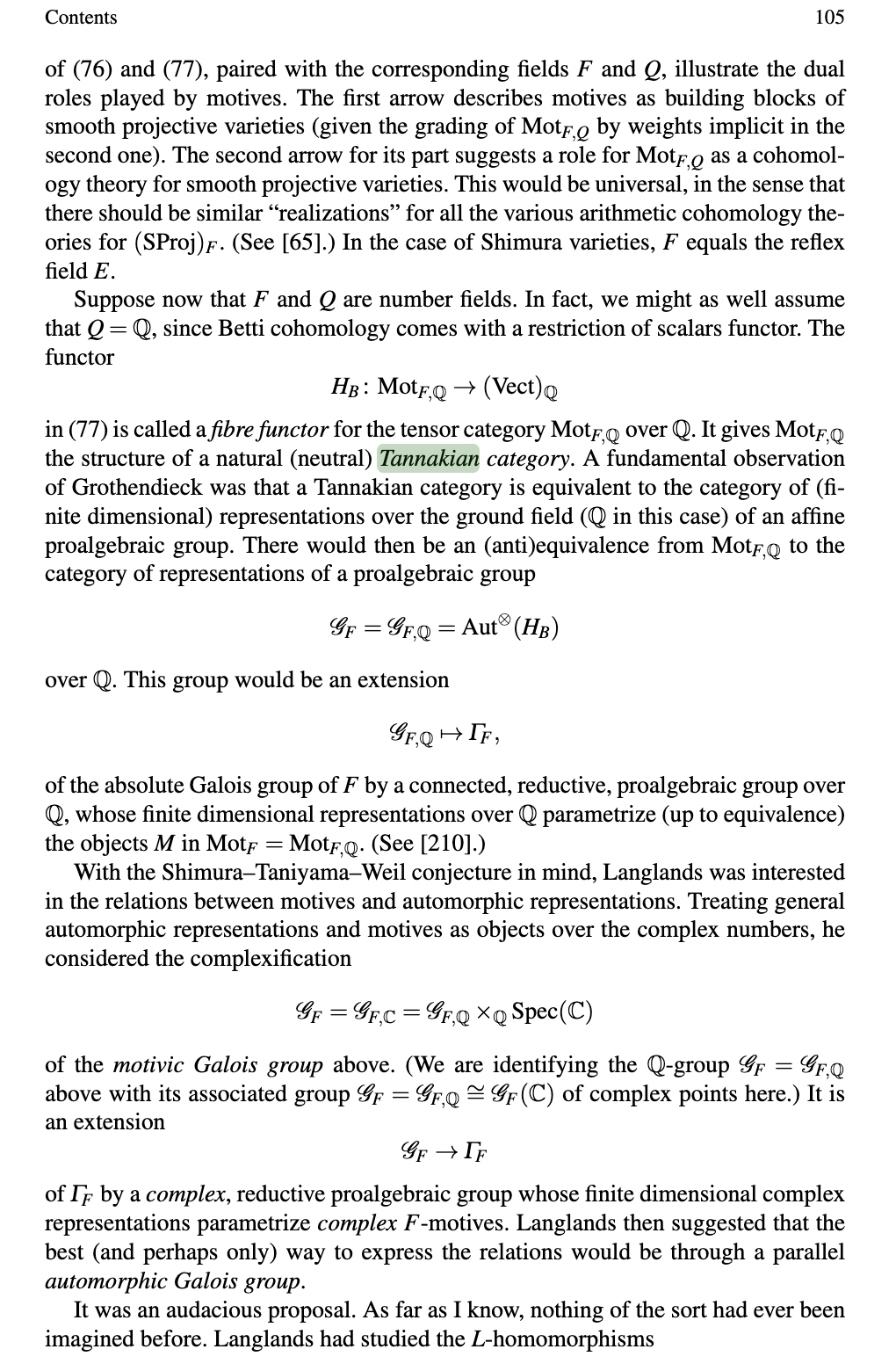
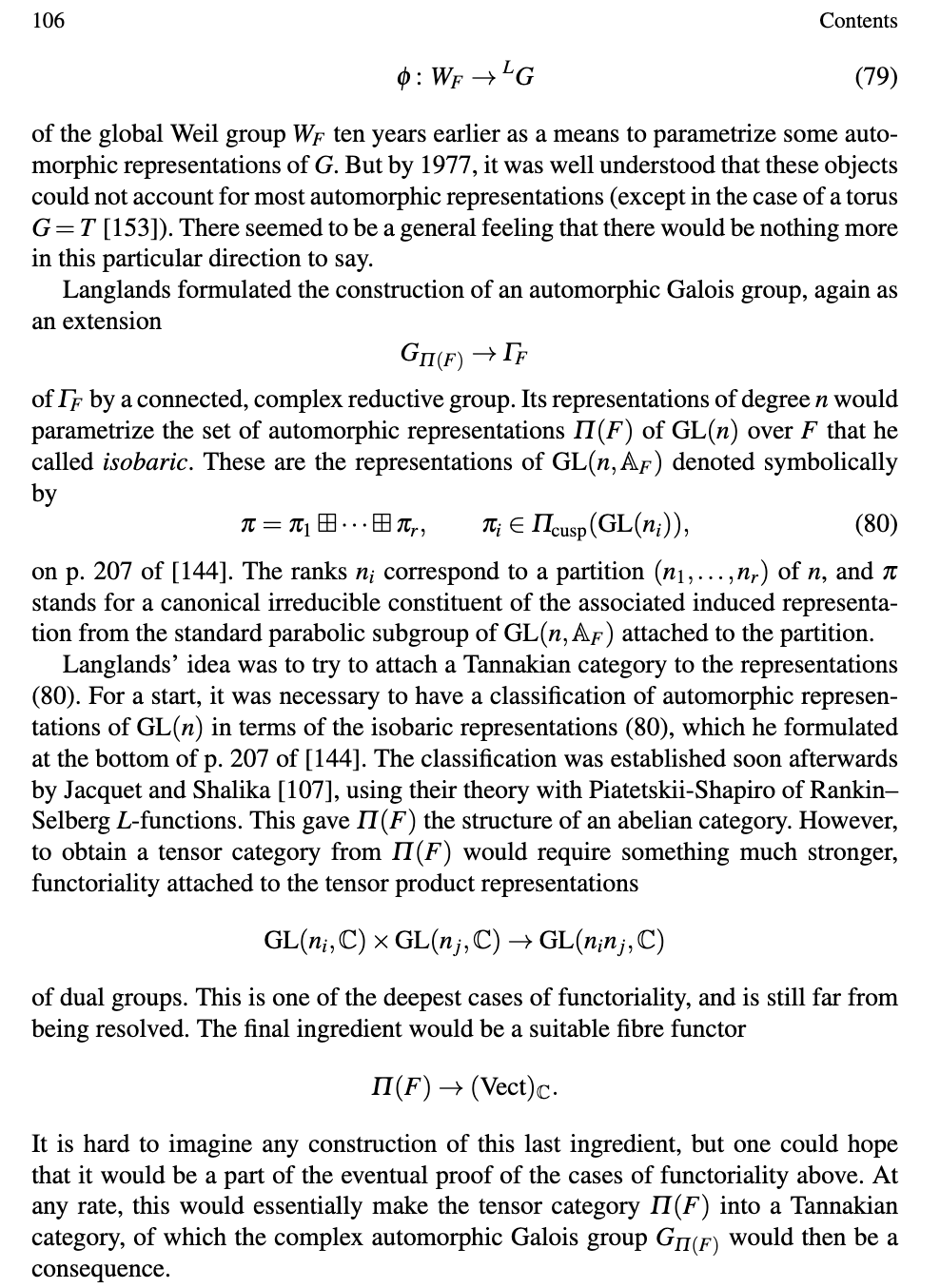
It was Langlands who started dreaming about an even deeper and more general Tannakian theory, encompassing all L-functions, and these ideas appeared in his Märchen paper in the famous Corvallis volumes (not online, but table of contents here). There is a wonderful exposition of these ideas in the recent survey article of Arthur, and I cannot explain this story any better than Arthur himself, so below are the three key pages. Note that the conjectures of Grothendieck mentioned there are his standard conjectures (see this expository note by Ji and the old papers of Kleiman, here and here). These standard conjectures are closely related to the (Millennium Problem) Hodge Conjecture, and the math involved (algebraic cycles) is super-super-difficult. Note also that in Grothendieck's original paper, he emphasizes that the second conjecture is a statement on positivity, which would lead to the local Riemann Hypothesis. Famously, Deligne found another route, which in Grothendieck's view was not the "true path". But I digress - here is Arthur's explanation of these dreams!
What is known?
Arthur describes the situation well - the problem of finding the mysterious Tannakian category is closely tied up with Langlands Functoriality, discussed back in Chapter 2. However, Arthur himself (one of the great pioneers in the Langlands program and a former president of the American Mathematical Society) has a research program on how the Langlands group might be constructed under the assumption of sufficient knowledge on functoriality. There is a short paper from 2025 called Motives and Automorphic representations (based on a talk from 2023), with a pointer to a future paper still in progress, called On universal Galois groups.
One could perhaps speculate that Langlands was too optimistic, and that the category underlying L-functions is not in fact Tannakian, but some other kind of tensor category. An analogous question could be asked in physics contexts where physical objects (like quarks) behave like representations of a Lie group - is it really the case that in all such settings an actual group exists, or should one maybe look for more general kinds of categories?
If you approach the dream of Langlands as a serious student, one thing to study is the situation on the other side of the Rosetta Stone, i.e. for automorphic representations over a function field rather than a number field. In this setting things are a bit simpler:
- There is is no "infinite prime" (and hence no Gamma factors for the L-function)
- There is no dichotomy between algebraic and transcendental L-functions; all L-functions are algebraic.
- There is a notion of "base field", meaning the finite field $\mathbb{F}_q$, which allow for geometric considerations which are not possible over number fields (but perhaps would be, if we had a field with one element).
Given that the number field world has a transcendental-algebraic dichotomy, and that this dichotomy does not exist for the other Rosetta Stone columns (function fields and Riemann surfaces), it seems to me that we should look for other geometric worlds in which there is a genuine dichotomy between algebraic and transcendental objects, which could serve as analogies and inspiration. Perhaps something in the direction of "real-analytic curves". But maybe this idea is too naive.
A final remark, or word of advice: The entire story of the Langlands group is incredibly abstract, and it may seem difficult to learn all of the background and technical details. One place to start digging is to focus on what's called the pole order of an L-function, which is the order of the pole at the near-central point, i.e. at the point $s=1$, if the critical line is at $Re(s) = \frac{1}{2}$. You may recall from graphs seen in the RH Saga videos that the Riemann zeta function has a pole of order 1 here, while other simple L-functions (like from elliptic curves or Dirichlet characters) do not have poles. For more complicated L-functions, this pole order (a very concrete integer) carries a significant amount of information about the hoped-for Tannakian category structure, and especially so if you also consider pole orders of symmetric/exterior powers or tensor products of L-functions. As an example, for an elliptic curve over $\mathbb{Q}$, the sequence $Sym^k E$ has pole order 1 if $k$ is a multiple of 4, and 0 otherwise, if the curve has complex multiplication (CM). For non-CM curves, the pole orders are just 0 for all $k$. These are numbers you can learn to compute! A more abstract piece of motivation is that the pole orders should compute the fusion coefficients (aka structure constants) in the tensor product structure, like in the decompositions we saw in Chapter 5.2 in connection with particle physics and $SU(3)$. The statement is that the number of copies of $H$ in the (additive) decomposition of $F \otimes G$ should be the pole order of the L-function attached to $F \otimes G \otimes \bar{H}$, the last factor being the dual ("complex-conjugate") of $H$. This general formula has many interesting special cases, and starting to look at such examples is a path towards the deep Tannakian mysteries, leading to the world of Sato-Tate groups and beyond.