
RH Saga Chapter 2: Langlands and the landscape of L-functions

The "Himalayan peaks" that hold the secrets of these nonabelian reciprocity laws challenge humanity, and, with the visionary Langlands program, we have mapped out before us one means of ascent to those lofty peaks. The recent work of Wiles suggests that an important case (the semistable case) of the Shimura-Taniyama conjecture is on the horizon and perhaps this is another means of ascent. In either case, a long journey is predicted. To paraphrase the cartographer, it is not a journey for the faint-hearted. Indeed, there is a forest to traverse, "whose trees will not fall with a few timid blows. We have to take up the double-bitted axe and the cross-cut saw and hope that our muscles are equal to them."
Ram Murty (1994)
If you are young and you feel the calling to take up the double-bitted axe together with Ram Murty, I would wholeheartedly recommend beginning your journey by selecting a limited class of L-functions, and then work to become intimately familiar with this specific class. Learn to compute things for this class, learn the proofs of known theorems, and start to explore some open research problems on your own. Later, you can expand your horizons to other L-functions and gradually also to more of the technical (automorphic and motivic) machinery underpinning the Langlands program and other great problems.
In fact, I would even like to suggest that a good place to begin is to study those L-functions that are of degree 1 and have integer coefficients. This is a beautiful and easy to define class of L-functions called the quadratic Dirichlet L-functions, and although these functions are well understood in many ways, they also come with many open and interesting research problems. Historically, they go way back. In fact, Dirichlet's original paper on these functions appeared in 1837, more than 20 years before Riemann's famous paper on the Riemann zeta function.
If you watched the RH Saga Episode 2, you will remember the function $L_P$, which is just the Riemann zeta function, and the function $L_A$, which has periodic coefficients with period $1, 0, -1, 0$. Both of these happen to be quadratic Dirichlet L-functions. The function $L_K$ is an example of a Dedekind zeta function, and the function $L_E$ is an example of an elliptic curve L-functions, and both of these are natural classes to learn about later, as you progress further. Let's begin!
Quadratic Dirichlet L-functions
What is a quadratic Dirichlet L-function? First of all you must know that there is precisely one quadratic Dirichlet L-function for each fundamental discriminant.
Definition: An integer $D$ is called a fundamental discriminant if it is not divisible by the square of any odd prime and it satisfies one of the following three congruences:
- $D \equiv 1 \pmod{4}$
- $D \equiv 8 \pmod{16}$
- $D \equiv 12 \pmod{16}$
Now you can check for yourself that the first few positive fundemental discriminants are
\[ 1, 5, 8, 12, 13, 17, 21, 24, 28, 29, \ldots \]
and the first few negative ones are
\[ −3, −4, −7, −8, −11, −15, −19, −20, −23, −24, −31, \ldots \]
Getting started with Sage
For any $D$ in the above lists, let us write $L_D$ for the corresponding L-function.
With Sage, you can start looking at these L-functions immediately. Here is some code where you can choose a value of $D$ and print the list of coefficients (which will be a sequence repeating with period length $\vert D \vert$.
The actual L-function is (like always) defined in terms of the coeffients as the series
\[ L_D(s) = \sum_{n=1}^{\infty} \frac{a_n}{n ^s} \]
In the case $D=-4$, the coefficients are $1, 0, -1, 0$ (repeating), and you get the function $L_A$ from the RH Saga videos.
In general, $s$ is a complex number, but for starters, we can consider only real values of $s$, and plot the L-function in a range of your choosing.
If you plot the function $L_5(s)$, you will see that there are trivial zeroes for $s=0, -2, -4$ and so on. What trivial zeroes do you see for a negative $D$?
Next, try plotting some Dirichlet L-functions in the range $0$ to $1$, i.e. for real values in the critical strip. Many open research problems relate specifically to these values. How do the functions behave? When do they have zeroes? When do they have local minima or maxima?
Formal definition
For completeness, I also want to include the formal definition of a quadratic Dirichlet L-function.
As already explained, for each fundamental discriminant $D$, there is a unique quadratic Dirichlet L-function. The coefficents $a_1, a_2, a_3, \ldots$ for this L-functions are defined by the formula
\[ a_n = \left(\frac{D}{n}\right) \]
where the right hand side is the Kronecker symbol.
Ok, but what is the Kronecker symbol? It is defined as follows, for any positive integer $D$. For an odd prime $p$, we have:
\[ \left(\frac{D}{p}\right) = \begin{cases} 0 & \text{if } p \mid D, \\ 1 & \text{if } p \nmid D \text{ and } D \text{ is a square mod } p, \\ -1 & \text{if } p \nmid D \text{ and } D \text{ is not a square mod } p, \end{cases} \]
and for the prime $p=2$ we have
\[ \left(\frac{D}{2}\right) = \begin{cases} 0 & \text{if } 2 \mid D, \\ 1 & \text{if } D \equiv 1 \text{ or } 7 \pmod{8}, \\ -1 & \text{if } D \equiv 3 \text{ or } 5 \pmod{8}. \end{cases} \]
Finally we extend the definition to all positive integers $n$ by complete multiplicativity, i.e. we just multiply all the Kronecker symbols together for each of the primes (with repetition) in the factorization of $n$. In symbols, the formula is
\[ \left(\frac{D}{n}\right) = \prod_{p \mid n} \left(\frac{D}{p}\right)^{v_p(n)}, \]
where $v_p(n)$ denotes the exponent of $p$ in the factorization of $n$.
The Big Five for Dirichlet L-functions
In Chapter 1, we saw the Big Five immortal problems motivating the quest for the field with one element.
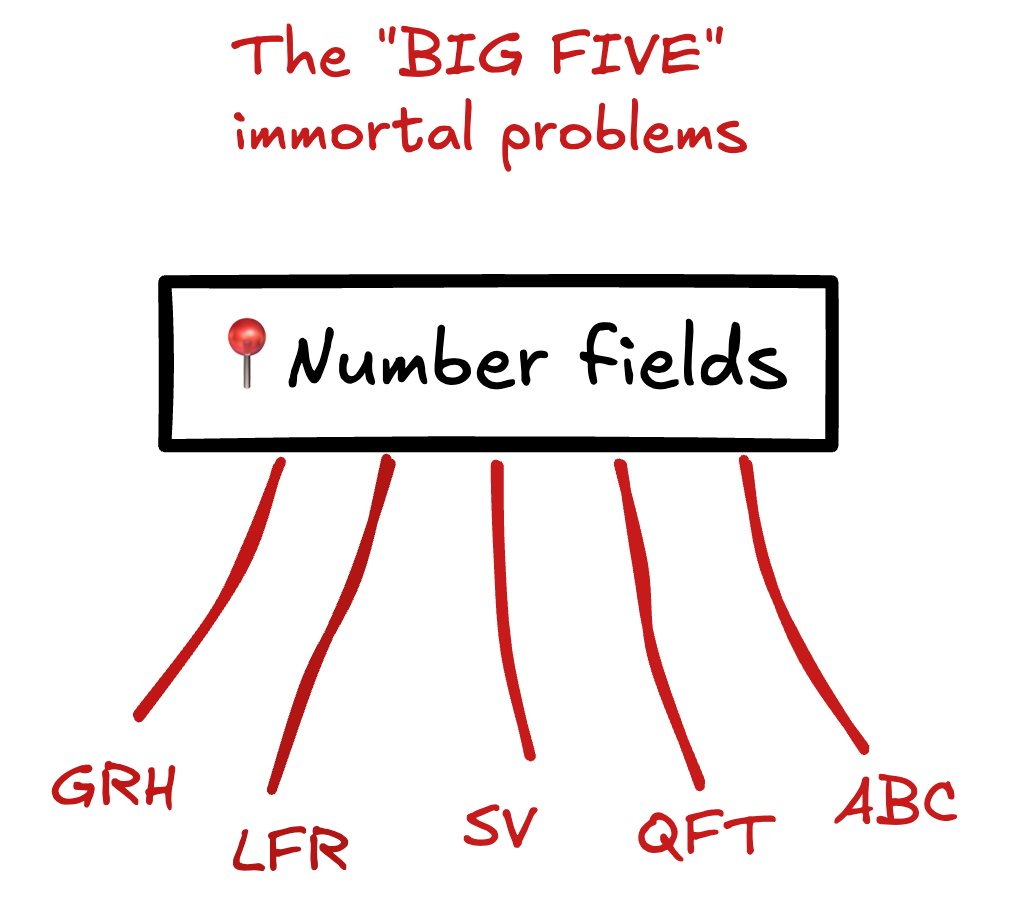
We can use a tour of the Big Five to give an introduction to quadratic Dirichlet L-functions.
Reciprocity
Langlands reciprocity is the general statement that every motivic L-function is in fact also automorphic. Recall that a motivic L-function is (roughly speaking) an L-function defined by equations, like $x^2+1=0$ or $y ^2 + xy + y = x ^3 - x$, where the L-function coefficients come from counting solutions to the equations in different finite fields, for example modulo 5. And an automorphic L-function is (very roughly speaking) an L-function defined as an integral transform of a "modular" or "automorphic" function, which is a function with lots of symmetries. In particular, these symmetries imply that an automorphic L-function has meromorphic continuation (i.e. can be defined in the entire complex plane), and satisfies the functional equation, which is a perfect symmetry around the critical line.
The statement of Langlands reciprocity is a super-abstract distillation of a large number of more concrete or elementary statements discovered about motivic L-functions. Quadratic Dirichlet L-functions are precisely the L-functions that encode the simplest and most classical of all reciprocity laws, Gauss's "Golden Theorem", the Law of Quadratic Reciprocity. This law solves the basic problem of when a quadratic equation (like $x^2+1=0$) is solvable modulo a prime number, and it is the basis for many other important notions in number theory.
To learn this theory from scratch, you can watch the Mathologer introduction to quadratic reciprocity on YouTube, or read this introductory short note by Nils Ketelaars, or (for more depth and context) read the wonderful and openly available Topology of Numbers book by Hatcher (especially chapter 6.4). Another resource (perhaps the best one if you are just beginning to learn number theory) is this YouTube lecture series by Michael Penn, which begins at the most basic level and reaches quadratic reciprocity in lectures 22 to 25. In these lectures Penn also covers other topics relevant for the RH Saga, like Hensel's lemma (lecture 15) and primitive roots (lectures 16 to 19).
I also want to share and recommend a remarkable and idiosyncratic set of notes by Ilya Zakharevich. I'm not familiar with the complete background story here, but it looks like these notes grew from an attempt to teach Langlands to primary school kids at the Berkeley Math Circle.
Finally, the survey article mentioned in the RH Saga Episode 2 video is this paper by Matthew Emerton. It is perhaps the best research-level introduction to reciprocity, with some historical background too.
Functoriality
Langlands functoriality can be formulated in different levels of generality. The philosophy of the Langlands program is that all L-functions should come from automorphic representations, and "functoriality" covers a large family of conjectures concerning operations on automorphic representations.
But for the purposes of the RH Saga, we don't really need to dive into the incredibly technical world of automorphic representations. Instead, we can think of functoriality purely in terms of operations on L-functions. Roughly speaking then, functoriality says that if you take a symmetric power of an L-function, or if you take the tensor product of two L-functions, then the result is again an L-function. These operations were discussed in RH Saga Episode 5.
A very optimistic dream would be that in some future $\mathbb{F}_1$-geometry, operations like tensor product and symmetric powers should have a concrete geometric interpretation, so that functoriality (in the sense of L-function operations) would just follow from the geometric theory. An indication that something like this might be possible is that there are similarities between the tensor product of two L-functions and the normalized fibre product of two algebraic curves branched over the projective line.
But let's look concretely at what tensor product means for quadratic Dirichlet L-functions! For any two fundamental discriminants $D_1, D_2$, we can take the tensor product of their L-functions, which will again be a quadratic Dirichlet L-function. Here is a "multiplication table" for this tensor product, for the first few positive discriminants.
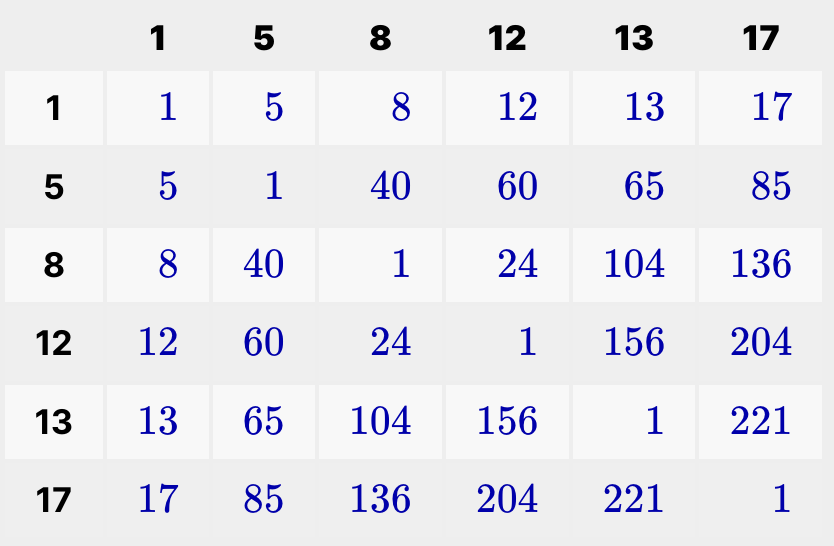
This is the tensor product of Langlands functoriality, in the simplest of simplest of cases! Already this case is fascinating. Can you work out the pattern? What is the general rule here?
To make things even more interesting, here is the corresponding table for the first few negative discriminants. Negative times negative is positive, but what precisely is going on?
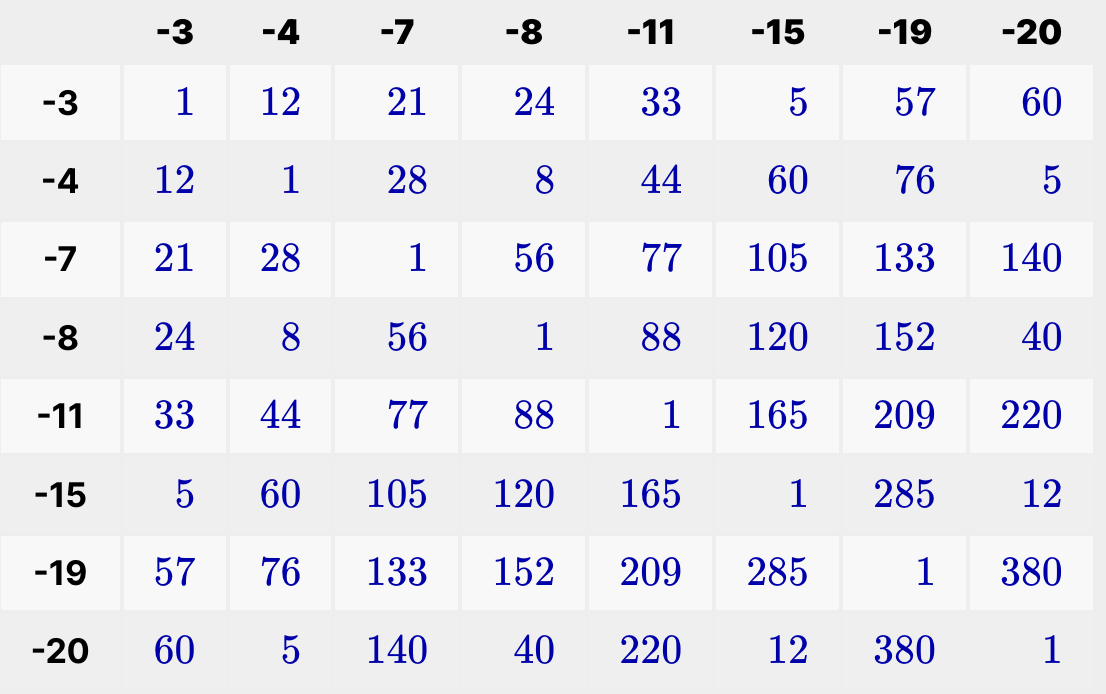
If you want larger ranges of discriminants, or if you want to see what happens when you tensor a positive one with a negative one, you can generate your own multiplication table with the code below. Just choose your own IntegerRange of discriminants around line 20 in the program.
To really understand the depth and power of Langlands functoriality, we would have to move on to more complicated classes of L-functions, and in the RH Saga we will do this at least for the case of elliptic curves. But I believe this baby case of quadratic Dirichlet L-functions already gives a taste of the mysteries to come!
Special values
You can now take any quadratic Dirichlet L-function and compute its value at any integer $k$. These numbers $L_D(k)$ are unbelievably rich and interesting. Here is code that lets you compute all of these values.
Let's begin with the function $L_{-4}(s)$, with repeating coefficients $1, 0, -1, 0$. The code above computes the value for $k=3$. Try it and you should get
\[ L_{-4}(3) = 0.9689461462593693804836348458469\ldots \]
Imagine you are Leonhard Euler, and you found the above value numerically. How would you go about finding an exact expression for what this number is? Does such a formula even exist?
Experience with the Riemann zeta function suggests that the exact formula for $L_D(k)$ might have the power $\pi^k$ in it. To test this idea, take the above value and divide it by $\pi ^3$. This is what we get:
\[ \frac{0.9689461462593693804836348458469}{\pi^3} = 0.031250000000000000\ldots \]
Looking good! We can recognize this value. Work out the arithmetic and it is precisely $\frac{1}{32}$. So the conclusion is that we have the exact formula
\[ L_{-4}(3) = \frac{\pi^3}{32} \]
I will leave it as a challenge to you to try other values and see if you can find the exact formulas for them. Dividing by a power of $\pi$ may be helpful, and sometimes it also helps to square the number in order to recognize it.
There is in fact a universal formula for all of these values, generalizing what you see for the Riemann zeta function with the Bernoulli numbers. There are also important connections to notions from algebraic number theory, such as fundamental units, regulators, and class numbers. One of the best places for learning about all of this is the book Bernoulli numbers and zeta functions, by Arakawa, Ibukiyama, and Kaneko. But I will also be posting about these things in future exploratory posts here in the RH Saga.
QFT
I have included Quantum Field Theory as one of the Big Five, echoing the general hope that a deeper understanding of the arithmetic world will give insights also into the nature of our physical universe.
Are there any deep connections between physics and quadratic Dirichlet L-functions specifically? Not as far as I am aware. However, there is one perhaps accidental connection, in that if you study what's called the Ising model on a lattice built from either squares, triangles or hexagons (i.e. a honeycomb lattice), then the critical free energy in each of these models can be expressed in terms of a Dirichlet L-function special value at $k=2$. Below are the formulas, taken from Viswanathan: Mahler measures, elliptic curves and L-functions for the free energy of the Ising model, page 6.
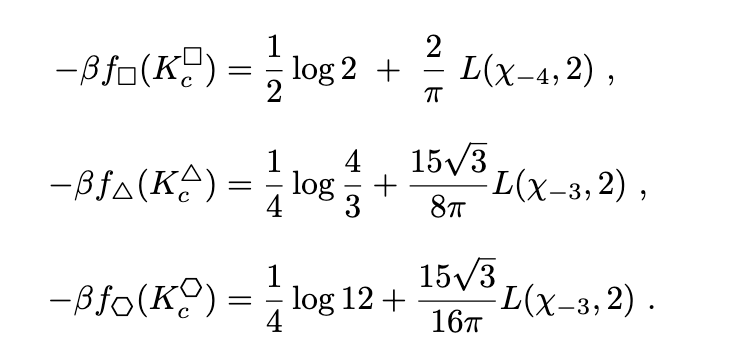
Here you see the more standard notation $L(\chi_{-4}, 2)$ used in place of our $L_{-4}(2)$.
These formulas might be more of a numerical coincidence than a deep conceptual bridge between physics and number theory. But the Ising model is a great thing to learn about (and I really wish someone had taught me this theory when I was much younger!). If you are aiming to learn about quantum field theory (possibly the only mathematical field deeper and more challenging than L-functions), then starting out with the Ising model and other models of a similar flavour is one possible path for you, where you can actually start doing your own computations almost immediately, and hence develop your own intuition much better than from reading only.
For a quick panorama of the Ising model in modern mathematical research, check out this playlist from an IHES conference held in 2022, with an incredible list of speakers, starting with Fields medallist Wendelin Werner. But for a more immediate view of the explicit computations you could be doing, and a link to the Millennium problem on Yang-Mills, I would in fact recommend instead this incredible talk on Yang-Mills gauge theory by Scott Sheffield. I wouldn't want to tempt you away from L-functions, but if you are young and you're searching for the most extreme intellectual challenges possible, you should at least be aware that quantum field theory is also an option.
ABC
As far as I know, quadratic Dirichlet characters are not directly related to the abc conjecture. But the abc conjecture has a baby cousin, namely the problem of how fast the class number $h_D$ grows in terms of $D$. And this is a problem you can start exploring immediately! Run this code to get the class numbers for the negative discriminants from $-1$ to $-100$:
Take note of the discriminants with class number $1$. One of the most famous conjectures from the early days of algebraic number theory is Gauss's class number problem, saying that there are only nine negative discriminants with class number $1$. Can you find them in the above list?
In fact the class number problem (for negative discriminants) is a bit more general; it says that for any value of $n$, there is only a finite number of $D$ with class number $n$, and part of the problem is to determine this list. A version of the problem was originally posed by Gauss in 1801, in his Disquisitiones Arithmeticae, written when he was only 21 years old.
For positive discriminants, it is conjectured that there are infinitely many $D$ with class number $1$, but this is still an open problem! Check out the discriminants up to say 500, by changing the parameters in the code above.
The standard definition of the class number is the order of the class group of the quadratic number field of discriminant $D$. But since we haven't really talked about number fields, I want to give another more explicit definition valid in the case of negative discriminants. The formula is
\[ h_D = \frac{w}{2D} \sum_{n=1} ^{\vert D \vert} n \cdot \left(\frac{D}{n}\right) \]
Here the number $w$ is a special invariant equal to $6$ (if $D=-3$) and to $4$ (if $D=-4$) and to $2$ for all other negative discriminants.
Note how explicit the above formula is! If you have the repeating digits for the L-function, you simply write them out, like this:
\[ 1, 0, -1, 0 \]
Then you multiply these digits by $1, 2, 3\ldots$, respectively, in this case to get
\[ 1, 0, -3, 0 \]
Finally you sum this sequence and multiply the answer by $\frac{w}{2D}$, which for this example is $\frac{4}{2 \cdot (-4)}$, so the class number is $1$ (which is a reformulation of the fact that the Gaussian integers have unique factorization).
In fact, you can now also verify for yourself one of the remarkable connections to special values. You can take any $D$, but for simplicity, first take $D \leq -7$. Try to compute the class number, and compute also the special value $L_D(0)$.
What do you find?
Note: In the cases $D=-4$ and $D = -3$, there a slight twist to the story, which you will find by trying these values. For the case of positive $D$, there is a more significant twist. Briefly, the formula for the class number has to be modified to take into account something called the regulator, defined as $\log(\varepsilon)$, where $\varepsilon$ is a so called fundamental unit for $D$. This regulator also appear in the relation with the L-function.
Note: We will come back to the actual abc conjecture once we've covered some theory of elliptic curves. For elliptic curves, the analogue of the class number is an invariant called the "order of Sha". It appears in the strong version of the Birch and Swinnerton-Dyer conjecture, just like the class number $h_D$ appears in the special value $L_D(0)$.
For some inspiring reading material related to all of the above, have a look at this piece on the life and work of Alan Baker, who solved the class number problem, won a Fields medal, and also proposed his own version of the abc conjecture. The article is written by David Masser, who together with Joseph Oesterlé came up with the original abc conjecture in 1985.
GRH
For any function $L_D(s)$, you can ask Sage to produce the spectrum of the L-function, i.e. the (imaginary parts of) the zeroes in the critical strip.
Set $D=1$ and you recover the case of the Riemann zeta function. Try other values of $D$, and you have access to an infinite family of other L-functions. This is the starting point for a great many adventures!
In the next Chapter of the RH Saga, we will focus on the GRH problem, and how to start exploring what happens for these quadratic Dirichlet L-functions.
The general landscape of L-functions
So far we have talked about quadratic Dirichlet L-functions and how the Big Five problems appear from the perspective of this specific class. But I also want to give you a sense of the larger space of L-functions, so that you can start building your own mental maps for all of them. It is my belief that a good theory of $\mathbb{F}_1$ (if it exists) will account not just for the Riemann zeta function or some limited class, but for all L-functions. So in order to find the theory, we should search for patterns and conceptual clues that make sense for L-functions in general.
L-functions by source
One approach to mapping the world of L-functions is to classify them by source, i.e. by what I called the "primal objects" (perhaps not the best terminology) from which they are constructed. The famous picture from the LMFDB database looks like this, but if you go to the LMFDB page instead, you get a slightly interactive and better image.
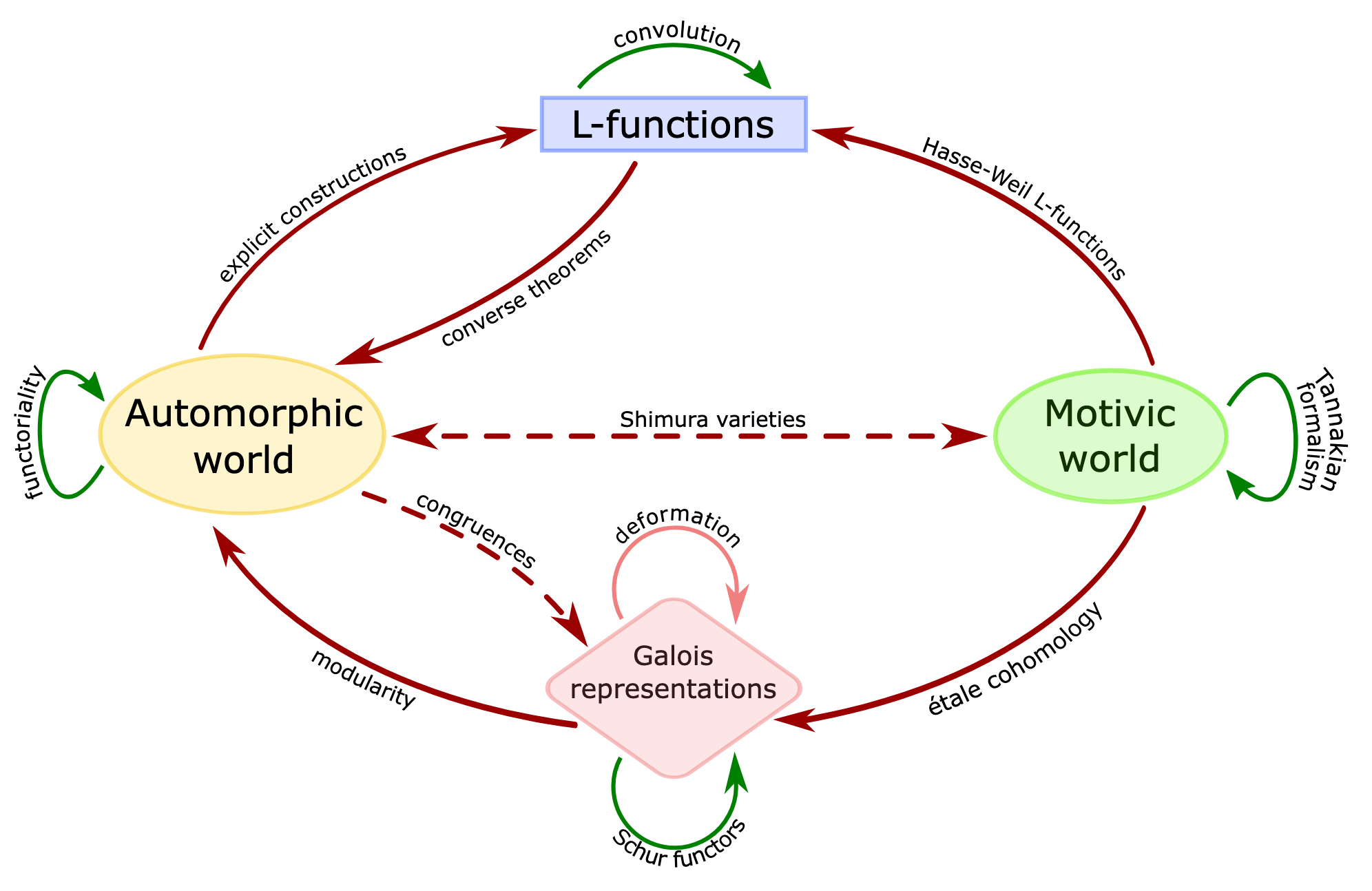
In addition to the three sources here (Motives, Galois representations, Automorphic representations), I would also like to include flat schemes as a separate source, even though some would argue that they are closely related to motives and hence perhaps superfluous in this picture. My reason for including schemes is that some of the language used to define L-functions (like the notion of "minimal models") really refers to the scheme and not the motives built from the scheme. Also, important invariants (like the class group, the Tate-Shafarevich group, and the minimal discriminant ideal) are not even defined for a motive (at least not in the usual language of motives with rational coefficients), but really depend on the underlying scheme.
Within each main source, one can identify subclasses of primal objects, and expanding your own map of L-functions can be done by gradually learning about more and more general classes of these objects. For example, you may soon be learning about elliptic curves over $\mathbb{Q}$ and their L-functions. Later you can generalize to elliptic curves over other number fields. Such elliptic curves in fact constitute one of the more recent additions to the LMFDB! Elliptic curves are curves of genus 1, and you can generalize to curves of higher genus. Elliptic curves are also one-dimensional abelian varieties, and you can generalize to abelian varieties of higher dimension. Or even to abelian varieties over general number fields. Just to give the flavour of such generalizations, I will point to the PhD thesis of Céline Maistret.
Here is a first sketch of a "frame" for sources of L-functions. Many things can be added here in future versions!
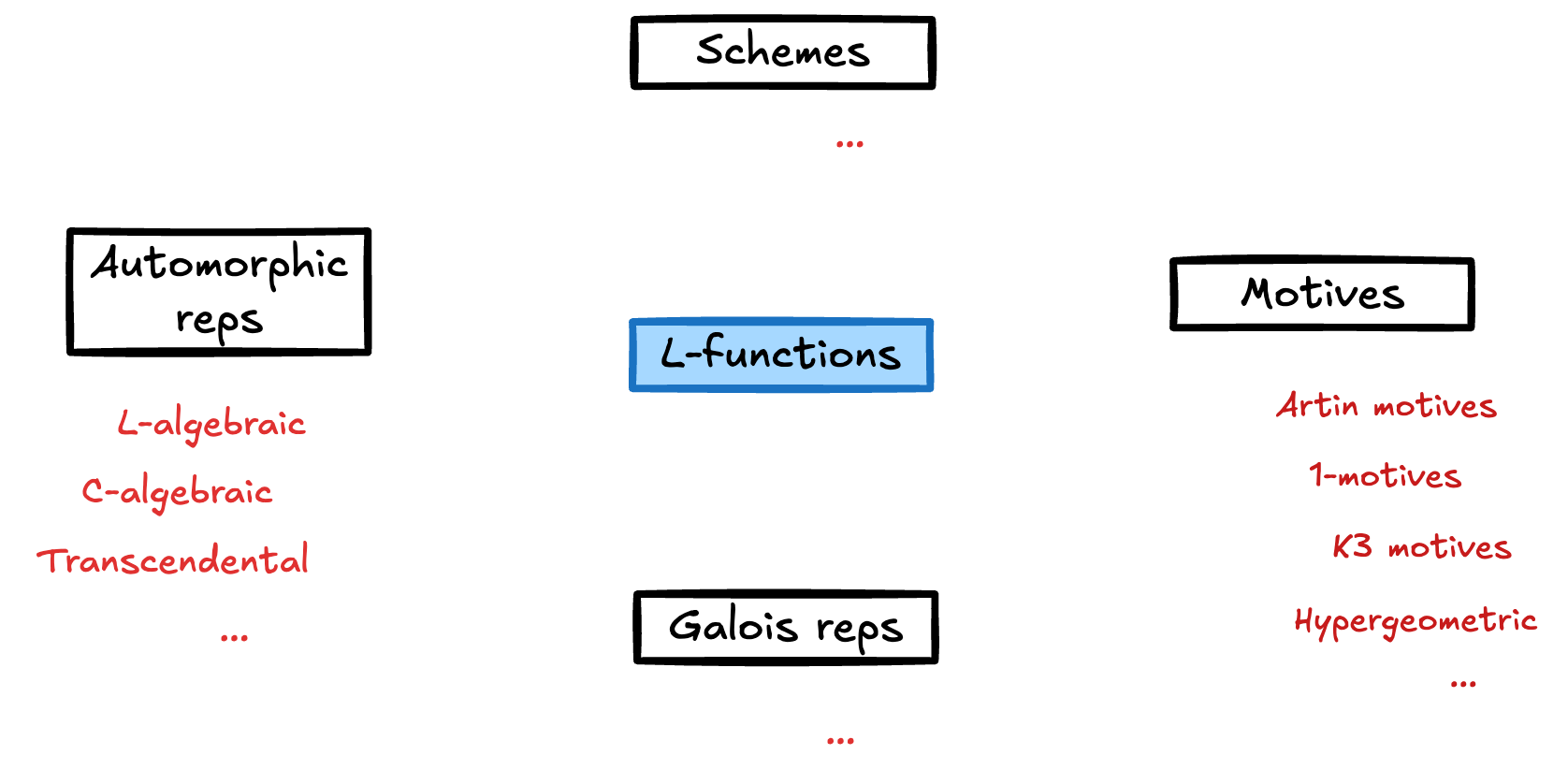
Among the above sources, perhaps I should highlight the hypergeometric motives. Hypergeometric motives is a rather recent topic of study, and they have the very pleasant property that their coefficients can be rapidly computed starting only from a small datum (a finite list of integers together with one rational number) encoding the entire L-function. Read more in this friendly introduction by David P. Roberts and Fernando Rodriguez Villegas.
There is huge number of research articles in which people study more complicated classes of L-functions. I'll give just two more examples from the motivic side.
In one recent paper, Thu Ha Trieu studies L-functions of K3 surfaces, and in particular some of their special values which are connected to Mahler measures (same concept that appeared in the Ising model paper mentioned above).
Quite recently, Dominik Burek finished his PhD thesis, and in this preprint (part of the thesis project) he describes motives of Calabi-Yau varieties, with an interesting method for computing their L-functions.
L-functions by complexity measures
The Riemann zeta function has degree $d=1$ (lowest possible), weight $w=0$ (lowest possible), and conductor $N=1$ (also lowest possible). In this sense, the Riemann zeta function is the simplest L-function of all.
A general quadratic Dirichlet L-function also has degree $d=1$ and weight $w=0$, but the conductor is $N = \vert D \vert$.
The Dedekind zeta function $L_K$ from the Episode 2 video (attached to the Gaussian integers) has degree $d=2$, weight $w=0$, and conductor $N=4$.
An elliptic curve L-function (like $L_E$ in the video) has degree $d=2$ and (in contrast to all the previous ones!) weight $w=1$. The conductor in our specific example was $N=14$, which is the reason we had to use coins with values $1$, $2$, $7$ and $14$ (and their multiples) in order to express the L-function (somewhat indirectly!) in terms of explicit combinatorial invariants.
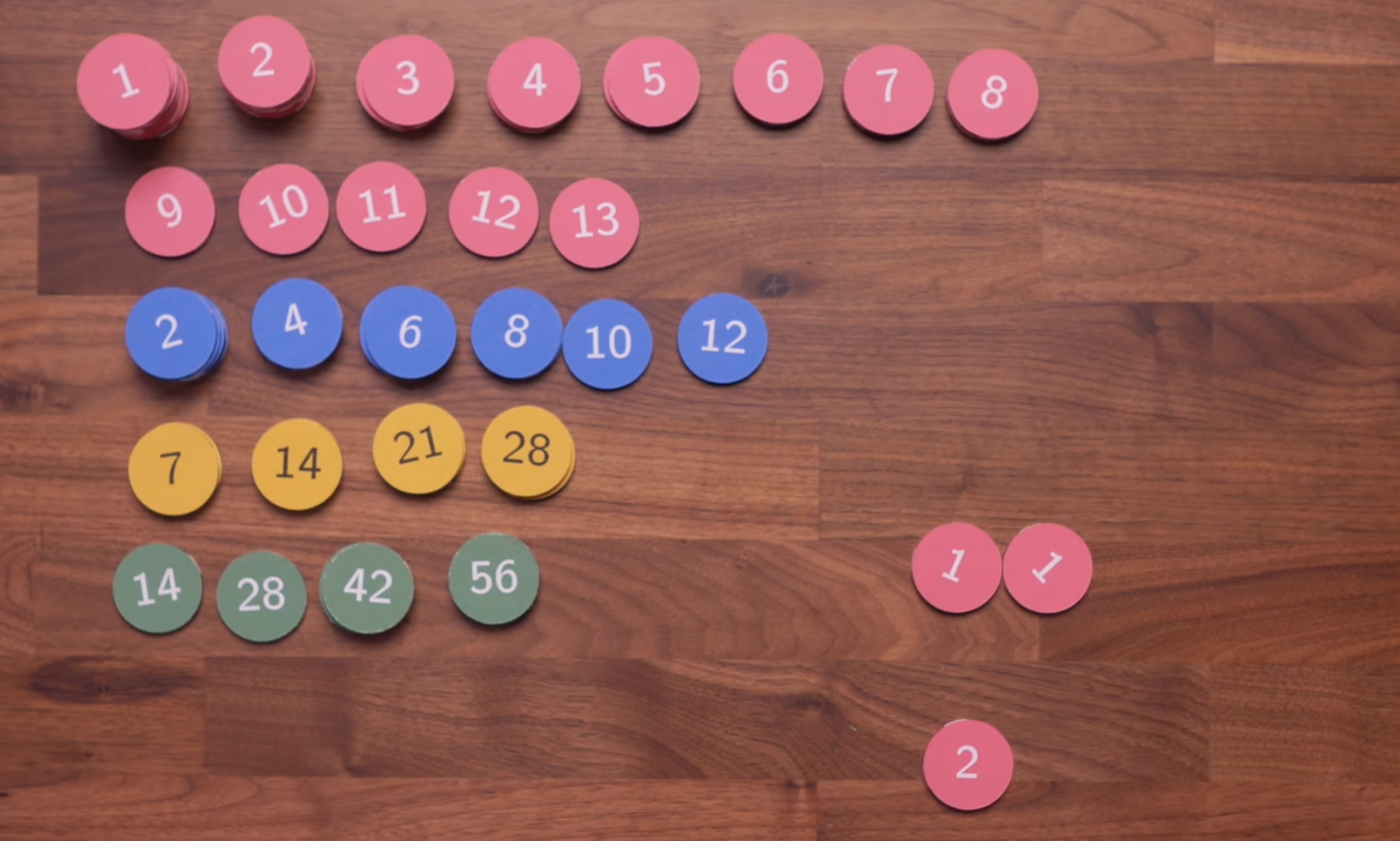
Every motivic L-function you will ever see comes with these three integers, each in its own way measuring the complexity of the L-function.
There are other complexity measures too, like how complicated the number system is in which you find the coefficients $a_1, a_2, a_3, \ldots$, or how high up the critical strip you need to go in order to find the first zero (in this case a high zero means low complexity). But the three invariants $d$, $w$ and $N$ are natural numbers (with $0$ allowed in the case of $w$), and they form the three fundamental axes in a kind of "great cube of all motivic L-functions" that you can perhaps picture in your head.
When you learn about a new class of motivic L-functions, ask first: What is the degree and what is the weight in this class? Then, within that class (which often has specific fixed values for $d$ and $w$) there will always be a infinite family of L-functions of increasing conductor, occasionally with a finite few L-functions of the same conductor. Let's look at some representatative examples.
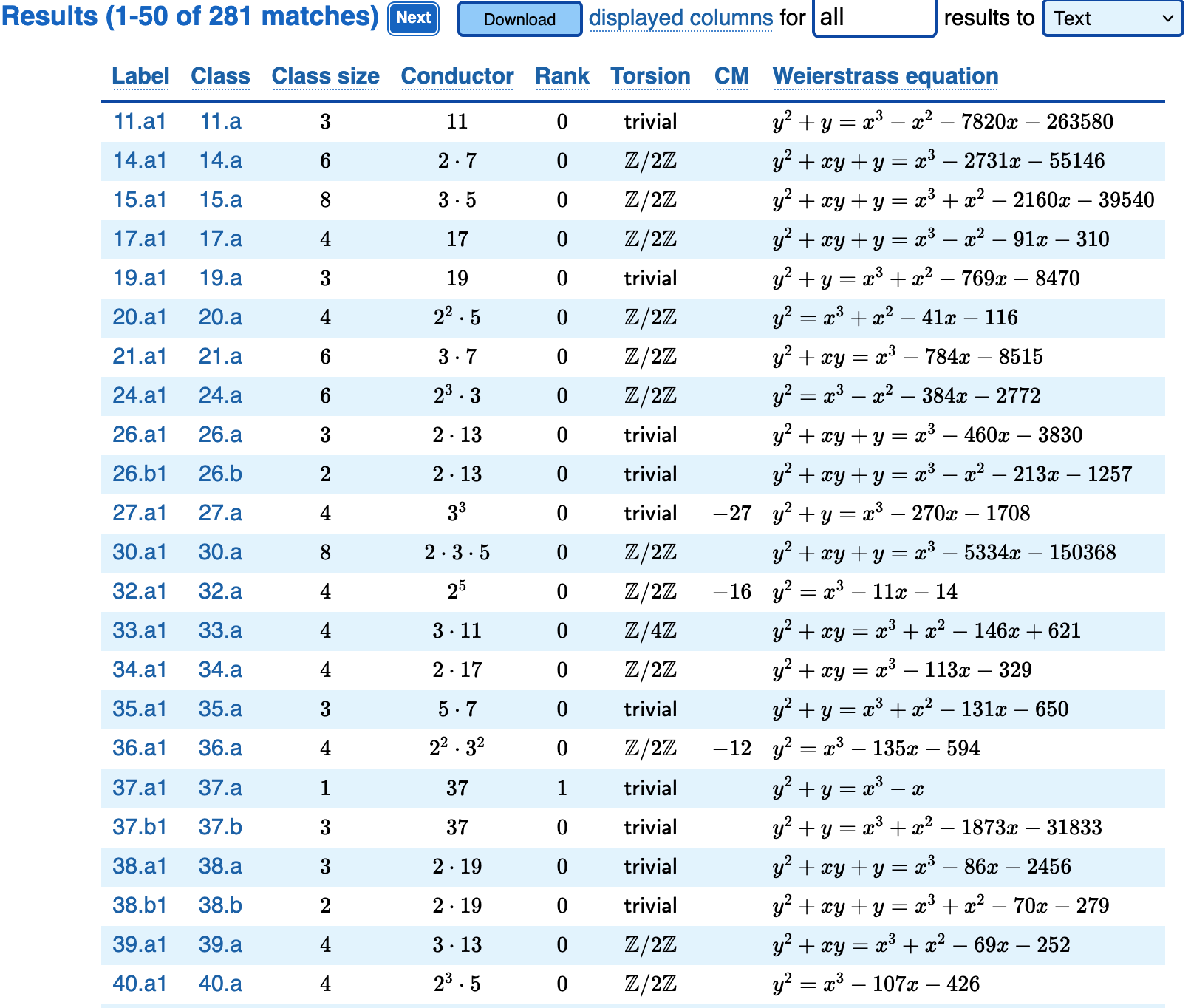
Here are the elliptic curves in LMFDB listed by increasing conductor (one curve for each possible L-function). Click this link or see the picture below. Here I searched for all L-functions of conductor up to 200, and you see that there is a total of 281 such L-functions, among them the L-function of conductor 14 from the video.
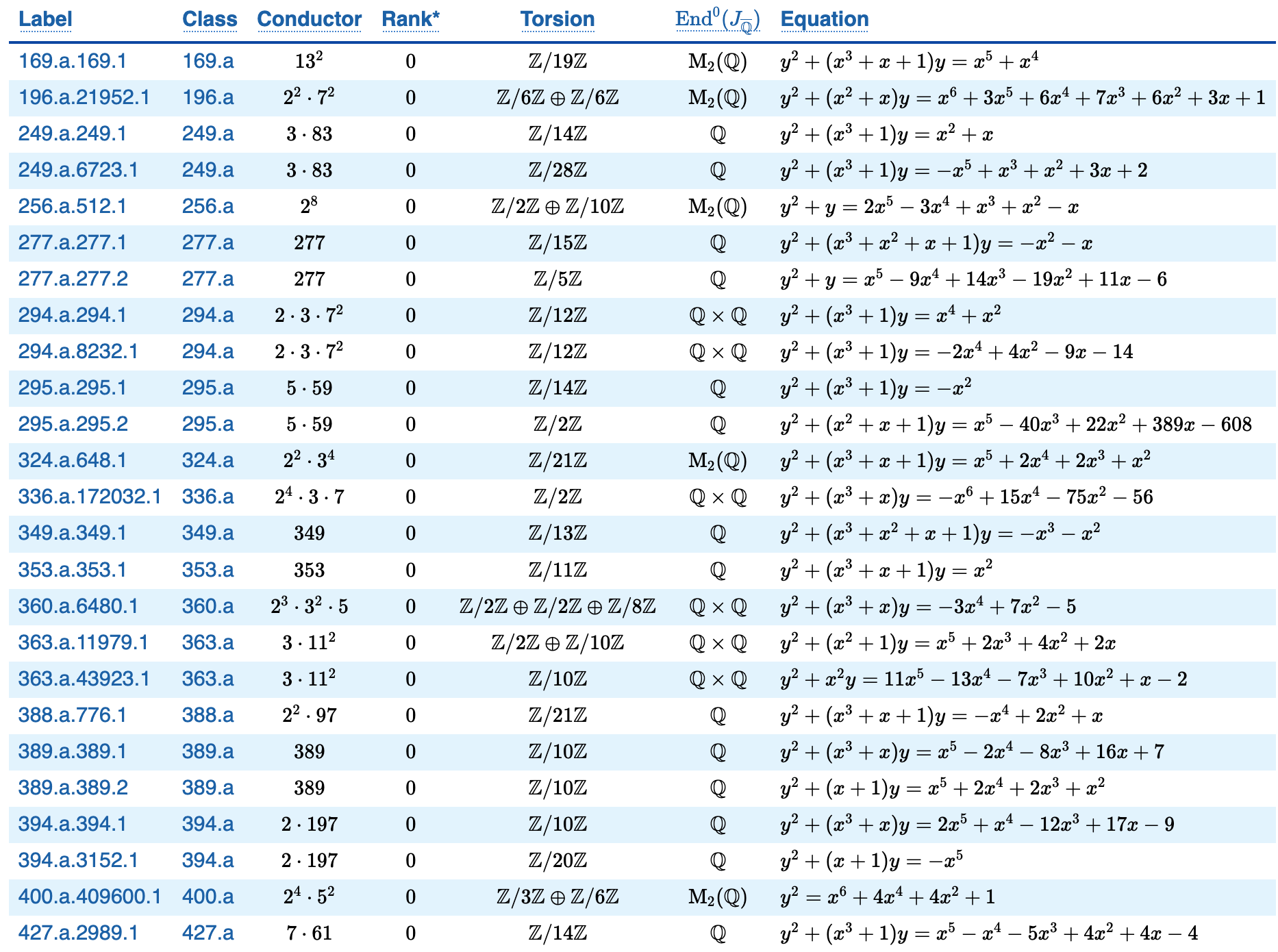
Another class would be the L-functions of genus 2 curves over $\mathbb{Q}$. For this class we have $w=1$ but now the degree is $d=4$. The beginning of the list of possible conductors can be seen at this link or in the image below. The way things work in the LMFDB is such that the two different curves labeled 249.a.x in fact have the same L-function, so to find two distinct L-functions with the same conductor here you have to go to the LMFDB link and scroll down all the way to $N=576$ (which, coincidentally or not, happens to be the square of the wonderful number 24).
One exceptionally interesting line of research which has been pursued by various people like David Farmer, Sally Koutsoliotas, Stefan Lemurell and Pascal Molin (from around 2010 and onwards), is the numerical search for L-functions based only on their axiomatic properties, and hence completely independent of all technical (motivic and automorphic) machinery. One representative paper is this one, in which they performed a numerical search for L-functions of degree $d=4$ and weight $w=1$, with conductor up to $N=500$. Only after finding a long an interesting list do they proceed to (as far as possible) identify a motivic or automorphic object which gives rise to the L-function. You may recall that elliptic curve L-functions ($d=2$) also come from classical modular forms (by the Taniyama-Shimura-Weil conjecture), and in this more complicated setting ($d=4$), the authors find a variety of more exotic objects for their L-functions, including Siegel modular forms, Bianchi modular forms, and Hilbert modular forms, each one a kind of generalization of classical modular forms.
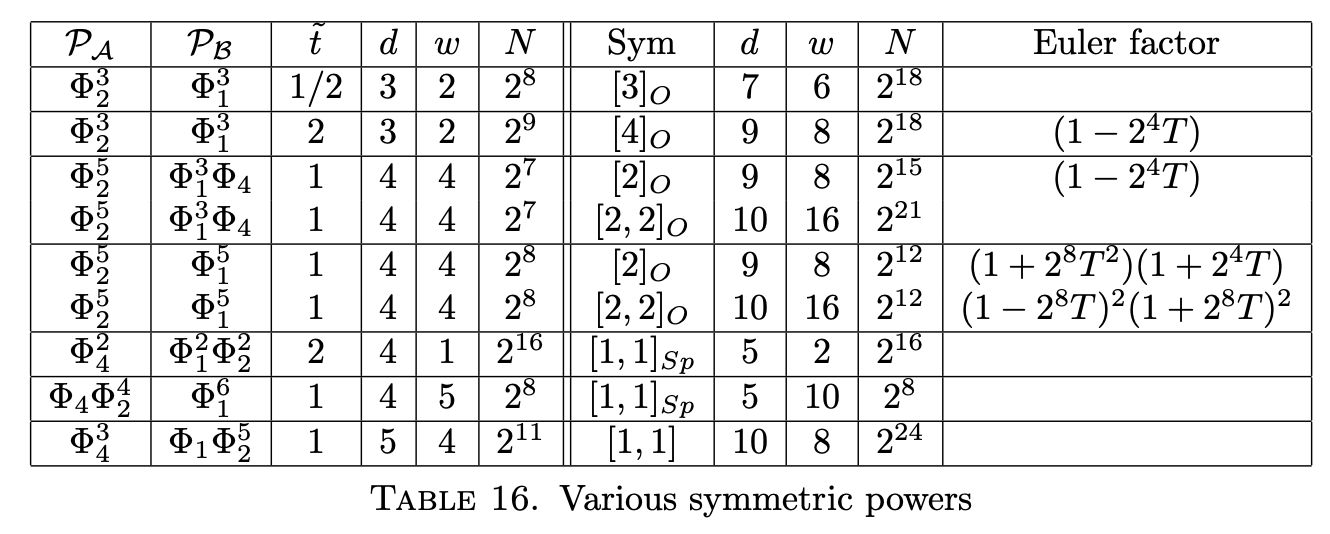
As should be clear from the work of Farmer et. al., computing L-functions becomes very challenging as soon as the three complexity measures become just moderately large. One of the main reasons for the great excitement surrounding hypergeometric L-functions, is that they provide a huge supply of quite easily computed L-functions with large values of $d$ and $w$. The table below is taken from Mark Watkins: Hypergeometric motives over $\mathbb{Q}$ and their L-functions (page 31). The point here is not to understand all of the notation, but simply to show that you have the three invariants $d, w, N$ with examples like $d=5$, $w=4$, a far more complex L-function than anything anyone would normally think of computing before the advent of hypergeometric L-functions. The right part of the table also illustrates the idea that one can apply symmetric power operations to get new L-functions with even larger complexity, like an example with $d=10$, $w=8$, and $N=2^{24}$. So hypergeometric L-functions allow us to probe the L-function universe further than ever before, testing a variety of conjectures numerically, and exploring patterns that may have been invisible or misleading had we looked only at much simpler examples.
Transcendental L-functions
There is one fundamental fact of nature that I think was never mentioned in the entire Season 1 of the RH Saga videos. This is the fact that there are two fundamentally different species of L-functions. In addition to the motivic ones (of which we have now seen many examples), there are also the transcendental L-functions, for which the coefficients are believed to be transcendental numbers (with occasional exceptions), and for which there is a slight twist to the complexity measures we have discussed. These L-functions also have a degree and a conductor which are natural numbers, but instead of a weight they have another invariant, a complex number usually called the spectral parameter. In fact, there isn't just one spectral parameter, but a finite set (which I believe is always of size $d-1$), and these parameters have complexity roughly speaking measured by their size.
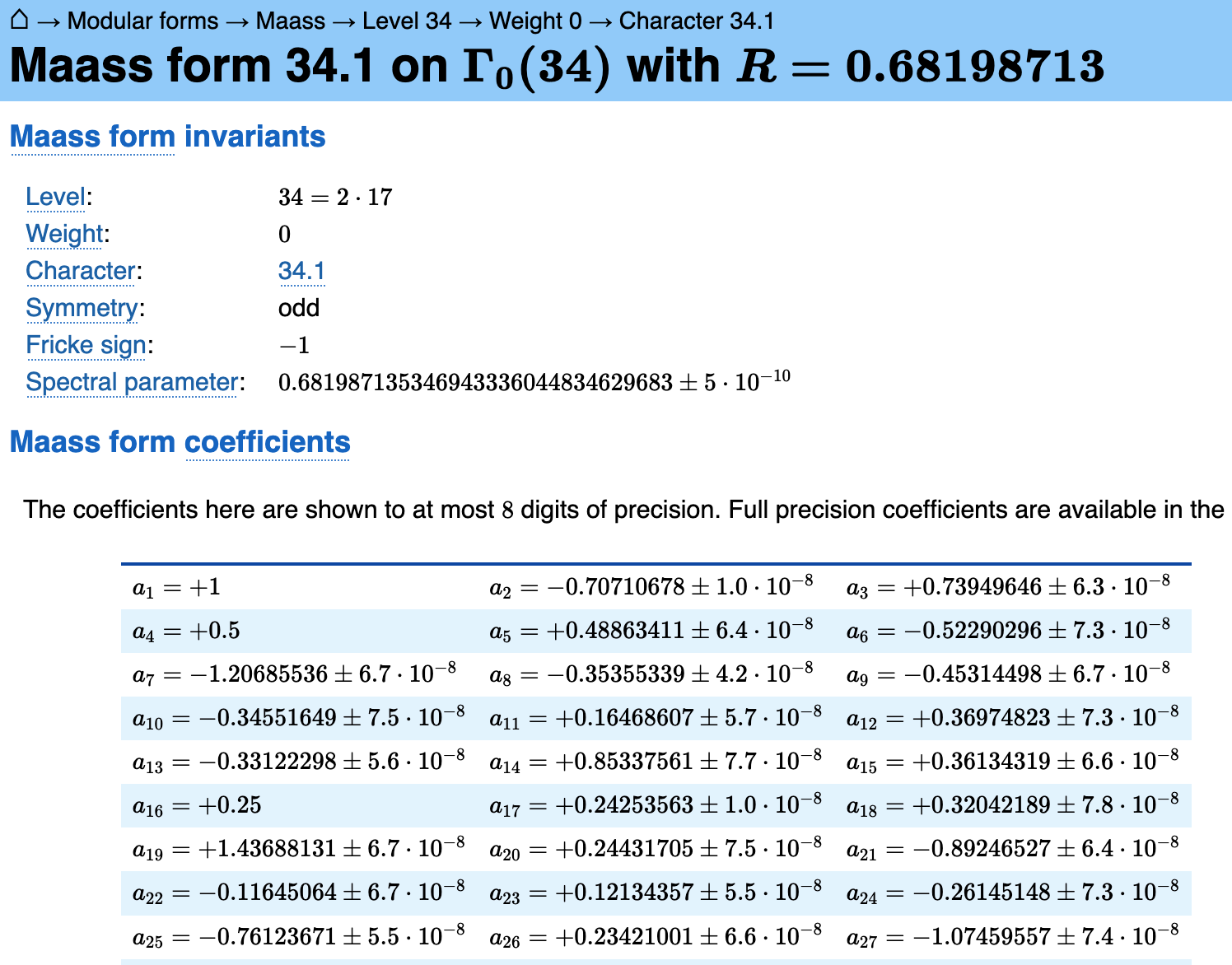
To give an idea of what these look like, on this LMFDB page I searched for Maass forms of spectral parameter between $0$ and $1$. Image below; the word "level" means the conductor.
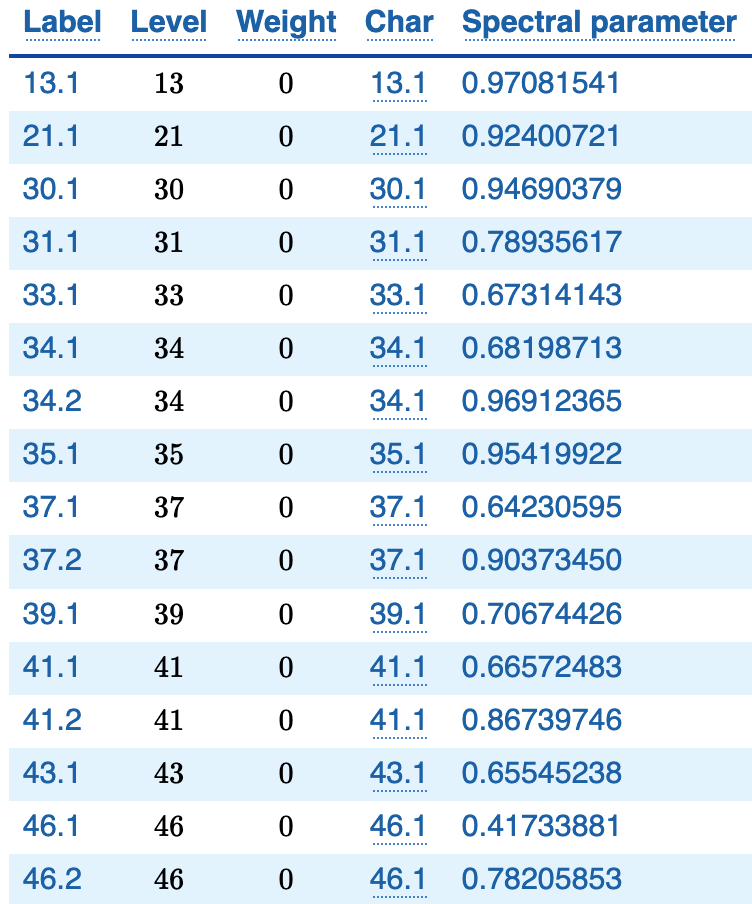
If you click on one of these Maass forms, you will see the coefficients $a_1, a_2, a_3, \ldots$ of the L-function. As you can see, with the exception of $a_1, a_4, a_{16}$ in this example, the coefficients are complicated and believed to be transcendental numbers, hence the term "transcendental L-function".
David Farmer gave the opening talk at the LuCaNT 2023 conference, in which he reported on a project searching for transcendental L-functions with $d=3$ and $N=1$. This is a very nice talk which starts out by introducing the "landscape of L-functions" in some generality. For these degree 3 L-functions there are strictly speaking 3 spectral parameters (which contribute to the Gamma factors of the completed L-function), but because their sum is zero, only 2 of them (i.e. $d-1$) are actually needed as data points.
As a side note - browsing all the talks from all of the LuCaNT conferences is a great way to get a good feeling for current research in areas informed by the LMFDB database.
One of my favourite PhD theses of recent years is the 2023 thesis of Andrei Seymour-Howell, in which he rigorously computes many examples of Maass forms. This thesis might in fact be the best possible starting point for anyone wishing to learn about transcendental L-functions in general.
The Langlands program
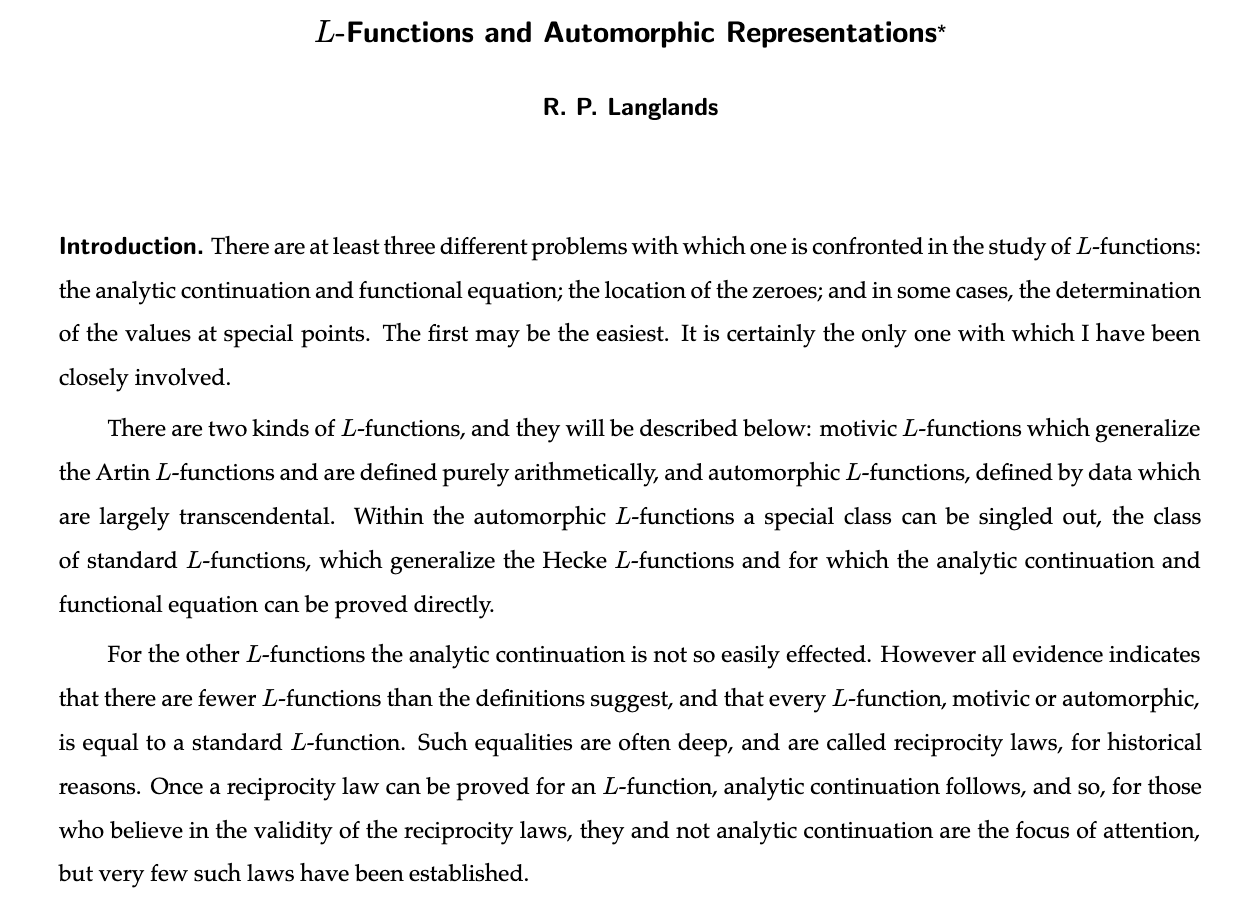
When Robert Langlands addressed the International Congress of Mathematicians in 1978, he opened his talk by mentioning the Big Three. At this time, the abc conjecture had not yet been formulated, and the idea that number theory and physics should be deeply intertwined was not yet in the air (I believe it grew out of the Soviet-era $p$-adic physics movement in the 80s). Here is what Langlands said in his introduction, and the whole 10-page paper is totally worth reading in its entirety.
In the RH Saga Episode 2 video I made an attempt to sketch the different branches of the Langlands program.
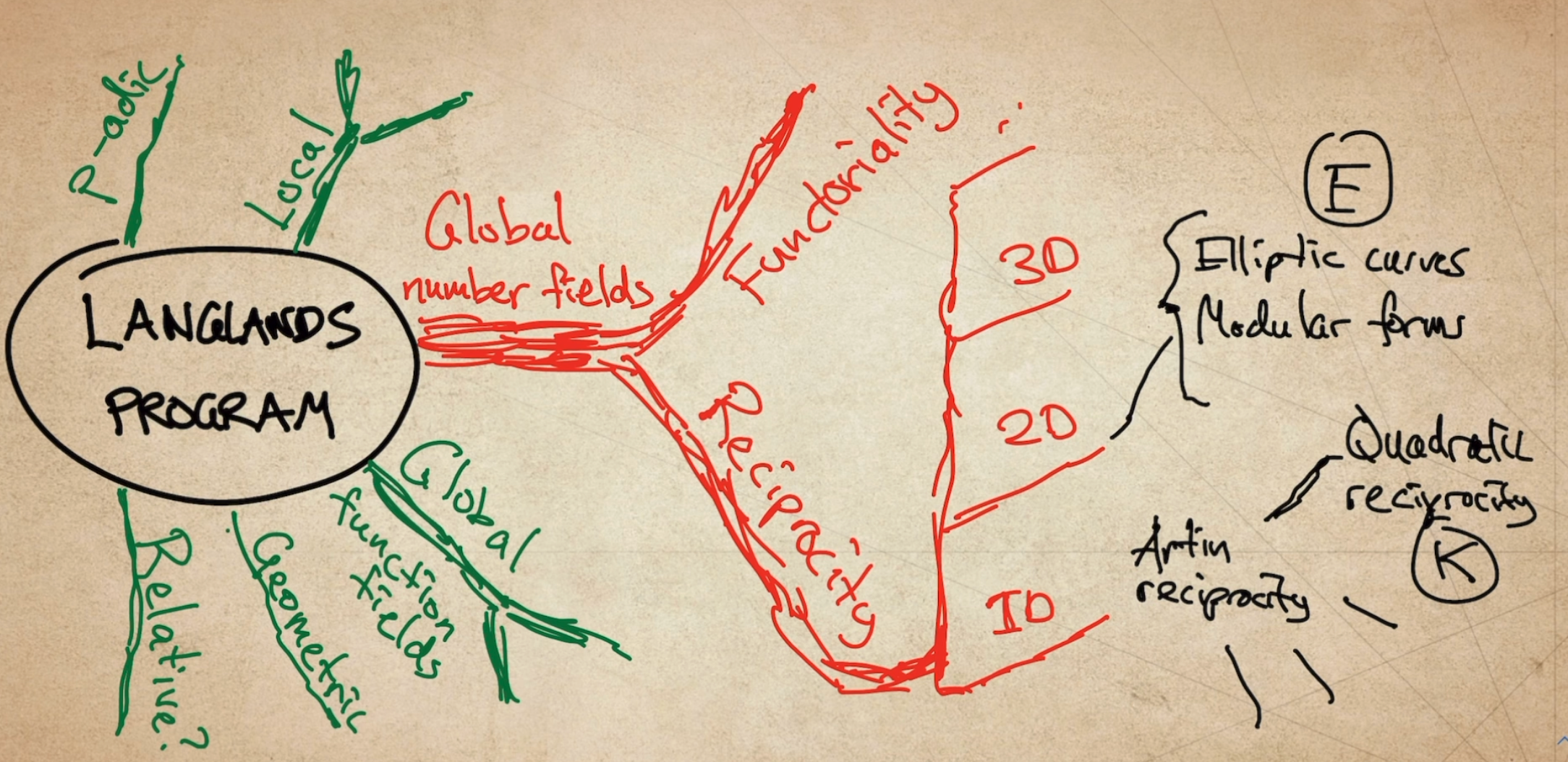
It is impossible to give any kind of justice to the Langlands program in its entirety, and I am certainly not the right person to even try. But I can still give a few very crude hints, complementing what was said in the video, while pointing to some important research papers and surveys from recent years.
Five early branches and three variants
I think its reasonable to say that the Langlands program has five early branches, organised by Weil's Rosetta Stone, like this, where the left-most and most important branch (global Langlands over number fields) splits into Functoriality and Reciprocity.
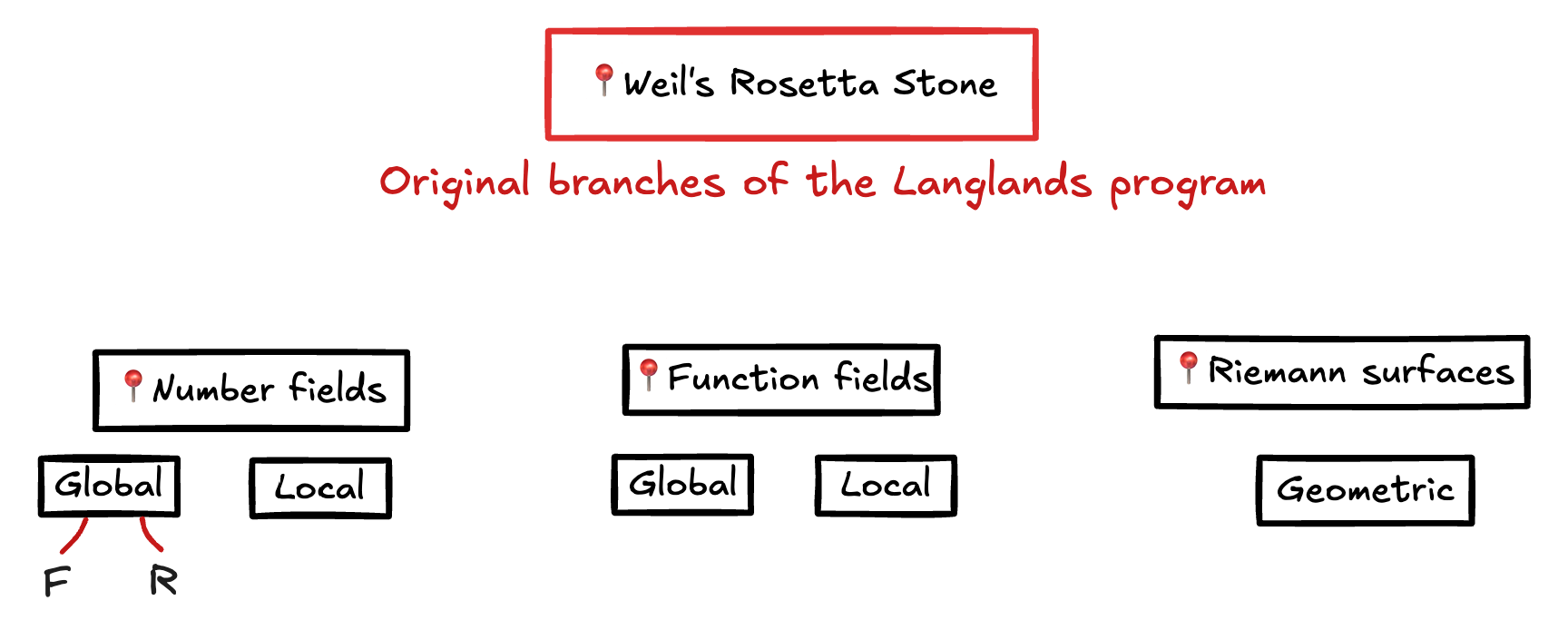
One place to read about all of the above would be Edward Frenkel's Lectures on the Langlands Program and Conformal Field Theory. From page 9 he talks about the number field case and from page 24 the function fields. Then in later parts he talks about the geometric Langlands program as it was understood at the time, as well as some connections to physics, specifically conformal field theory.
Since the time of Frenkel's notes, a number of important variants of the five original branches have become gradually more important. Here are three key ones which are useful to be aware of.
$p$-adic Langlands
For the case of number fields, there is the $p$-adic perspective, connected to things like $p$-adic and mod $p$ modular forms, which in particular allows for a theory where objects "vary in families", as opposed to being "rigid" (i.e. geometrically isolated and alone). Two references for this direction is Breuil (2010) and Emerton, Gee and Hellman (2022).
Relative Langlands
One of the scariest math papers you will ever see is this ground-breaking work from 2024 by Ben-Zvi, Sakellaridis and Venkatesh, where they unify a large number of previously observed phenomena into a new research program called Relative Langlands. This paper is 474 pages long, but luckily there is also a short overview (only 134 pages!) by Beuzart-Plessis.
Analytic Langlands
There is a variant of geometric Langlands called analytic Langlands, developed by Etingof, Frenkel and Kazhdan.
Current developments
At its core, the Langlands program seeks to describe the vector space of automorphic functions. This is just a fancy name for something extremely basic.
Peter Scholze (2026)
All of the five original branches together with the three "variants" listed above are extremely active areas of current research, with an unlimited number of interesting open problems to which you could one day make a contribution. If you at this point really want to learn even more about current research directions, you can explore the videos from the 2022 IHES summer school on the Langlands program, and the 2026 Thematic month on the Langlands program at CIRM (in the latter case you have to click through some layers of links in order to find the actual abstracts and lecture videos). For the IHES summer school, you should check out the table of contents for the three-volume proceedings, and rather than buying these books for 350 USD you can search for individual chapters as pdfs (as many are freely available on arXiv).
One of the most striking recent developments is that ideas from the geometric Langlands program is starting to migrate into the other columns of the Rosetta Stone, even to the hardest and in some sense most important case of global Langlands over number fields (for which I again remind you of Emerton's wonderful survey). This trend, together with the remarkable proof of Gaitsgory (and many collaborators!) of a version of geometric Langlands, is the subject of two important recent surveys, one by Ben-Zvi and one by Scholze. Finally, for a view of how experts discuss these developments, see the blog posts (and the comment sections!) of Peter Woit's blog, but look specifically here at the posts tagged with Langlands.
Hopefully some of the above hints will be helpful for you, as you chart your own way over the misty oceans that few dare to brave, and through the thick forests whose trees will not fall with a few timid blows.
Back to quadratic Dirichlet L-functions
The student should not be overly discouraged, however, because there is no person currently alive who has the necessary prerequisites to really understand the entire subject.
The above quote is taken from Getz and Hahn: Introduction to automorphic representations (also a wonderful book, perhaps the best textbook on the Langlands program over number fields and function fields). Ending this chapter of our Saga, I really want to encourage you not to feel overwhelmed, but to dive into computing and exploring things on your own. Whether you are still in high school and just beginning to learn higher mathematics, or whether you have come further in your undergraduate or research journey, nothing beats the feeling of finding a corner of the mathematical landscape where some problems become your own, and you realize that you too can be part of the discovery process that has ultimately led us all to the unfathomable depths of the Langlands program and L-function theory more generally.
I will share many interesting and accessible research problems with you here on PeakMath in the coming months. Use all of these freely, or find your own problems. We'll begin with quadratic Dirichlet L-functions, in upcoming posts. While there are already many important research problems connected to these functions, learning about the basic Dirichlet setting will also provide a path to more advanced topics. Three examples:
- The Selberg trace formula used in Seymour-Howell's thesis to find transcendental L-functions of degree $2$ relies on computing class numbers (or special values at $s=1$) for $L_D(s)$, just like we did above in Sage, but now for the case of positive discriminants $D$.
- One of the basic tools for exploring families of elliptic curves is to twist one elliptic curve L-function by a sequence of quadratic Dirichlet L-functions.
- One of the most powerful methods for computing the special values $L_D(k)$ actually relies on something called Eisenstein series, a topic normally seen as part of the theory of modular forms.
These are examples of the deep interconnectivity that runs through the entire L-function landscape.