
RH Saga Chapter 4: What is an L-function?

In Enrico Bombieri's official Millennium problem description of RH, he says the following:
It is outside the scope of this article even to outline the definition of global L-functions, referring instead to Iwaniec and Sarnak [IS] for a survey of the expected properties satisfied by them; it suffices here to say that the study of the analytic properties of these functions presents extraordinary difficulties.
Mathematics as a scientific field is characterized by the rather unique feature that all concepts have rigorous definitions. However, there are certain exceptions to this rule! In some cases, the concept is so deep that the "right" definition seems to lie beyond our current knowledge or understanding.
In my private notes, I maintain a list of concepts of this kind. Among them are notions like L-function, theta function and cohomology theory, all of them central to the RH Saga. It's not that these words lack definitions completely, but rather that the definitions we currently have seem to cover only a limited range of the examples we would like to include, or the other way around (too many things included), or that the definition might be close to the "right one", but we're unable to prove some of the most basic expected consequences of making that specific definition.
In the talk by Andrew Booker on L-functions you will get an excellent sense of this tension among expert mathematicians even if you watch just the first 13 minutes or so.
For something like the BSD conjecture, this lack of a satisfactory definition is not really a problem, since the conjecture deals only with the specific class of L-functions coming from elliptic curves, and this specific class is completely well-defined, with no disagreement among experts.
But for something like GRH, which we expect to hold for all L-functions, the missing definition is part of the problem, since the hoped-for method of a future proof would have to involve the very definition we haven't yet elucidated!
In this chapter, I want to give an overview of our current understanding of this thorny conceptual challenge, and a guide to the places where you can learn more.
There are two main approaches to defining what an L-function is, if the ambition is to cover all examples expected to satisfy the Generalized Riemann Hypothesis.
- The axiomatic approach, in the spirit of Selberg
- The automorphic approach
It is perfectly possible to consider other more relaxed definitions, yielding larger classes of L-functions some of which do not satisfy the Riemann Hypothesis. One can also define more narrow classes. But from the point of view of searching for $\mathbb{F}_1$-geometry, I think the right thing to focus on is a definition corresponding precisely to L-functions satisfying GRH. One could speculate that some day in the future, we can define the category of "$\mathbb{F}_1$-objects", define the L-function of such an object in a clean and simple manner, and then simply say that the word "L-function" means the L-function attached to any $\mathbb{F}_1$-object. But this, for now, is fantasy.
I also want to emphasize that if you are learning about L-functions, on your way to becoming a researcher, the most sensible thing to do is probably not to start with any of the above general definitions (automorphic or axiomatic) but rather to focus on specific examples and classes of L-functions (like the functions $L_D$, or those of elliptic curves), and find interesting open research problems to work on for these. The general theory has its place, of course, but it's really hard to do interesting mathematics directly from the general definition of an automorphic L-function, or from Selberg-style axioms. Still, for today the goal is to make some sense of the general frameworks!
Recommended introductory references on L-functions
It is instructive to compare different authors' approaches to explaining what an L-function is. Before we dive into the axiomatic and the automorphic approaches, I will share some of the best general introductory references, hoping that you will find something here that is both relevant and accessible!
If you're looking for just a single brief introduction, check out Peter Bruin: What is... an L-function?
If you are looking for a textbook, I would totally recommend the recent book by Davide Lombardo, called L-functions, An Elementary Introduction, available from Springer or any online bookshop. Some freely available alternatives in the same spirit are the notes of Hindry and the notes of Horawa.
Another beautiful set of lecture notes, perhaps slighly more advanced, are the three introductory lectures of Kowalski.
For video lectures (besides the RH Saga Episode 4 of course!), see the recent posts with videos of Murty, Belabas, and Booker.
The axiomatic approach
In some ways, I don't have a lot to add to what was said the Episode 4 video about axioms for L-functions. The article of Farmer, Pitale, Ryan and Schmidt (FPRS) is really the best reference for a modern and careful definition of what an L-function is, to the best of our current understanding, and the aim of the video was to explain this definition and connect it to the examples of L-functions seen in previous episodes. For easy reference, below is a screenshot of these axioms.
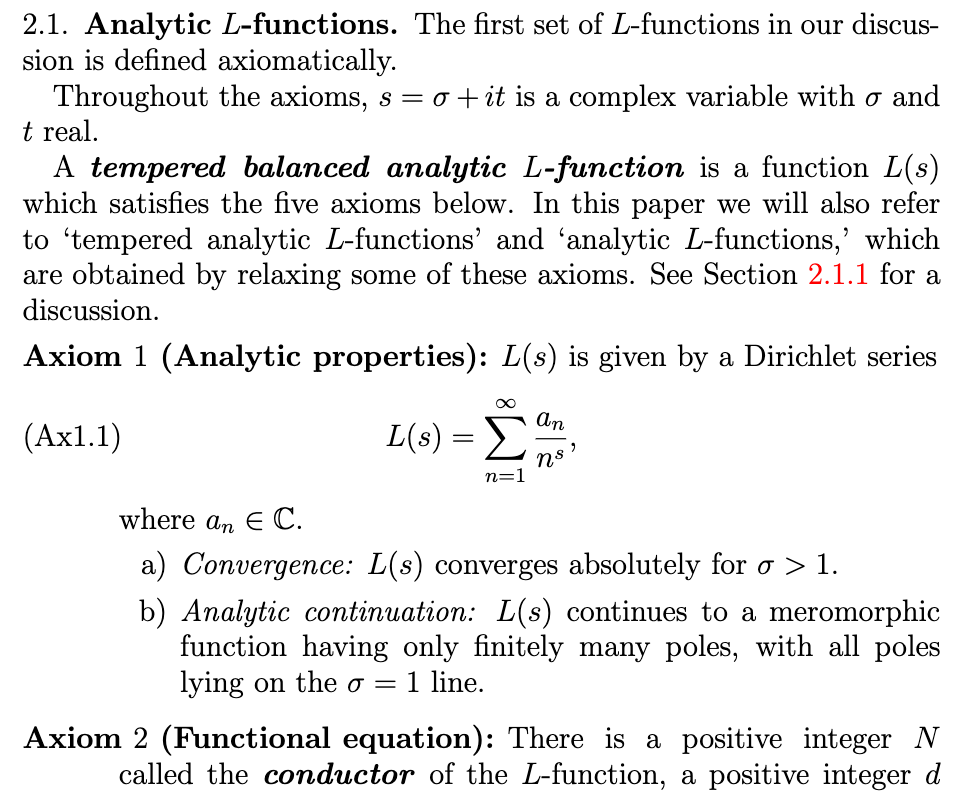
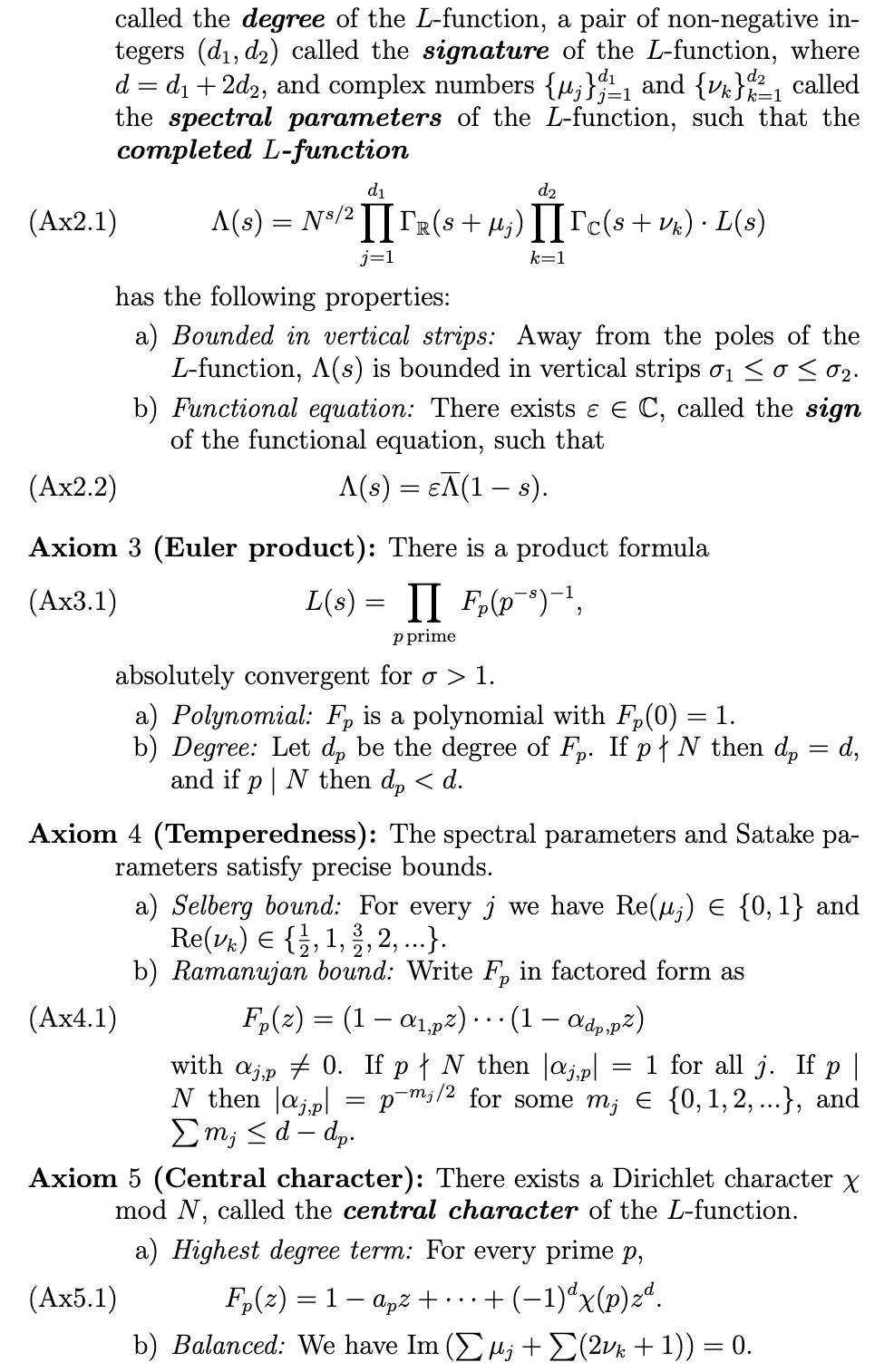

You may compare the above precise formulation with the original axioms for the Selberg class, which I take here from a paper of Murty from the early 90s.
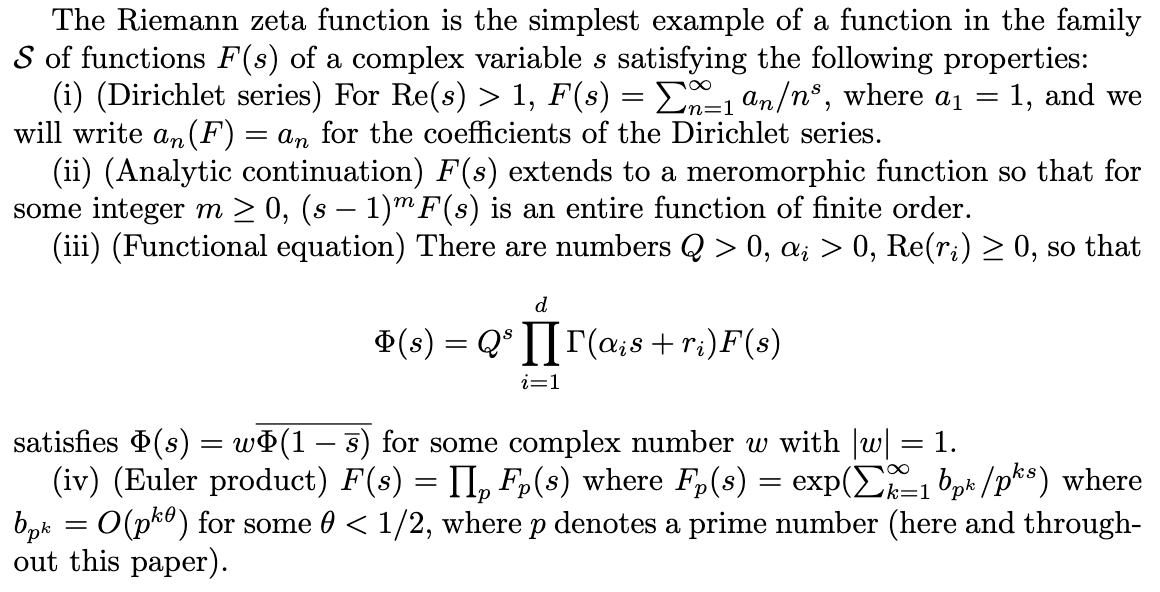

Note in particular the following:
- FPRS require both the conductor and the degree to be (positive) integers. This was not required by Selberg. In fact, a long series of famous papers by Jerzy Kaczorowski and Alberto Perelli aims to prove that the degree has to be an integer, which they do achieve in the range $0<d<2$. See this Annals paper from 2011 for a representative example, where they in fact use the so-called extended Selberg class, a variant of the original axioms without the Euler product and the Ramanujan hypothesis.
- The hope attached to Selberg's definition was that there might be some axiomatic approach to proving the Riemann Hypothesis, i.e. by starting out with the axioms, there should be some direct proof not necessarily involving automorphic language or some deep and complicated geometric framework. Such hopes seem to have been much too optimistic. One of the basic problems is that the functional equation and the Euler product are quite different in nature, and hence difficult to combine.
- As explained by Booker in his talk, the role and meaning of the Euler product is particularly unclear. It could very well be the case that it should be replaced by something morally equivalent, like non-vanishing in the halfplane of convergence.
- Even if an axiomatic proof of RH exists, it may very well be that the list of axioms we currently have is missing some items! Perhaps there are additional properties that should be included on the list, some of which no-one has even thought about up to this point.
- One way to better understand the axioms is to relax one of them at a time. This has been done by many authors, and sometimes it is possible to then find a function that fails to satisfy RH but still satisfies all the other axioms. Some relevant keywords if you want to study this line of thought are the Davenport–Heilbronn example, Epstein zeta functions, Hurwitz zeta functions, Shintani zeta functions, and Beurling primes. Each of these shed some limited light on the structure of a hypothetical axiomatic proof of GRH.
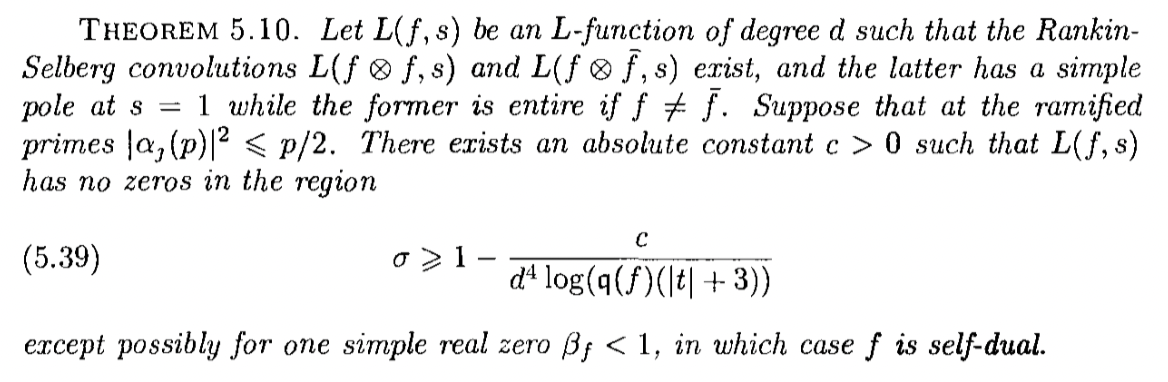
Perhaps it is interesting to see one additional variant of the axioms. I will take this one from the book Analytic number theory by Iwaniec and Kowalski, where Chapter 5 develops in a very nice way many consequences of the axioms, like estimates for the number of zeroes in the critical strip (up to some height $T$), explicit formulae, and bounds for the L-function on the critical line.
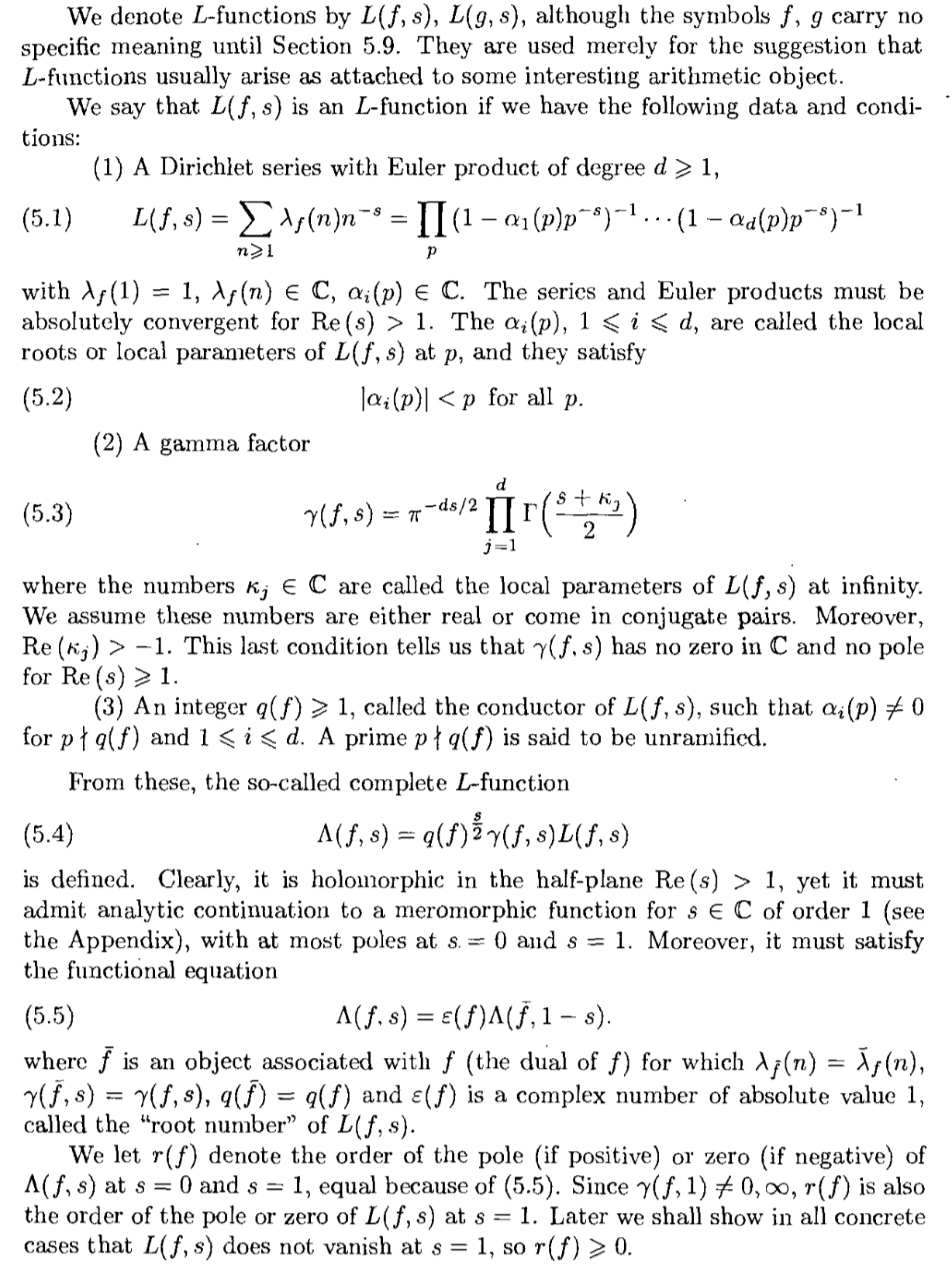
This book chapter is, I believe, the best reference for seeing how the axioms are applied, and in particular how they can be used to prove not the Riemann hypothesis, but the weaker statement of a zero-free region in the critical strip. But the zero-free region comes with two caveats! There might be an exceptional "Siegel zero" on the real line, and the proof requires a necessary "additional axiom", in that certain tensor products must exist. These are the tensor products we have discussed before in the context of Langlands functoriality, and to which we shall also return again in the next chapter!
The automorphic approach
When it comes to automorphic L-functions, I myself find the amount of technical baggage almost unbearable, and hence I have little to add to what can already be found in other expositions. The FPRS paper is still a good basic overview of some key definitions and their relationships. What I can do here is to list some really good references for the brave souls who wish to dive deeper into the theory.
If you want to read only one paper, I would recommend Arthur: L-functions and automorphic representations, where he makes a serious effort to make the theory accessible to a "general mathematical audience". But I think he means a general mathematical audience who is willing to put in quite a lot of effort!
Some other classical references:
- Borel: Automorphic L-functions. This is a chapter from the famous Corvallis volumes on the Langlands program, based on a conference held in 1977. You can also get a sense of what this epic conference was like in this letter from Arthur to Venkatesh!
- Shahidi: Automorphic L-functions, a survey. From 1990.
- A longer reference from around the same time is Arthur and Gelbart: Lectures on automorphic L-functions.
Finally, a book with all the technical background explained step by step is again Getz and Hahn, where L-functions are treated in Chapter 11.