
RH Saga Chapter 6: Invariants of L-functions (intro)

The world of L-function invariants is mindblowingly and extraordinarily rich. In this chapter, I want to make an attempt at organising and structuring this world.
By an invariant, I will mean a rule which attaches a number to an L-function. In other words, it is a machine which takes an L-function as input and gives a (complex) number as output.
Introductory remarks
Before we can begin a kind of overview, some preliminary remarks.
Focus on additive invariants! The primary aim of this chapter is to study the additive invariants, since they (and the "explicit formulas" relating them to each other) seem to be at the heart of the search for a conceptual reason underlying the truth of GRH. But as we will see, there are two more classes of "morally additive" invariants which are also of utmost importance.
Beyond complex-number invariants? If the aim is to give a complete overview of all L-function invariants, is it too restrictive to look only at those taking values in complex numbers? There are indeed other invariants, and I will mention the Sato-Tate group, the Jensen polynomials, and invariants of $p$-adic nature, like the Mazur-Tate-Teitelbaum $\mathcal{L}$-invariant. But for the purposes of this chapter specifically, we restrict attention to invariants which are complex numbers.
Several meanings of "moments". In the theory of L-functions, the term "moments" is used in several different ways. To increase confusion, a "moment" is sometimes an invariant of a single L-function, and sometimes an invariant of a family. The generic basic idea of a moment is that we may sum or integrate the $k$-th powers of some expression involving the L-function. This defines a kind of "$k$-th moment" invariant, and we shall encounter several incarnations of this idea, notably the Sato-Tate moments and the classical "continuous power moments" (which are integrals along the critical line).
Invariants not seen by the L-function. An important philosophical point is that in a theory which attaches L-functions to objects (for example the Dedekind zeta function attached to a number field), the object may have invariants which are not "seen" by the L-function. For example, two number fields may have the same L-function but different class numbers, as in the nice Master thesis of Lotte van der Zalm from 2008.
Invariants of families, invariants in families, and families of invariants. In the study of invariants, there are three different general directions to explore in relation to families. First, one can define invariants of a family of L-functions, for example the basic invariants $i_1$, $i_2$ and $i_3$ mentioned in Chapter 5.1, or the fascinating functions called murmuration densities (see the first few pages of Zubrilina for some examples). Second, we can fix a choice of L-function invariant (i.e. invariant of a single L-function), like, say, the second Keiper-Li coefficient, and study how this single fixed invariant behaves in a family of L-functions. For example, we may look at the special value at $s=1$ in a family of Dirichlet L-functions of increasing conductor; the growth rate of this sequence is intimately connected to the story of Siegel zeros. And third, we can study a family of invariants applied to a single fixed L-function. For example, the sequence of Sato-Tate moments $M_{2k}$, applied to a single elliptic curve L-function, yields the famous sequence of Catalan numbers, provided the elliptic curve does not have CM (complex multiplication).
In the last case, we distinguish between a family of invariants that determines the L-function completely (the trivial example being the sequence of Dirichlet series coefficients), and a family that does not, like the sequence $M_{2k}$, which sees nothing about an elliptic curve except if it has CM or not. Any instance of the first case can be thought of as a "coordinate system" for L-functions.
Connections to $\mathbb{F} _1$? Although there are a million fascinating substories to pursue in the world of L-function invariants, it is of course (for the RH Saga) particularly interesting to think about possible connections to the field with one element. One way to do this is to, for each new invariant encountered, consult the Rosetta Stone, and compare the L-function story (in the number field world) to the parallel situation over function fields, and sometimes even to Selberg zeta functions (in the world of Riemann surfaces). Even more specifically, you may recall from the Weil Conjectures that the L-function (or "zeta function") of a curve $X$ over a finite field (which is analogous to the Dedekind zeta function of a number field) can be written on the form
\[ \frac{(1-\alpha_1 T)(1 - \alpha_2 T) \cdots (1-\alpha _{2g} T)}{(1-T)(1-qT)} \]
where the numerator is a finite product of $2g$ factors, and the numbers $\alpha _j$ come in $g$ complex-conjugate pairs (where $g$ is the genus of the curve). In particular, the finite list of reciprocal roots $\alpha_j$ encodes completely the entire L-function (and hence also all invariants seen by the L-function). It is often extraordinarily interesting to think about what shadows of these numbers might be lurking in the dark in the analogous number field setting. Just to give one example, a Dedekind zeta function has an invariant called the Euler-Kronecker constant (it is the constant term of the Laurent series of the log derivative at $s=1$). In the parallel world of function fields, this invariant is known to be (1) a rational multiple of $\log(q)$, and (2) related to the harmonic mean of the real numbers $(1-\alpha)(1 - \bar{\alpha})$. Neither of these two statements have a meaning in the number field world. For statement (1), naively, $\log(q)$ would be zero, but in the simplest example of the Riemann zeta function, the invariant is equal to the Euler-Mascheroni constant $\gamma$. Does this mean that in some deep unknown $\mathbb{F} _1$-sense, the number $\gamma$ is rational? For statement (2), the list of $\alpha$'s simply doesn't exist, but some quantities derived from them (like the harmonic mean) still has shadows in the number field world. A reference for this story is Ihara.
Structural overview of invariants
Recall the operations on L-functions from Chapter 5: The binary operations "direct sum" and "tensor product", as well as the (lambda-ring) unary operations, like symmetric powers, exterior powers, and Adams operations, and also the notion of a dual, or complex-conjugate. With the help of these operations, we may impose at least some modicum of order upon the wild jungle of invariants.
In what follows, we denote two L-functions by $A$ and $B$, and write $F$ for an invariant taking L-functions to numbers.
Additive invariants
It may happen that for all $A$ and $B$, we have
\[ F(A \oplus B) = F(A) + F(B) \]
In this case, we say that $F$ is additive, and we could also have called this a functional, as in a linear map from $\mathbb{L}$ to $\mathbb{C}$. Some key examples would be:
- Spectral sums, i.e. any convergent sum over the nontrivial L-function zeros, like $\sum \frac{1}{\vert \rho \vert ^2}$, or any fixed Keiper-Li coefficient.
- Any fixed Dirichlet series coefficient of the log derivative, like the invariant $N_5$ used in the RH Saga Episode 6 video. In general there is an $N_q$ for any prime power $q$.
- Any fixed Taylor (or Laurent) coefficient of the log derivative, like the "constant term at $s=1$" mentioned earlier.
We will compile a more complete list in a subsequent post dedicated to additive invariants only.
"Exponential" invariants
Another thing that may happen is that
\[ F(A \oplus B) = F(A) \cdot F(B) \]
When this holds for all $A$ and $B$, we can say that $F$ is exponential (in analogy with the elementary exponential function, which also transforms addition to multiplication). Key examples include the root number, the conductor, the analytic conductor, and any fixed special value, like "the value at $s=2$".
In cases where a multiplicative invariant lands entirely in the positive reals (like the conductor), we can take its logarithm to obtain an additive invariant capturing the same information.
"Lambda-additive" invariants
Some invariants are obtained by composing some of the lambda-ring operations (like $Sym ^2$) with an additive invariant. It seems reasonable to call these invariants lambda-additive. Examples include:
- The Dirichlet coefficient $a_q$ where $q = p ^k$ is a prime power but not a prime. This is the symmetric power $Sym ^k$ composed with the additive invariant $N_p$.
- Any Sato-Tate moment $M_{k}$. This is the $k$-th tensor power $A \mapsto A ^{\otimes k}$ composed with the additive map "pole order at $s=1$".
- The Selberg norm, i.e. the inner product of an L-function with its dual. This is also the tensor product of $A$ with its dual, followed by the same "pole order" invariant.
Other invariants
The above three cases cover most of the important L-function invariants in a rather pleasant structural framework. But are there other invariants which fall outside this trichotomy?
Indeed there are. But as far I can tell, they are not central to the story of the RH Saga, and I will not spend too much time on them. Instead, I will give a few examples here, before we move on in upcoming posts to the three main structural classes.
The first examples that come to mind would be various types of moments (not Sato-Tate moments, but other kinds of integrals and sums of $k$-th powers, for $k$ an integer or sometimes a more general number). The general theory of moments is a sprawling body of different ideas (as explained in that talk by Soundararajan posted a few weeks back). I will not try to cover all of these directions, but instead present two of the most interesting and classical examples. I will use the Riemann zeta function for concreteness, but the most general conjectures should apply to any L-function.
The classical continuous power moments. For any $k$, we may consider the integral
\[ I _k(T) = \int _0 ^T \vert \zeta(\frac{1}{2} + it) \vert ^{2k} \mathrm{d}t \]
from $0$ to some height $T$ on the critical line. This is a function of $T$, and it is an important problem to understand the growth rate of this function. For example, the Lindelöf Hypothesis is equivalent to the statement that for any fixed $k \in \mathbb{Z} ^{+}$ and $\epsilon > 0$, we have $I_k(T) = \mathcal{O}(T ^{1+\epsilon})$. As an example, it is known that
\[ I_2(T) \sim \frac{1}{2 \pi^2} T (\log T) ^4 \]
The general conjecture is that $I_k$ should grow like $C_k T (\log T)^{k ^2}$ for a certain constant $C_k$. The search for $C_k$ in explicit form is a very famous story, told in the Music of the Primes book by du Sautoy. See Soundararajan and the excellent recent survey of Florea for details!
In fact, this $I_k$ is also an example of an invariant taking values not in complex numbers but in some appropriate ring of functions of $T$. However, the asymptotic growth rates of these functions are encoded by complex numbers, like the number $C_k$, so we may for most practical purposes think of moments simply in terms of complex invariants.
Derivative sums. Back in the 80's, Steve Gonek studied expressions of the form
\[ J_k(T) = \frac{1}{N(T)} \sum_{0 < Im(\rho) < T)} \vert \zeta'(\rho) \vert ^{2k} \]
Here $N(T)$ is the number of terms in the sum, so that we compute the average of those $2k$-th powers of the derivative. There are conjectures and conditional theorems for the growth rates of $J_k$ for various $k$, see Hiary and Odlyzko for a very nice introduction to formulas of this type:
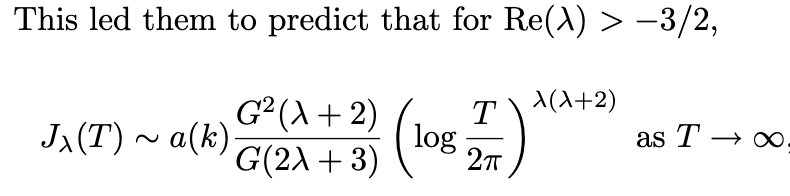
I find it quite remarkable that anything at all can be conjectured about such sums, and that strange functions (like the Barnes G-function) appear.
The de Bruijn-Newman constant. To give one final example of an invariant outside of our three main classes, the de Bruijn-Newman constant $\Gamma_L$ can be defined for any L-function, and used (at least in the case of Dirichlet L-functions) to give a reformulation of GRH, namely that $\Gamma_L \leq 0$. This constant was treated in a PolyMath project led by Terence Tao around 2018-2019, and has gained some traction in recent weeks because of AI-generated proof claims of some improved bounds. For some theory background, check out the PolyMath paper (for the case of Riemann zeta) and this recent paper (for the case of Dirichlet L-functions, by Freire et. al.). If you care about the AI claims at all, references seem to be continuously updated on the MathWorld page.
Final introductory remarks
Tensor homomorphisms? The three main classes of invariants above were either homomorphisms with respect to $\oplus$, or built from such a homomorphism (by composition with some binary or unary lambda-ring operations). But what about homomorphisms with respect to $\otimes$? Shouldn't they play an important role too? I think this question has some very good answers, but I am not sure what those answers are. There are a few basic examples of $\otimes$-homomorphisms, like the degree $d$ and the weight $w$, since we have
\[ d(A \otimes B) = d(A) \cdot d(B) \quad \quad \textrm{and \quad \quad } w(A \otimes B) = w(A) + w(B) \]
However, it seems very hard to construct a rich plethora of invariants which behave well with respect to tensor product. My vague intuition is that this is connected to the mysterious "Tannakian symmetry group" conjectured by Langlands, from Chapter 5.5.
Moments and $\mathbb{F}_1$? One might ask if there are important $\mathbb{F}_1$-clues hidden in the theory of invariants outside our three main classes. The theory of moments is intertwined with random matrix models, as seen for example is one of the most famous papers of this entire area (the CFKRS Recipe paper), and in some of the talks from a 2022 conference on moments. In the analogous function fields world, there is an interesting line of inquiry explored by Bergström, Diaconu, Petersen and Westerland, developing unexpected connections to homological stability. Another interesting paper is the approach by Sawin to moments over function fields. I don't know if any of these ideas can be transferred to the world of number fields.
Until next time. We are now in a good position to delve deeper into the three main types of invariants: Additive, exponential and lambda-additive. In the meantime, feel free to watch or rewatch the RH Saga Episode 6 video here: