Weekend research talk: Andrew Booker on L-functions

Writing up Chapter 4 of the RH Saga is taking a bit longer than expected, as I'm travelling while also enduring the quite unusual European heatwave. But there is one more important video I can share now to which I want to refer in Chapter 4, and this is the talk of Andrew Booker at the 2018 conference Perspectives on the Riemann Hypothesis, simply titled L-functions. You can find the video here (not available on YouTube as far as I know), and the slides here.
Andrew Booker was once a student of Sarnak, and is now one of the leading experts in the world on L-functions. This talk is perhaps slightly more philosophical and technical than the talk of Belabas and the talk of Murty shared in previous posts. He mentions at the beginning the two principal methods for defining what an L-function is (the automorphic and the axiomatic approach), and then dives into the Selberg class and various ideas on how one could perhaps improve or reframe our conceptual understanding of these axioms. Some key ideas from the talk:
- Instead of focussing on L-functions as Dirichlet series in the standard way, perhaps we should instead think of L-functions more in terms of their explicit formulae. Roughly speaking, in the language of RH Saga Episode 6, this means focussing on "functionals" of L-functions, i.e. maps from L-functions to complex numbers that behave additively with respect to the "direct sum" operation.
- Perhaps the axiom of having an Euler product can (and should) be dispensed with (in the context of explicit formulae). There are different ways of making this more precise, and one way is to use "non-vanishing" properties.
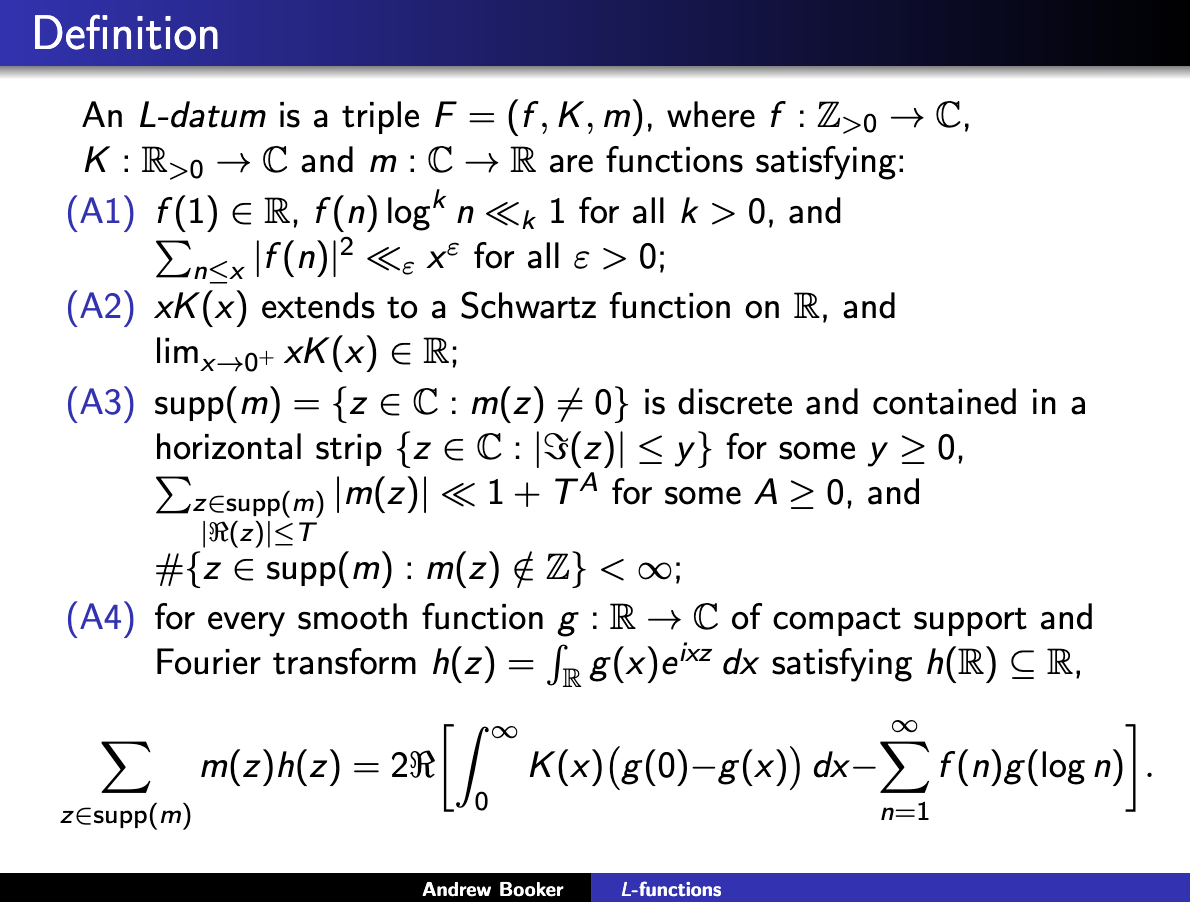
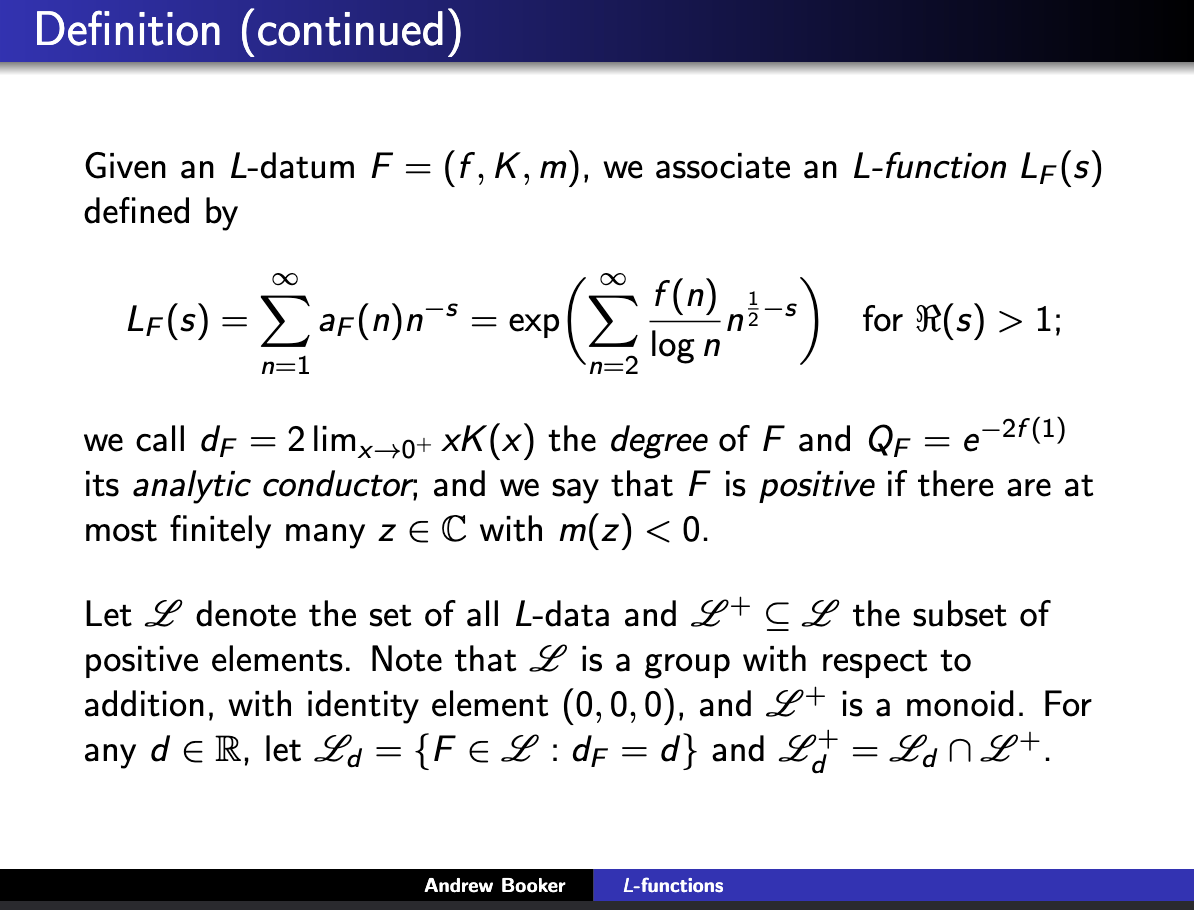
- Booker proposes the notion of an "L-datum" as an alternative axiomatic approach to L-functions.
- There are unanswered questions about the role of "twists" in the theory of L-functions, and the appropriate role these twists should play when writing down axioms.
Below are just two of the slides linked above, indicating how the notion of an L-datum (with suitable axioms) is a possibly deeper and more natural idea underlying the L-functions we usually speak about.