RH Saga Chapter 5.4: Perturbations

There are many situations in the literature in which two Dirichlet series arise which have identical Euler products except at a finite number of primes, where the Euler factors differ.
Motivated by all of these examples, I want to define a perturbation of an Euler product as any operation that changes a finite number of Euler factors. When $L_1$ is a perturbation of $L_2$, I also want to introduce the notation
\[ L_1 \approx L_2 \]
and say the the two L-functions are almost equal.
If you imagine the space $\mathbb{L}$ of all L-functions as a lattice (sitting inside a Hilbert space), then a given L-function (in the sense of the axioms of Chapter 4) has unit distance 1 to its nearest neighbours. But we can think of the perturbations of that L-function as points living in an infinitesimally small cloud around that lattice point, infinitesimally close to (almost equal to) the L-function we started with.
The archetypal situation where this happens is when you have the ring of integers of a number field, say the ring $\mathbb{Z}[\frac{1+\sqrt{-7}}{2}]$ inside the number field $\mathbb{Q(\sqrt{-7})}$, and you consider a proper subring $R$ of finite index (also called a non-maximal order), like $\mathbb{Z}[\sqrt{-7}]$. In this setting, the ring of integers is a Dedekind domain but $R$ is not, and one can apply a procedure called taking the integral closure to $R$ to recover the ring of integers. An operation of this kind can also be referred to as normalization, or resolution of singularities, or a blow-up, depending on the context and the precise technical details.
In the above setting, the zeta function of $R$ is a perturbation of the zeta function of the ring of integers (the Dedekind zeta function, which factors into irreducible Artin L-functions), and the differing Euler factors correspond to the primes where $R$ has singularities.
As another clue for $\mathbb{F}_1$, we can collect examples of perturbations and ask whether there is a general geometric interpretation of what perturbations are, which cover not just the narrow setting of number fields, but L-functions in general. With this in mind, here is a list of examples from the literature, which may or may not be relevant for our quest!
- A non-primitive Dirichlet character has an associated primitive Dirichlet character, and the two L-functions will be almost equal.
- There is a perturbation of the Riemann zeta function called the Dirichlet eta function, which is Riemann zeta multiplied by the factor $(1-2T)$, where $T = 2^{-s}$. The resulting Euler product (perturbed at the prime $p=2$) converges not just for $Re(s) >1$, but for $Re(s)>0$, and hence it gives us an elementary approach to talking about the Riemann Hypothesis without depending on any notion of analytic continuation.
- A situation closely related to the maximal order examples is that of $S$-integers, where $S$ is a finite set of primes. Given any ring of integers in a number field (you can stick to $\mathbb{Z}$ for simplicity), we can invert a finite number of primes in the ring. For example, the ring of $\{ 2, 5\}$-integers is precisely the ring of all fractions whose numerator contains only the primes $2$ and $5$, or in other words, it is the ring of all real numbers whose decimal expansion is finite. For an interesting research paper in this direction, check out Jordan and Poonen's paper on generalizing the analytic class number formula to all such examples.
- A similar but deeper situation is that of the Stark conjectures, where there is also a finite set $S$ of primes involved. See for example the classical book by Tate: Les Conjectures de Stark sur les Fonctions L d'Artin en s=0 (SpringerLink, paywalled) or the BSc thesis of Dasgupta.
- In the old literature aiming to completely classify elements of the Selberg class, you may see statements like in this paper (open access, see page 210) saying essentially that a general element of degree $1$ in the Selberg class is a Dirichlet L-function shifted by an imaginary argument and multiplied by a Dirichlet polynomial, i.e. a Dirichlet series with a finite number of terms.
- A variety over $\mathbb{Q}$ may have different models over $\mathbb{Z}$, and these models will typically have almost equal Hasse-Weil zeta functions. You may have encountered terms like minimal model, Weierstrass model, and Néron model. The study of such models is a deep and important topic in arithmetic geometry, related in particular to the theory of discriminants and their relation to the conductor of the L-function, as seen for example in the context of Szpiro's conjecture.
- The 2023 Annals paper of Dasgupta and Kakde uses a technical device called $T$-smoothing, for a finite set of primes $T$.
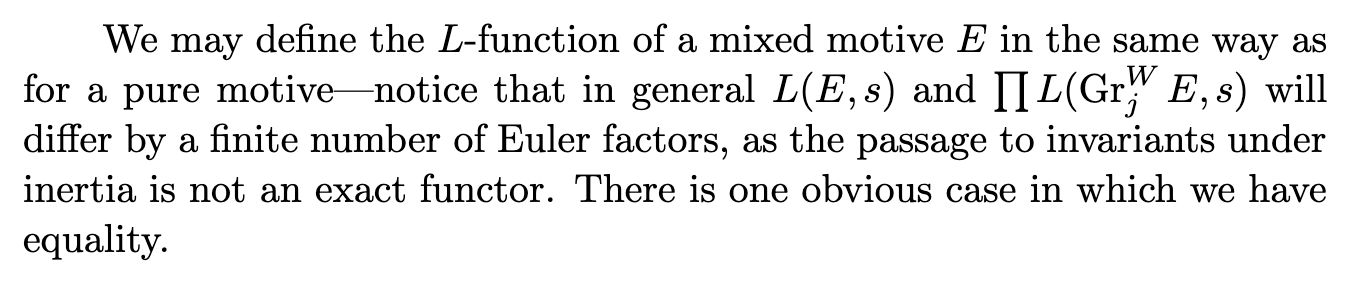
- The conjectural theory of mixed motives involves the idea that any object $M$ in the abelian category of mixed motives (over $\mathbb{Q}$ or some other number field) has an associated graded motive (which is a direct sum of pure motives). The two L-functions will be almost equal. Below is a tiny screenshot from Scholl: Remarks on special values of L-function, where you can also get a sense of this motivic language which aims to unify all special value conjectures under the umbrella called the Beilinson conjectures.
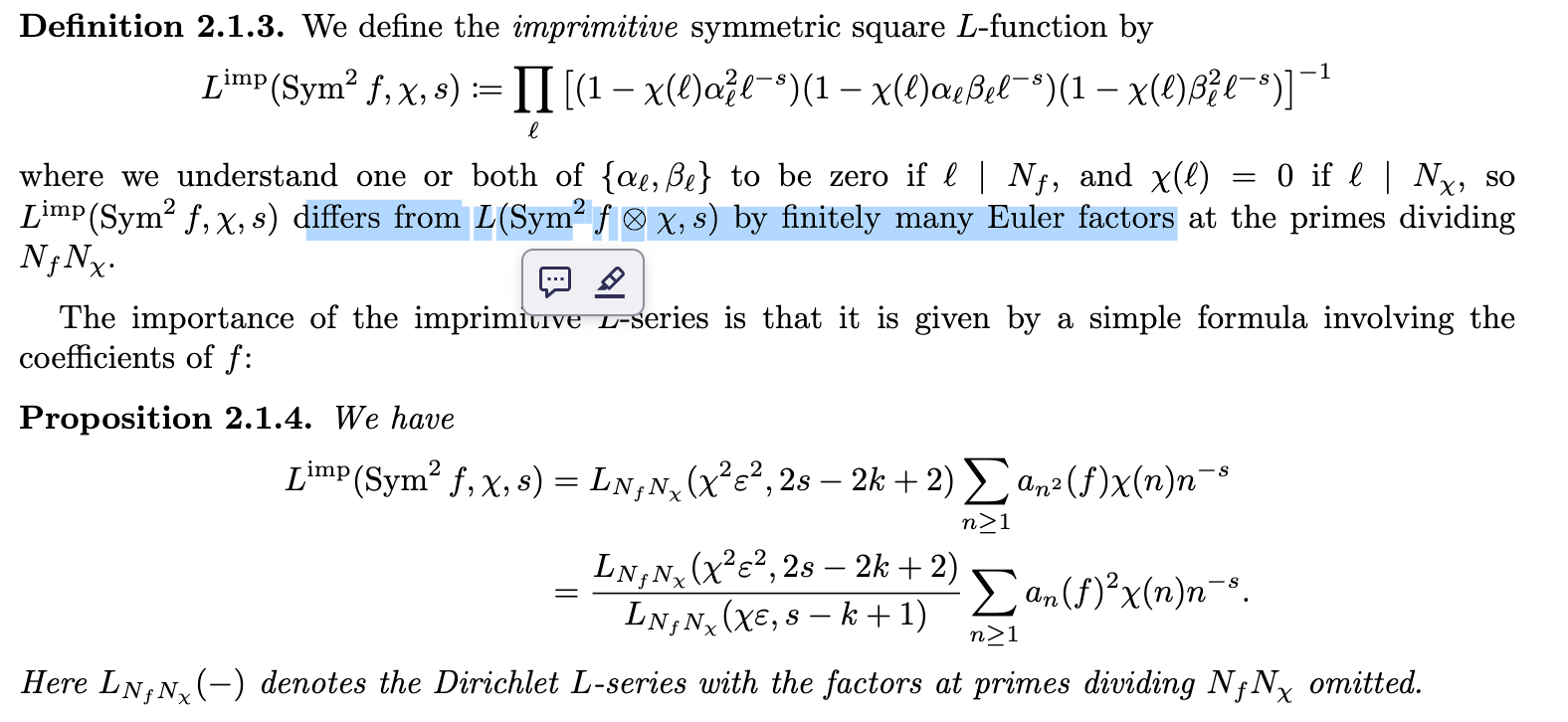
- The general tensor product (Rankin-Selberg product) of two L-functions. We have already discussed (in Chapter 5.2) the tensor product of L-functions, and the fact that the naive tensor product needs to be perturbed to find the true tensor product. And similarly for the symmetric powers and other lambda-operations on a single L-function. There are many concrete cases of this phenomenon scattered throughout the literature. For one such example, see Loeffler and Zerbes: Iwasawa theory for the symmetric square of a modular form. On page 4 they talk about the imprimitive symmetric square L-function and its relation to the true symmetric square L-function.
- The very important theory of $p$-adic L-functions has not been properly introduced in the RH Saga so far. But the most elementary starting point for this theory is that by removing one Euler factor from the Riemann zeta function (or one of our Dirichlet L-functions $L_D$), certain congruences hold (Kummer congruences) which imply that the special values of the L-function can be $p$-adically interpolated. One nice reference is the introduction to the long introduction of Jacinto and Williams.
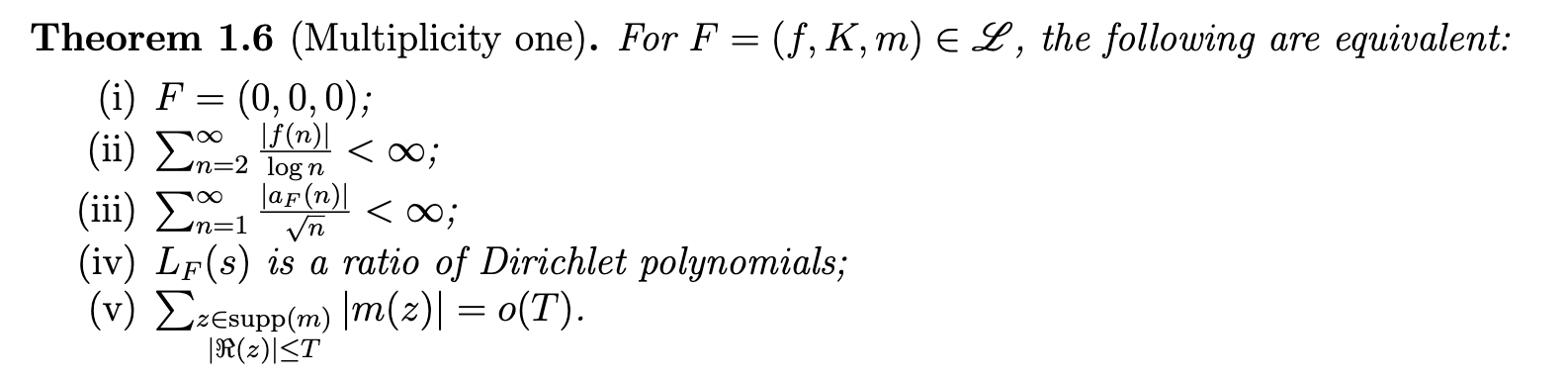
- In Booker's approach to L-functions as distributions, the perturbations are not seen. More precisely, the quotient of two almost equal L-functions have an L-datum which is trivial, i.e. $(0, 0, 0)$. Screenshot below.
Since 11 is a nice prime number, this is a good place to stop. Many of the above papers are well worth reading for reasons independent of our immediate interest in perturbations! Below are selected screenshots from these articles for easy access.
Scholl
Booker
Loeffler and Zerbes