
RH Saga - Chapter 1: The dream of a field with one element

The Riemann Hypothesis may be the greatest unsolved math problem of all time. In his book Zeta and L-functions of varieties and motives, Bruno Kahn calls it an unapproachable mystery. In a short YouTube clip, Terence Tao likened it to climbing a sheer cliff face, a mile high, with no handholds whatsoever.
The Riemann Hypothesis is on the surface a statement about the Riemann zeta function, or, equivalently, about prime numbers. But on a deeper level, mathematicians have gradually come to understand that the Riemann hypothesis can be generalized to a large class of functions called L-functions, and that a future proof might require the construction (or discovery) of an entirely new mathematical realm, often called geometry over the field with one element. This geometry is a conjectural and speculative theory of which we currently only see fragments and glimpses, at best.
In fact, the Riemann Hypothesis is not the only outstanding and seemingly impossible problem related to L-functions. There is another Millennium problem too, the Birch and Swinnerton-Dyer conjecture, which belongs to a general class of problems called conjectures on special values of L-functions. Another towering web of conjectures is of course the Langlands program, which among other things predicts that all L-functions possess certain symmetries which make them automorphic (this is the reciprocity conjecture), and that certain operations on L-functions (like tensor product and symmetric power operations) give new functions which are also L-functions (this is the functoriality conjecture). The hope expressed in different ways by many different mathematicians is that a good theory of the "field with one element" could open up new avenues to progress also on some of these other mysteries.
This quest for a new geometry underlying the theory of L-functions is to my mind the most challenging and most fascinating mathematical journey one could ever hope to undertake. The aim of the RH Saga is to tell the story of L-functions and the field with one element from the beginning all the way to the research frontier. My hope is that by telling this story as best I can, someone out there, perhaps you, will be inspired to cross the unfathomable abyss and find this new realm, by piecing together some of the many clues and insights we already have with others which surely remain to be found.
You may already have watched some or all of the RH Saga videos on YouTube. In these written lectures, I will go much deeper and into more detail, and I hope you will join me for an unforgettable adventure!
Historical origins
In 1859, Bernhard Riemann published a six-page paper titled Über die Anzahl der Primzahlen unter einer gegebenen Größe. This was to be the only paper he ever published on the subject of number theory, but it would leave a deep and lasting impression on the history of mathematics. In the paper, he investigates the Riemann zeta function and connects its zeroes to the distribution of the set of primes among the natural numbers. The Riemann zeta function \( \zeta(s) \) has zeroes for \( s = -2, -4, -6, \) and so on, and Riemann conjectured that all other zeroes in the complex plane have real part exactly equal to \( \frac{1}{2} \).
This conjecture, the Riemann Hypothesis, was listed by Hilbert in his famous list of 23 problems at the International Congress of Mathematicians in Paris in the year 1900. It was pursued throughout the 20th century by many of the greatest mathematical minds, until in the year 2000 it was included in the even more exclusive list of seven Millennium Problems, chosen by the Clay Foundation to represent some of the greatest challenges for the 21st century. By this time, it had become clear that the Riemann zeta function is but the simplest example of an infinite class of similar functions connected to a multitude of deep phenomena from all over the mathematical landscape. We still don't have a complete understanding of what these functions are, but they can be described either as automorphic L-functions (a perspective emerging from the Langlands program), or in terms of axioms (as pioneered by Norwegian Fields medallist Atle Selberg in a talk given in Amalfi in 1989). Conjecturally, these two descriptions are equivalent. These L-functions (often also called zeta functions) belong to the realm of number fields.
In the year 1921, another important development occurred. Emil Artin, under the direction of Otto Herglotz, obtained his PhD at the University of Leipzig. In the thesis, he develops "number theory" in quadratic function fields. Each such function field has a zeta function, and when Herglotz describes the thesis he mentions as a side remark that Artin obtained some evidence that the non-trivial zeroes of these zeta functions seem to have real part equal to \( \frac{1}{2} \). These observations (together with some earlier examples studied by Gauss) were the beginning of what later came to be known as the Weil Conjectures, a collection of statements describing the zeta functions (sometimes also called L-functions) from the parallel realm of function fields (or more precisely, function fields over finite fields). One of the Weil Conjectures is the Riemann Hypothesis for these zeta functions.
The Dream
There are two distinct realms in number theory: The world of number fields and the world of function fields. In each world there are L-functions (also called zeta functions), and for each L-function we can formulate the Riemann Hypothesis. In the world of function fields, the Riemann hypothesis has been proven, beginning with various special cases in the 20s and 30s, and culminating with the general proof of the Riemann Hypothesis by Deligne in 1974.
As various proofs of the Weil conjectures developed over these decades, mathematicians began to dream that the methods of these proofs could somehow be carried over to world of L-functions from number fields, and in particular to the original Riemann zeta function. The function field proofs rely on different aspects of algebraic geometry over finite fields. Every finite field \( \mathbb{F}_q \) has \( q \) elements, where \( q \) is a power of a prime number, i.e. a number like 2, 3, 4, 5, 7, 8, 9, 11, 13, 16, and so on. For reasons that will become clearer later, the intuition emerging was that a similar geometric theory for the number field world should be referred to as geometry over the field with one element, or geometry over \( \mathbb{F}_1 \).
Although many proposals have been made for how such a geometry might be defined, none of these proposals have as far as I know resulted in any new theorems about L-functions, and certainly not anything even remotely close to an actual proof of the Riemann Hypothesis. Yuri Manin refers to the realm of such proposals as the "unfathomable abyss". So the challenge that defied many of the greatest mathematicians remains - find the new and unknown theory that might prove the Riemann Hypothesis.
Cognitive maps for the world of L-functions
Attempting to cover all of the vast theory of L-functions may seem impossible. I want to go about this project in a very particular way. Instead of a linear exposition from basic definitions to gradually more advanced material, I want to build a sequence of "cognitive maps", or "frames", which we shall explore and slowly but surely populate with concepts, examples, theorems, conjectures, computations, and intuition. You can follow this exposition regardless of your current background. Engage with the material that you are already in a position to understand, and place whatever remains in the mental category of things that you are still in the process of learning. Questions are always encouraged - if a concept is unknown to you, just ask and we can work together to fill in whatever details were needed.
First frame: Weil's Rosetta Stone
We begin with Weil's Rosetta Stone. This conceptual map is an analogy between not just two, but three different realms of mathematics: Number fields, Function fields, and Riemann surfaces.
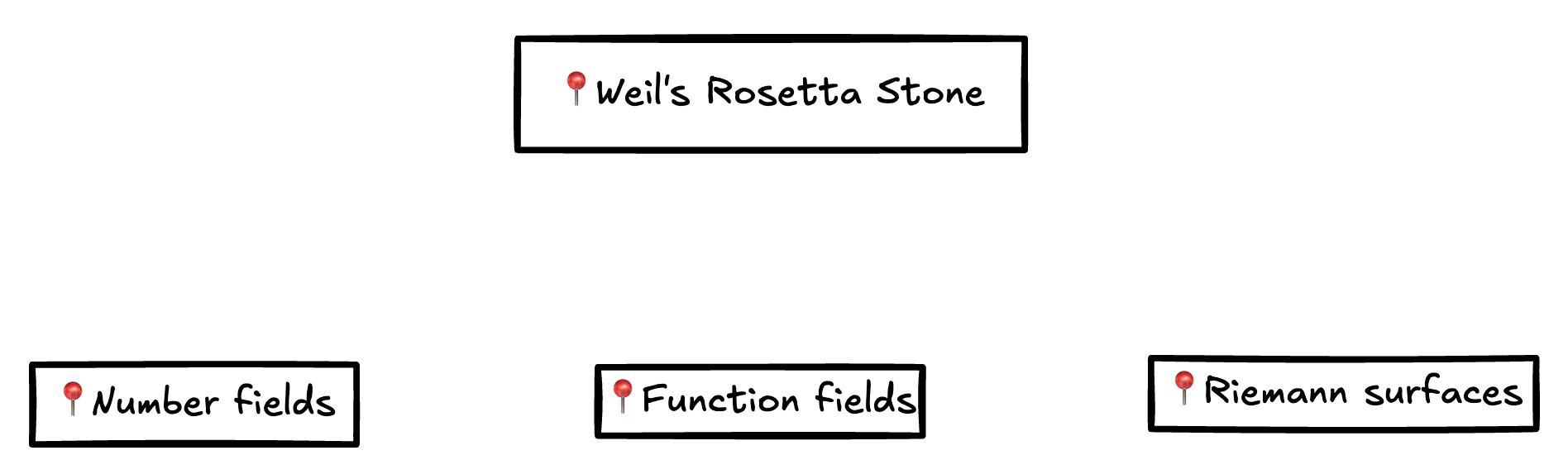
You may be familiar with this analogy from Chapter 9 of Edward Frenkel's book Love and Math, or from Episode 12 of the RH Saga.
Each of these three is in itself an immensely rich world of ideas, one where you could easily spend a lifetime of exploration and wonder. Even so, an additional layer of deep mystery comes from the fact that these three worlds seem to share many fundamental features, as if they were different symphonies emerging from the same underlying musical theme. Riemann surfaces and number fields are subjects you would normally encounter towards the end of an undergraduate degree in pure mathematics, but there is no reason not to begin learning about them much earlier, even if you are still in high school. Function fields are not always studied in a standard undergraduate curriculum, but I would wholeheartedly recommend getting familiar with them as early as possible. All three subjects lie at the heart of enormous amounts of research mathematics.
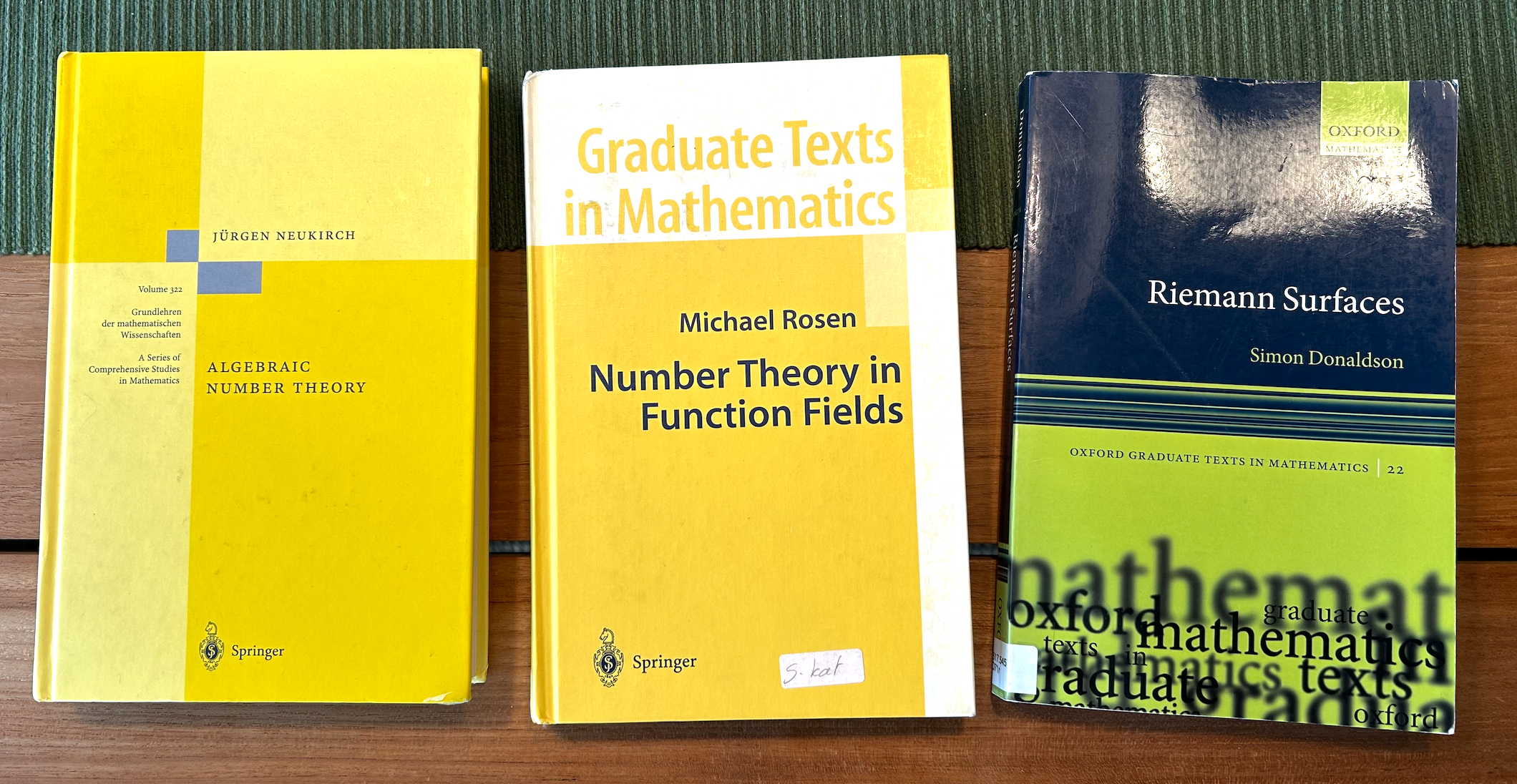
For inspiration, here is a selection of textbooks from my dinner table, one for each column of the Rosetta Stone. The first book is a bit heavy if you are looking for a first introduction to number fields. Instead, I would recommend Ireland and Rosen: A Classical Introduction to Modern Number Theory. Other people prefer Gary Marcus: Number Fields (but note that the 1st edition is visually old-school in typewriter style, and only the 2nd edition is nicely typeset in LaTeX). The other two books are beautiful introductions to the respective subjects - Rosen is a wonderful author, and Donaldson is a Fields medallist.
Second frame: The Big Five
The second frame (or "map") is what I call the "Big Five" immortal problems. These are problems in the world of number fields. Each of them has been discussed in different parts of the literature as motivation for the quest for $\mathbb{F}_1$.
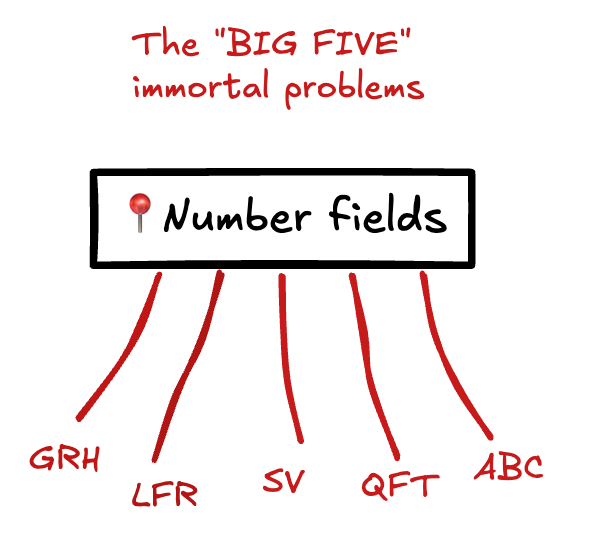
These abbreviations stand for the Generalized Riemann Hypothesis, Langlands Functoriality and Reciprocity, conjectures on Special Values, connections to Quantum Field Theory, and the abc conjecture.
Let's briefly discuss each one of them, with a pointer to the literature on $\mathbb{F}_1$.
GRH
First, from Lieven le Bruyn's collection of blog posts found here, I will quote from page 27:
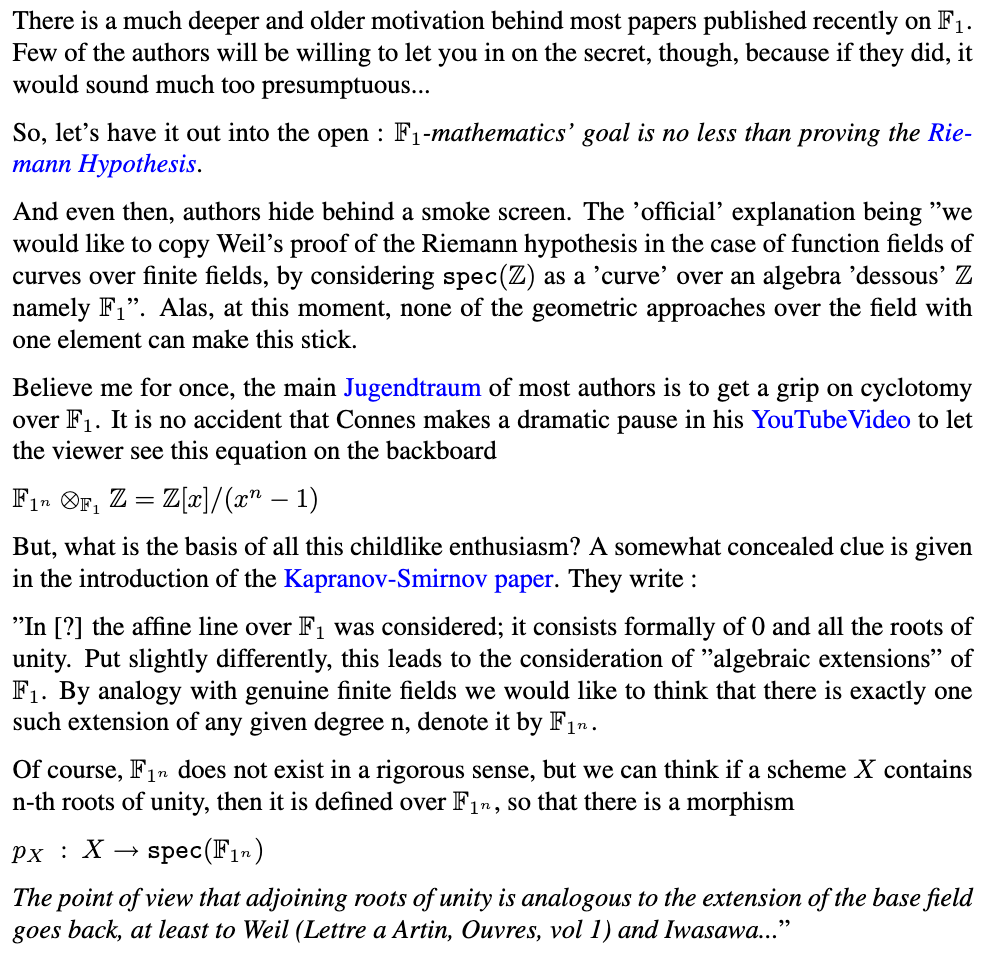
The writings of Le Bruyn were for many years one of the main sources of news and ideas regarding $\mathbb{F}_1$. The file linked above from around 2007 is still one of the best introductions to the subject.
As you will see over and over again, there are many authors who use the language of $\mathbb{F}_1$ freely in their talks and publications, among them Yuri Manin and Alain Connes (who won the Fields medal in 1982). See for example the articles of Connes on arXiv, like On the metaphysics of $\mathbb{F}_1$, written jointly with Caterina Consani in honour of the memory of Manin. At the same time, other leading experts (like Brian Conrey or Peter Sarnak) very rarely use the term $\mathbb{F}_1$. Perhaps they deem it too speculative, I don't know. But they still talk about the same ideas! For example in Sarnak's recent talk on the Riemann Hypothesis, the part about function fields begins at 31:40, and from around 34:00 he talks about one of Weil's proofs (the one using surfaces), as "the one that many of us still hope might be relevant in the real thing".
LFR
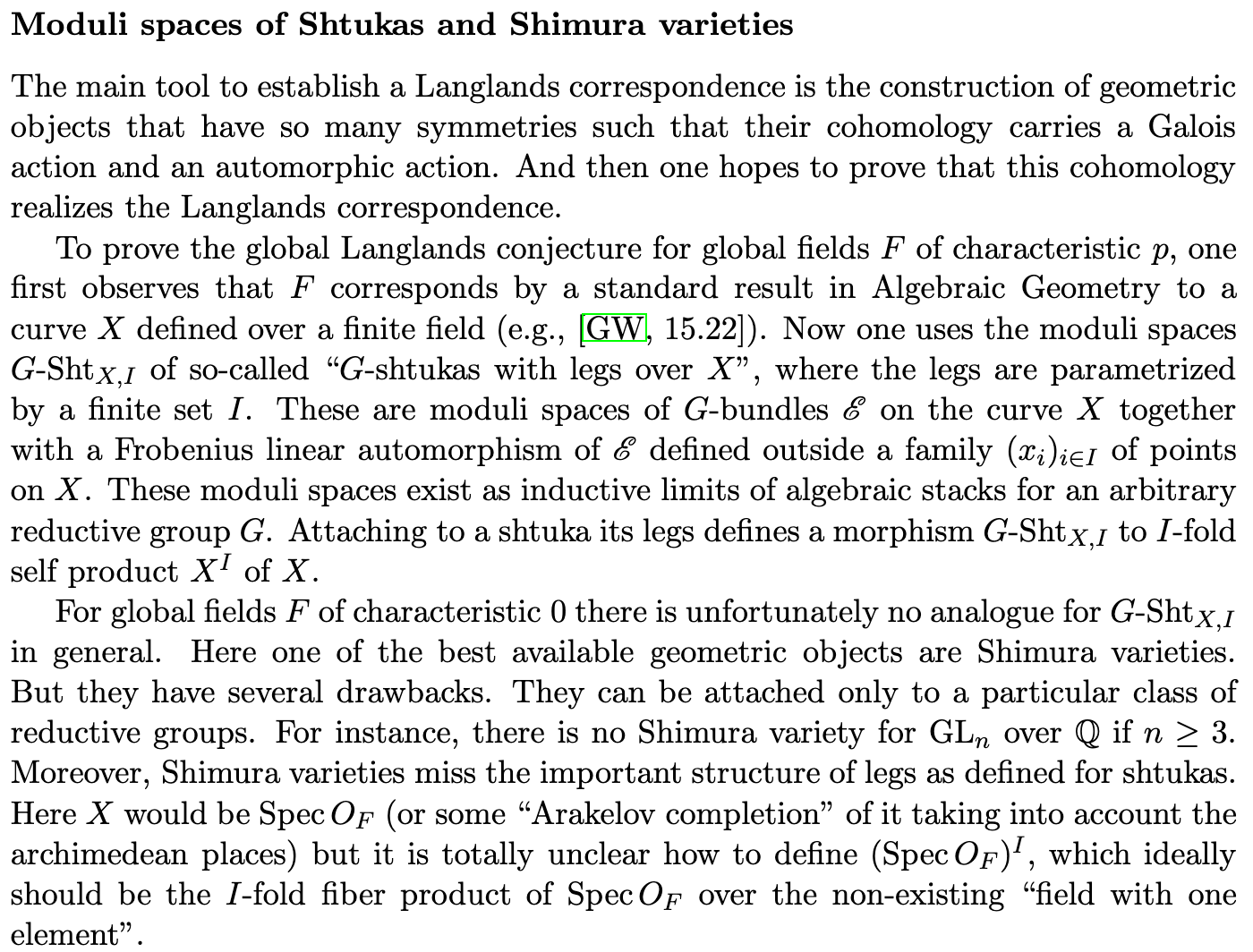
To get a glimpse of the possible connection between $\mathbb{F}_1$ and Langlands, I would totally recommend everyone to watch the last 7 minutes of Dustin Clausen's recent talk Weil Anima 1/4. Clausen is in collaboration with Peter Scholze in the process of creating a variety of entirely new geometric worlds in number theory. Even if you don't understand the technical details (and few people do!), it's highly interesting to see first-hand how someone like Clausen describes Scholze's hope that the function field concept of shtuka should in some form be transferable to the number field realm. Watch the video below from 1:42:12 to the end. The notion of a shtuka was key to the breakthrough in the Langlands programme over function fields that gave Laurent Lafforgue the Fields medal in 2002.
A written reference in the same direction is the survey article of Wedhorn on the work of Scholze. Here is a quote from page 35, where he says that it is totally unclear how a definition would look that ideally should be a fiber product over the non-existing "field with one element".
SV
The world of special value theorems and conjectures range from rather concrete statements like Euler's Basel problems and the sum of all natural numbers being $-\frac{1}{12}$, to things like Zagier's conjecture, the Birch and Swinnerton-Dyer conjecture, and the very general Bloch-Kato conjecture.
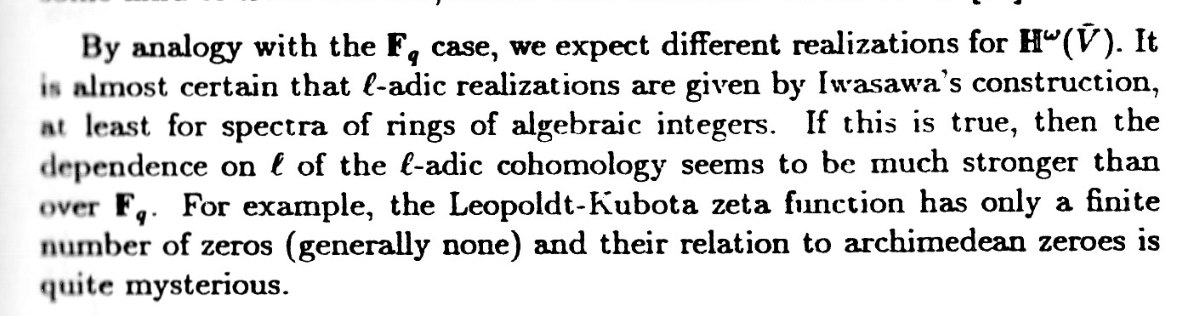
Much of the progress that has been made on the last two of these has come from ideas in Iwasawa theory. The starting point of Iwasawa theory is that by adjoining roots of unity to a number field we get structures that mimick some of the structures in function fields, as explained here by Dinesh Thakur. In the early $\mathbb{F}_1$ manuscript Lectures on zeta functions and motives by Yuri Manin, you see the idea expressed that Iwasawa's construction should come from some kind of cohomology over the field with one element.
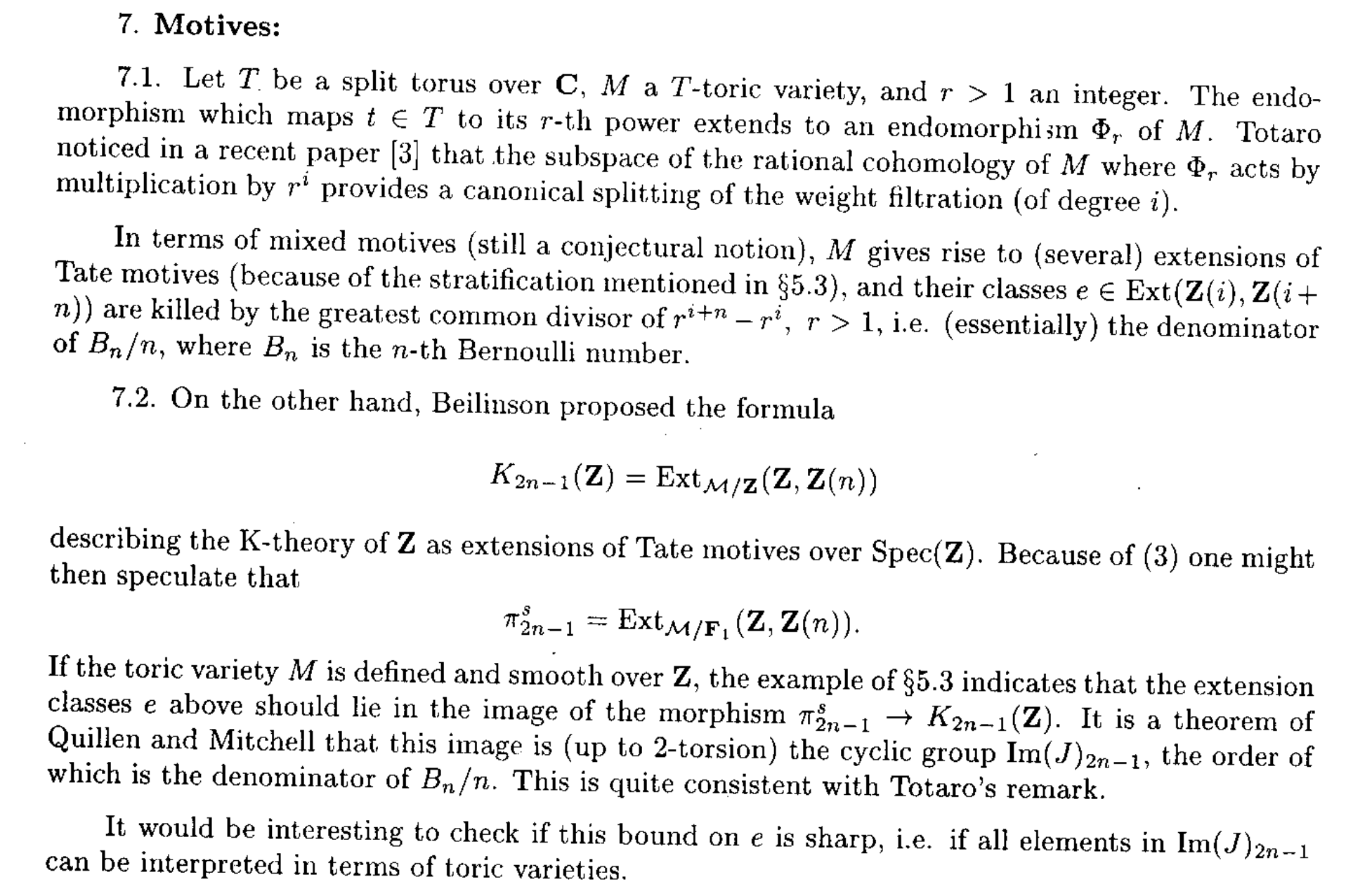
Another early reference is the note by Christophe Soulé: On the field with one element. Here in the final section you get a glimpse of the idea that there may be some category of "motives over F1", with connections to stable homotopy groups of spheres and the Bernoulli numbers appearing in special values of the Riemann zeta function.
QFT
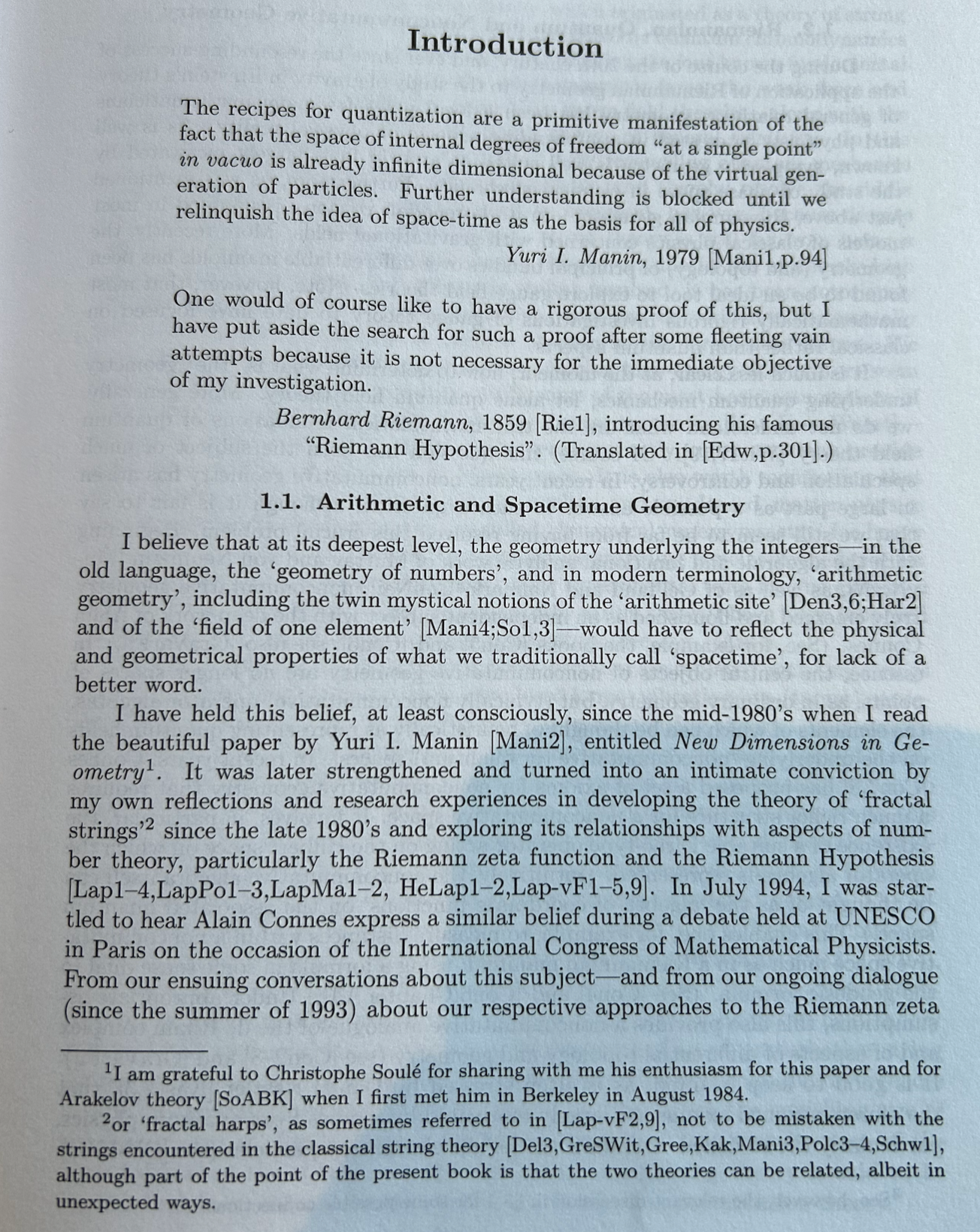
You may have watched RH Saga E10 on amplitudes from quantum field theory and Francis Brown's speculative notion of mixed L-functions. Here I want to show you something else, namely the entire first page of the book In Search of the Riemann Zeros by Michael Lapidus. He believes that there are deep connections between the field with one element and the geometry of spacetime.
ABC
Just like the Riemann Hypothesis, the abc conjecture describes a mysterious connection between addition and multiplication that we do not understand.
Alexander Smirnov has shown that if we had a notion of $\mathbb{F}_1$-geometry satisfying certain properties, a proof of abc would follow. Here is an article by Manoel Jarra where this approach is laid out. It relies on an analogy of the Riemann-Hurwitz formula, which is a well-known and basic theorem in the world of function fields.
Notes
This concludes the very brief initial tour of the five immortal problems that have been sources of inspiration for the Dream. Here is a selection of interesting books, one for each of these problems! Strictly speaking, the third is not a book, but some introductory lecture notes by Morten Risager with a tiny chapter at the end introducing the abc conjecture. I don't actually know if a book exists that is entirely devoted to abc.
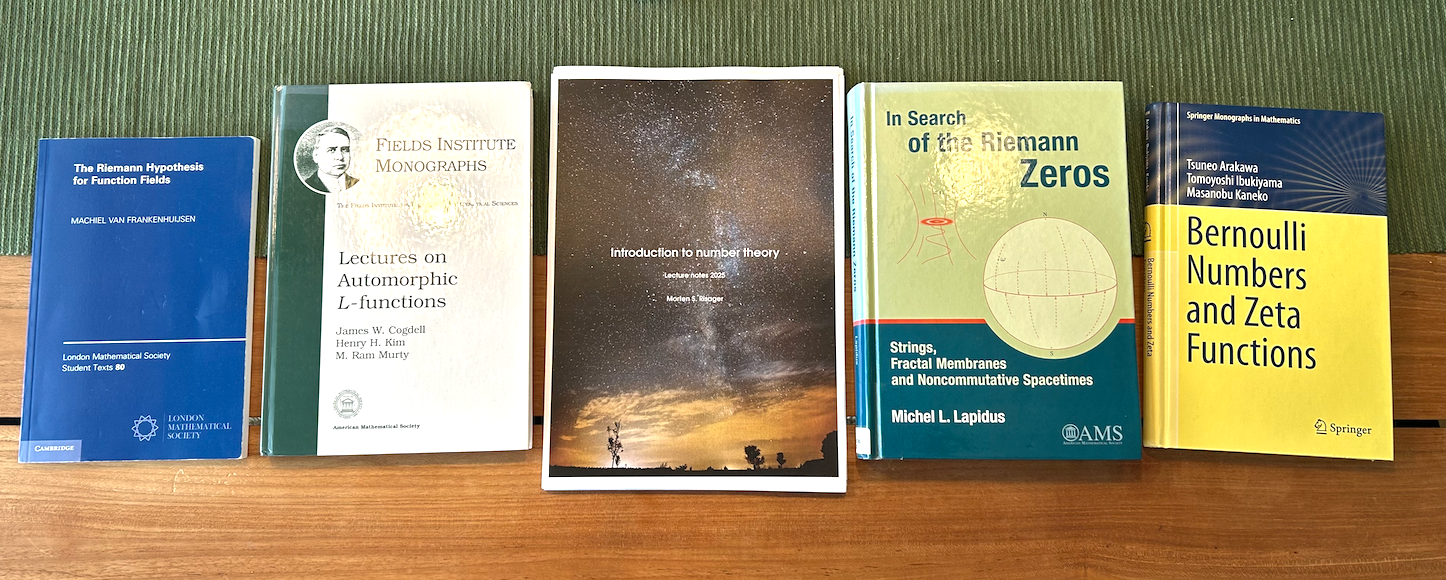
If the dream of $\mathbb{F}_1$ promised a resolution of only one of the five immortal problems, it would already seem too fantastical to be true. It may sound quite preposterous to suggest that there could be a a common theory which could lead to progress on all of them.
However, the five problems are more intimately connected than one would perhaps believe, and this may indicate that the idea of a common underlying theory is at least within the realm of possibility. For example, Granville and Stark proved that a version of abc implies a special case of GRH (namely that there are no Siegel zeroes for quadratic Dirichlet L-functions of negative discriminant). And the original version of the BSD conjecture (for the L-function of an elliptic curve) in fact implies the GRH for that L-function (see Theorem 1.1 in this paper of Keith Conrad).
Third frame: Mirror problems and mirror concepts
So far, we have the following embryo of a conceptual map of the $\mathbb{F}_1$ landscape:
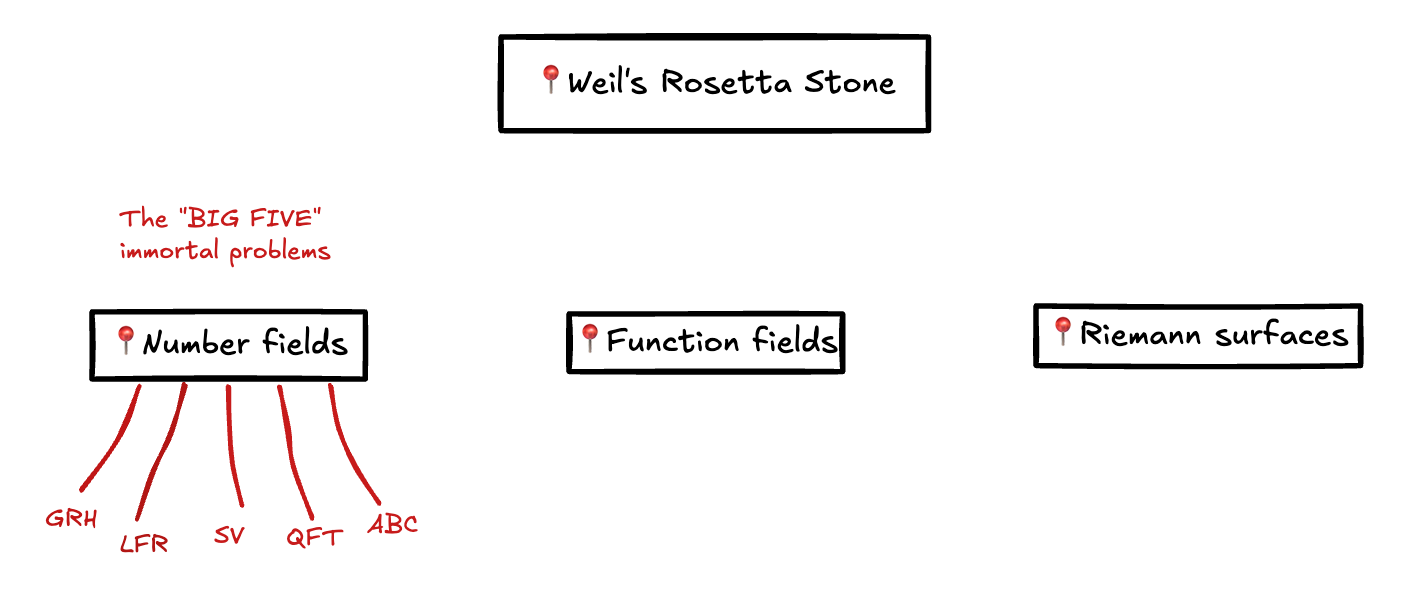
Now you can choose one of the Big Five problems. Let's choose GRH for illustration. Then you can choose one of the parallel realms (either Function fields or Riemann surfaces). I will choose Function fields.
What may happen in this situation is that the immortal problem may have a mirror problem in the other realm. Like this:
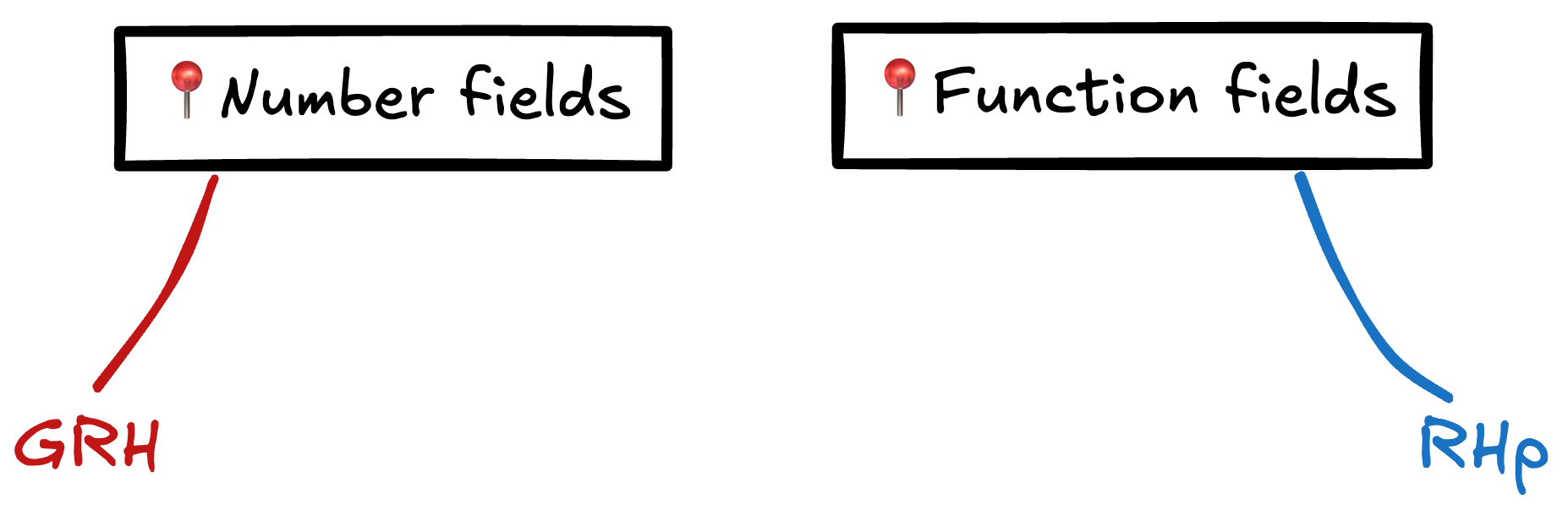
Here I have used the abbreviation RHp for the Riemann Hypothesis in characteristic p, which is a common name for the fourth Weil conjecture. A reference for RHp (in fact, the best reference I am aware of) is Peter Roquette's historical overview and introduction to the problem.
As our next step, we may take some concept from one side or the other, and ask if it has a mirror concept on the other side. For example, a tool used for one of the known proofs of RHp for curves is called the Jacobian (see pp. 124 of the Roquette pdf). Now we may ask: Could it be possible to construct the Jacobian for L-functions in the number field world, and use it to prove the Riemann hypothesis?
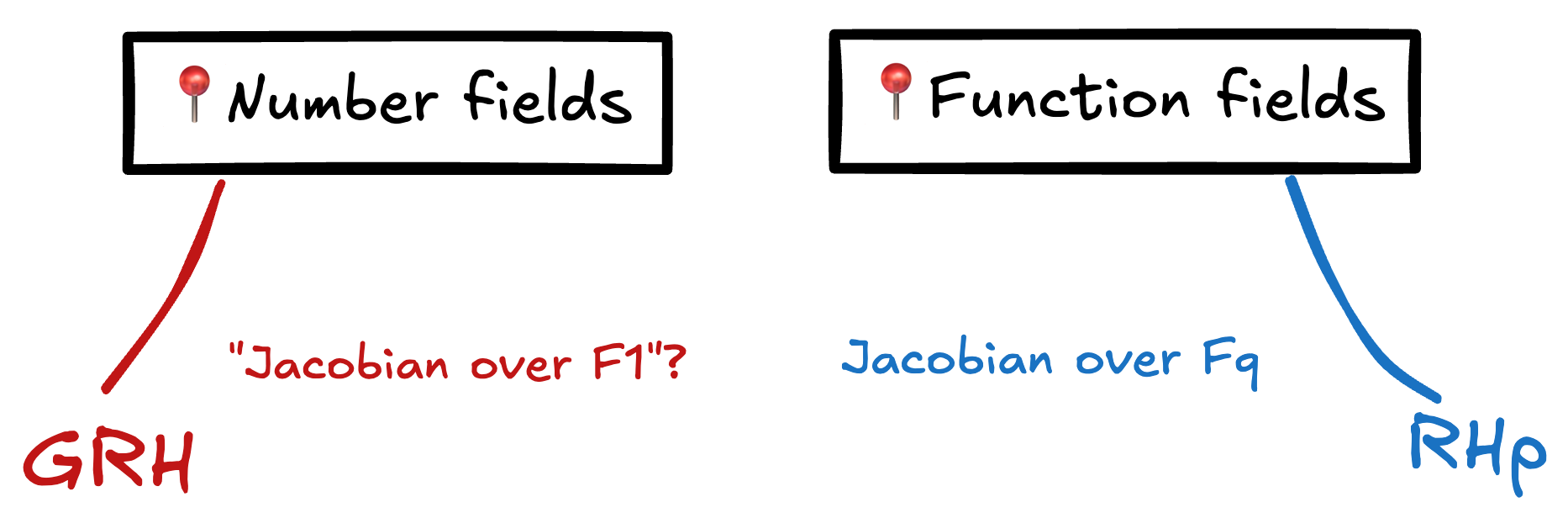
Machiel van Frankenhuijsen discusses different proofs of RHp in this nice article from 2008, and mentions specifically the Jacobian, for which "no analogue may ever be constructed for the integers".
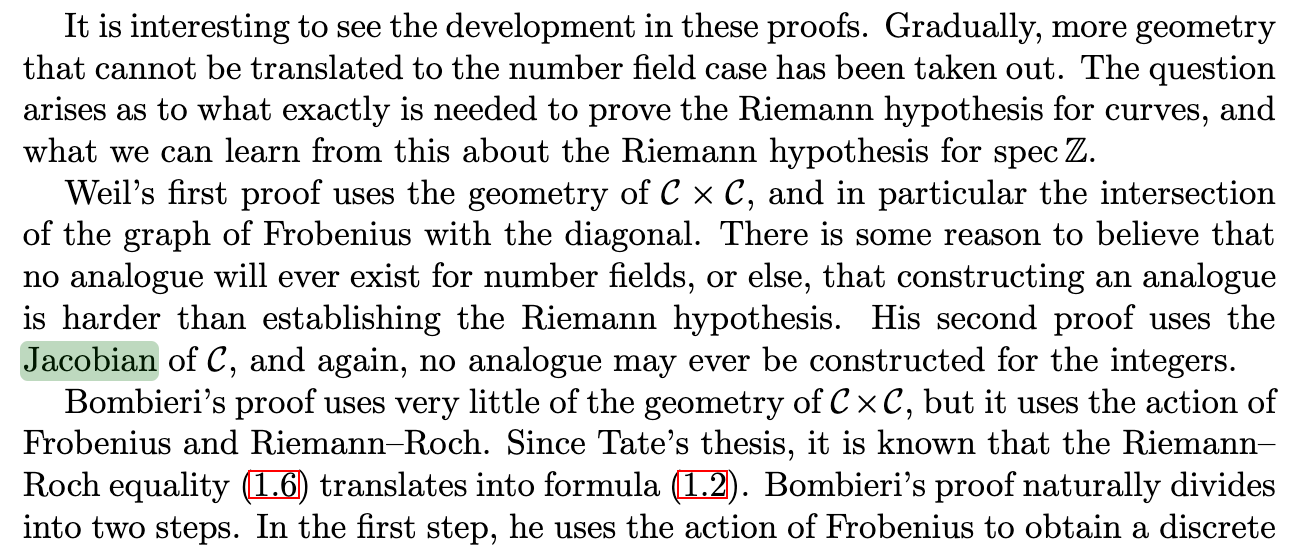
Only a few months ago did Connes and Consani release a new preprint in which they do construct an analogue of the Jacobian. This does not mean that they can prove the Riemann Hypothesis! But perhaps their construction will eventually turn out to be a small piece of the puzzle. In any case, this is a good example of how studying these "mirror concepts" across different realms of the Rosetta Stone is a driving force for cutting-edge research.
I really want to emphasize that we only looked an one single example of a mirror concept frame. For a Riemann surface, one possible analogue of L-functions is the so-called Selberg zeta function. Just to give one more example of a mirror problem, we could have looked at special values instead, and asked if there are analogues of special value conjectures for Selberg zeta functions. And indeed there are! Sarnak's paper from 1989 suggests connections to string theory (paywalled article). Takase in 1992 attemps to identify analogues for the period and the regulator appearing in the class number formula over number fields. A specific value (actually a value of the logarithmic derivative) is studied by Nicolas Templier, based on earlier work of people like Faltings and Jorgenson/Kramer.
Fourth frame: Surrounding problems
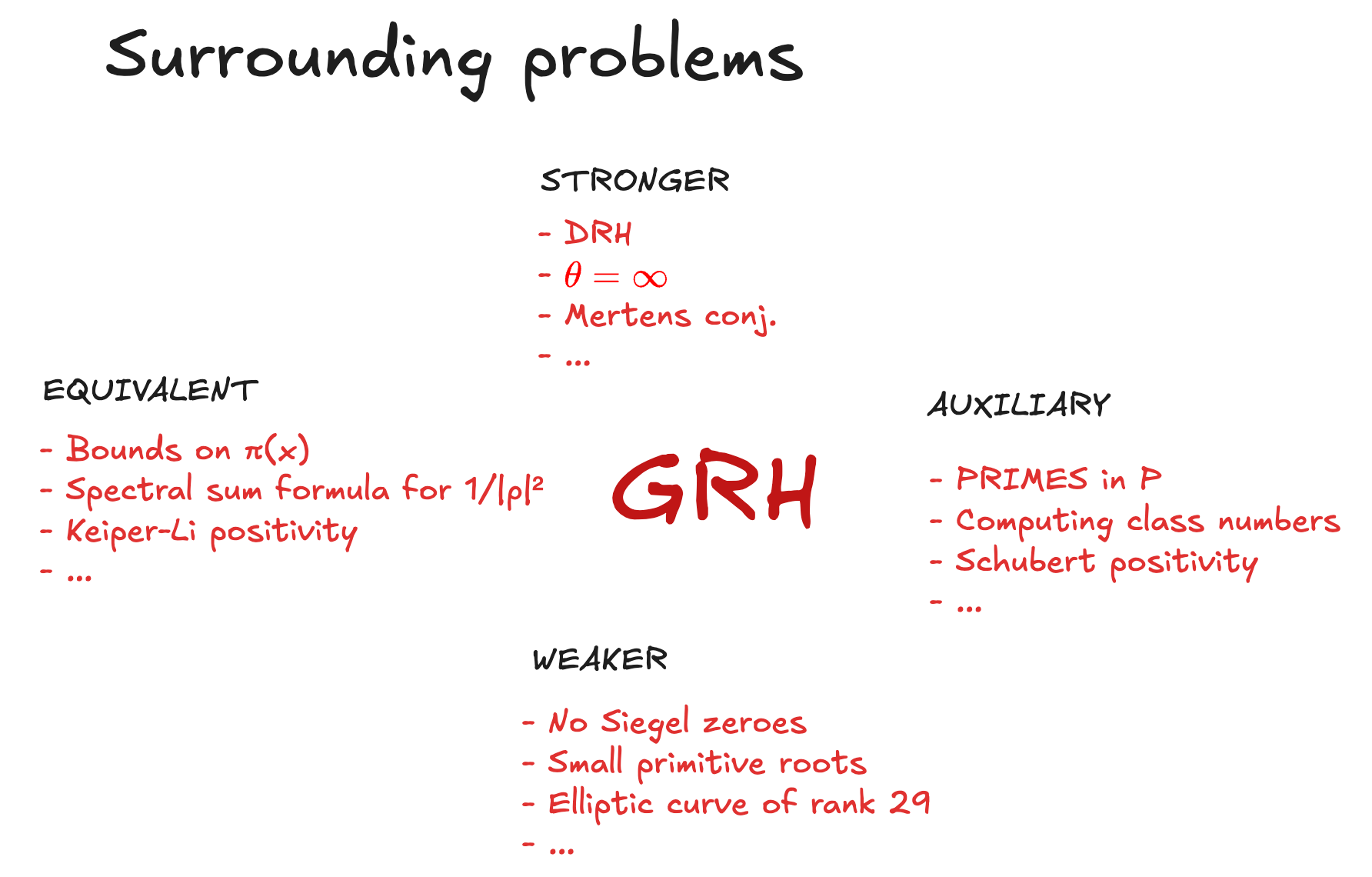
Finally, I want to illustrate how we can also zoom in on one specific problem, and place the problem within a conceptual landscape of related problems. Let's do this for GRH, only sketching the beginning of what such a frame would look like.
Here I have listed a few problems related to GRH. Some are stronger statements (and hence would imply GRH), some are special cases or in some other way weaker statements. Some are equivalent, and others are what I call auxiliary - they don't have a clear logical relationship to GRH, but there is a story to tell which connects them.
Stronger
For the stronger problems, I've chosen three. First out is DRH (the Deep Riemann Hypothesis) which I only learnt about last week, from Arshay Sheth. It is a statement that makes sense for L-functions that are entire. Such functions conjecturally includes all primitive L-functions except the Riemann zeta function. The DRH says that the Euler product expression for the L-function converges (conditionally, not absolutely) not just in the right halfplane of absolute convergence, but also inside the critical strip, all the way up to and including the critical line, so for $Re(s) \geq \frac{1}{2}$. The GRH (for an entire L-function) can in fact be rephrased as saying the Euler product converges to the right L-value for $Re(s)>\frac{1}{2}$.
Second on the list is David Farmer's $\theta = \infty$ conjecture, which has received some attention in recent years. See for example this recent paper by Conrey, Farmer, Kwan, Lin, and Turnage-Butterbaugh. It was only in 2017 that Sandro Bettin and Steven Gonek proved that this conjecture in fact implies RH.
Finally, the Mertens conjecture is a funny example, because while it was known to imply the Riemann Hypothesis, it was disproven by Odlyzko and te Riele in 1985.
Weaker
For the first of the weaker statements (or direct consequences), I have selected perhaps the most obvious one, namely that there are no Siegel zeros. A Siegel zero is a zero of a Dirichlet L-function that is on the real line and in a certain technical sense "close to 1" (and hence far off the critical line, which would contradict GRH). There is actually a pretty nice Numberphile video about this conjecture. For a more technical survey talk, see this lecture by Zaharescu.
One of my favourite consequences of the GRH is the fact that it implies the existence of small primitive roots, in a precise sense. For a prime number $p$, a primitive root mod $p$ is a number that generate the units mod $p$. Such a primitive root always exists. For example, for $p=7$, the sequence $1, 2, 4, 8, 16, 32 \ldots$ reduced mod $p$ becomes $1, 2, 4, 1, 2, 4, \ldots$, and since the units are the set $\{1, 2, 3, 4, 5, 6\}$, the number $2$ is not a primitive root. However, you can check for yourself that $3$ is a primitive root. When $p$ is very large, it is not at all obvious how far you need to search before you find a primitive root! The GRH implies that the size of the smallest primitive root can be bounded by a certain constant times $\log(p)^6$. This very small bound is far stronger than anything you can prove unconditionally.
Third on the bottom list is the recently discovered elliptic curve of record rank at least $29$. One can prove that the curve has rank exactly $29$ if one assumes the GRH.
Equivalent
For examples of equivalent problems, the first one expresses the core meaning of what RH for the Riemann zeta function tells you about the primes. It says that the prime counting function $\pi(x)$ is close to the logarithmic integral function $li(x)$, in the precise sense that the inequality
\[ \vert \pi(x) - li(x) \vert < \frac{\sqrt{x} \log(x)}{8 \pi} \]
is true for all $x > 2657$. Here the number $\pi$ on the right hand side is of course different from the function $\pi$ on the left hand side.
Another equivalent for the Riemann zeta function is the exact formula
\[ \sum_{\rho} \frac{1}{\vert \rho \vert^2} = 2 + \gamma - \log(4 \pi) \]
where the sum is taken over all nontrivial zeroes of $\zeta(s)$, and $\gamma$ is the Euler-Mascheroni constant. It is quite an interesting problem to try to work out what the corresponding formula is for other L-functions.
The third equivalent may be familiar to you from Episode 6 of the RH Saga; it says that all the Keiper-Li coefficients are positive.
Auxiliary
Determining whether a number $n$ is prime is a computational problem proven in 2002 by Agrawal, Kayal and Saxena to lie in complexity class P, i.e. it is polynomial in the number of digits of $n$. But before their landmark result, this was already known, conditional on GRH.
Computing class groups and class numbers is a central problem in number theory. Often we think of this problem as being connected with special values, since class numbers appear in special values of Dedekind zeta functions. But there are also several very interesting connections to GRH. See Keith Conrad's legendary MathOverflow list for some key examples. An additional connection is that in the context of function fields, class numbers in so-called constant field extensions can be explicitly computed in terms of zeroes of the zeta function, and this may hint towards structures in $\mathbb{F}_1$-geometry yet to be discovered.
Finally, an important problem in combinatorics is to prove that certain numbers called Schubert coefficients are positive. This is not known to be a consequence of GRH in itself, but Igor Pak showed in 2025 that it is a consequence of GRH together with another assumption called MVA, which can be viewed as a strengthening of the Millennium problem $P \neq NP$. So Schubert positivity is now reduced to an easy exercise for you - you just have to solve GRH and another problem a bit harder than P vs NP.
The voyage ahead
We have begun our exploration of the Rosetta Stone! We have identified five gargantuan problems in the world of number fields, each one playing a key role in the research literature as motivation for the pursuit of $\mathbb{F}_1$. We have seen how to shed light on a given problem by either comparing it to mirror problems in another realm, or by placing it within a web of surrounding problems.
These four kinds of frames are just the beginning. I the next chapter, I want to discuss the "landscape of L-functions", and how to organise the multitude of examples and types of L-functions, from the Riemann zeta function to more esoteric objects like hypergeometric L-functions.
The way I envision moving forward is that I will keep writing these Chapters of the RH Saga trying to give an overview of the entire landscape. In parallel, I will write shorter posts diving into specific concepts, conjectures, etc, to make the details come alive.
If you have questions, remarks, code, recommended references/videos, or points of disagreement or confusion, I would love to hear all of that. Add a comment below, or message me via the contact form so that I can include your comments in upcoming postings. Perhaps we could do dedicated posts for Q&A. The entire purpose of doing all of this is that we should all learn as much as possible, and help each other by sharing insights along the way.