
The Time of the Orc has Come

There are no Siegel zeros.
There are no zeros of the Riemann zeta function with real part bigger than $\frac{7}{8}$.
There are infinitely many primes for which $2$ is a primitive root.
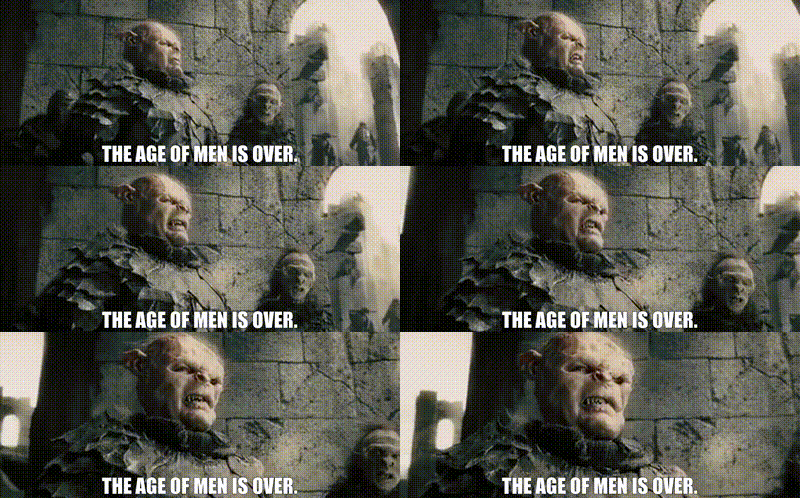
These three statements are special cases of the somewhat more general results found by OpenAI and released last week as part of their massive proof dump. The first two have been certified in Lean and the third has not. The human Jim Fowler asked Claude to make a browsable library of the OpenAI dump, and this seems like a good place to start exploring what's in these papers, should you wish to do so.
What this means
Everyone has been commenting on this everywhere, in particular over at Proofs and Prompts, and no-one really knows what it means. Personally, I will need time to reflect deeply on what I believe it means for math as a whole and for me personally. A podcast appeared today with Scott Aaronson, as a representative example of the bewilderment that has now beset the entire mathematical community.
The Mathocalypse
The math
The math in and of itself is, in my view, incredibly fascinating. If a young human had published a proof of just one of the above three statements, I think it's fair to say that they would instantly have been contenders for the next Fields medal. The Siegel zero paper is only nine pages long, weird and strange but in principle quite elementary, relying on ideas like bounding a certain explicit quantity both by archimedean means (i.e. classical inequality arguments for real numbers) and by non-archimedean means (i.e. number-theoretic divisibility arguments), like in an intermediate-level math olympiad problem on diophantine equations. A good human-readable exposition of the entire argument would be highly valued by many, so perhaps a challenge for the essay competition!
It will take time for mathematicians to digest all these proofs, and I hope to come back to the nature of the quasi-Riemann Hypothesis in particular. If you want some popular introductions to the statement of QRH itself, then check out the timely videos from Alvaro Lozano-Robledo and Zeta Explained, or check out Persiflage for some initial reactions of an expert.
The future
If you are young and you love math, I would encourage you not to despair, but to engage with what's likely to be an entirely new era of mathematical and scientific research. History will be written, and the choices we make will matter deeply for all future generations. Restricting attention somewhat narrowly to mathematics, I'd recommend reading two of the very few people who saw what was coming years before everyone else, so check out the brief vision sketch of Christian Szegedy on new ways to explore the mathematical landscape, and the proposal by Jared Duker Lichtman on MAP, something akin to the Human Genome project. If you don't see a future in academia, think about startup opportunities, or about reclaiming the contemplative life, or about doing something in education, for human flourishing.
I will be back soon with the next chapter of the RH Saga.