The Proofs and the future of the RH Saga

In this post, I want to share some thoughts on the very recent proofs of GRH, and what they mean for the future of the RH Saga and the search for $\mathbb{F}_1$. As many people have pointed out (including Alpöge himself), the huge Lean proof of RH (which is much shorter than 250 000 pages, that part of the announcement was a joke) is a sprawling and incredibly clever combination of many ideas, but it doesn't really seem to build any deep new geometric structures, so there is still a question of whether such structures could be found, maybe simplifying and conceptualizing the proof, as well as generalizing to L-functions beyond degree 1.
Where the RH Saga was going
Here is a very brief outline of what was planned for the RH Saga. The aim was to survey all of the different existing theories, attempts and clues from the literature that was pointing towards possible routes to the field with one element, and then to present some minor original ideas tying everything together at the end.
E6: Invariants. Additive invariants and explicit formulas, with connections to many central themes of analytic number theory. Lambda-additive invariants, with connections to ramification and the Langlands program.
E7: The BSD conjecture. Understanding algebraic rank and analytic rank, and analogous invariants in more general settings.
E8: Tools related to BSD. Iwasawa theory, p-adic L-functions and Euler systems. Gross-Zagier. Finiteness of Sha, with connections also to Szpiro and hence to the abc conjecture.
E9: Special values of L-functions. Many different examples of results and conjectures, like the the general conjectures of Zagier, Beilinson and Bloch-Kato, and more concrete examples for Dirichlet L-functions. Periods and regulators.
E10: Connections to physics. More details on the work and research program of Francis Brown and his students, in particular on theta functions and mixed L-functions. Other examples of "arithmetic physics".
E11: The Weil Conjectures. Explain the Weil Conjectures through many concrete examples, like curves and generalized Gauss sums.
E12: The Rosetta Stone. More details on each of the Rosetta Stone columns. Different philosophical perspectives on what the analogies "really mean".
S2E1: Proofs of the Weil Conjectures. The overarching theme of Season 2 would be to dive deeper into known proofs of the Weil Conjectures and all of the attempts made so far to transfer elements of these proofs to the number field world. Among these proofs are of course the Stepanov method (described many years ago at Terence Tao's blog), which has now been successfully transferred by Alpöge.
S2E2: Overview of attempts at the field with one element. Classical theories of arithmetic geometry, like schemes, Iwasawa theory, Arakelov theory, p-adic Hodge theory. The programs of Deninger and Connes. Proposals of Borger, Haran, Lorscheid etc. More on the abc conjecture and the proposal of Smirnov.
S2E3: Euler products. The role of the Euler product over function fields and number fields. F1-geometric interpretations of the behaviour of bad Euler factors.
S2E4: Rationality. Possible analogies of the first Weil Conjecture in the world of number fields. Different F1-interpretations of genus and characteristic of the base field.
S2E5: The functional equation. Possible meanings of the functional equation. F1-geometric interpretations of theta functions, and connections to the Langlands program and/or some form of Poincaré duality.
S2E6: Cohomology. Different types of cohomology theories known in arithmetic geometry ("absolute" and "geometric" theories, the role of different cohomologies for ingredients of special values). Conjectural cohomologies (Deninger, Hesselholt). Finiteness theorems and conjectures.
S2E7: Riemann-Roch. The role of Riemann-Roch in the function field world. Different versions and levels of abstractions. Different kinds of "duality" (Serre, Grothendieck, Verdier). Proofs and possible F1-analogies.
S2E8: Spectral interpretations. Return to proposed ideas on spectral interpretations, what to hope for, and possible workarounds.
S2E9: Positivity. Known approaches to positivity over function fields as well as number fields. Ideas for possible future F1 mechanisms.
S2E10: Discrete theta functions. Tying together much of the RH Saga through the idea of using "discrete theta functions" as a unifying language for almost all problems related to L-functions. Illustrating examples like CM values of the j-function, the Chowla-Selberg formula, and explicit zeros of modular forms. Numerical experiments and open problems.
On the strategy of Masullo
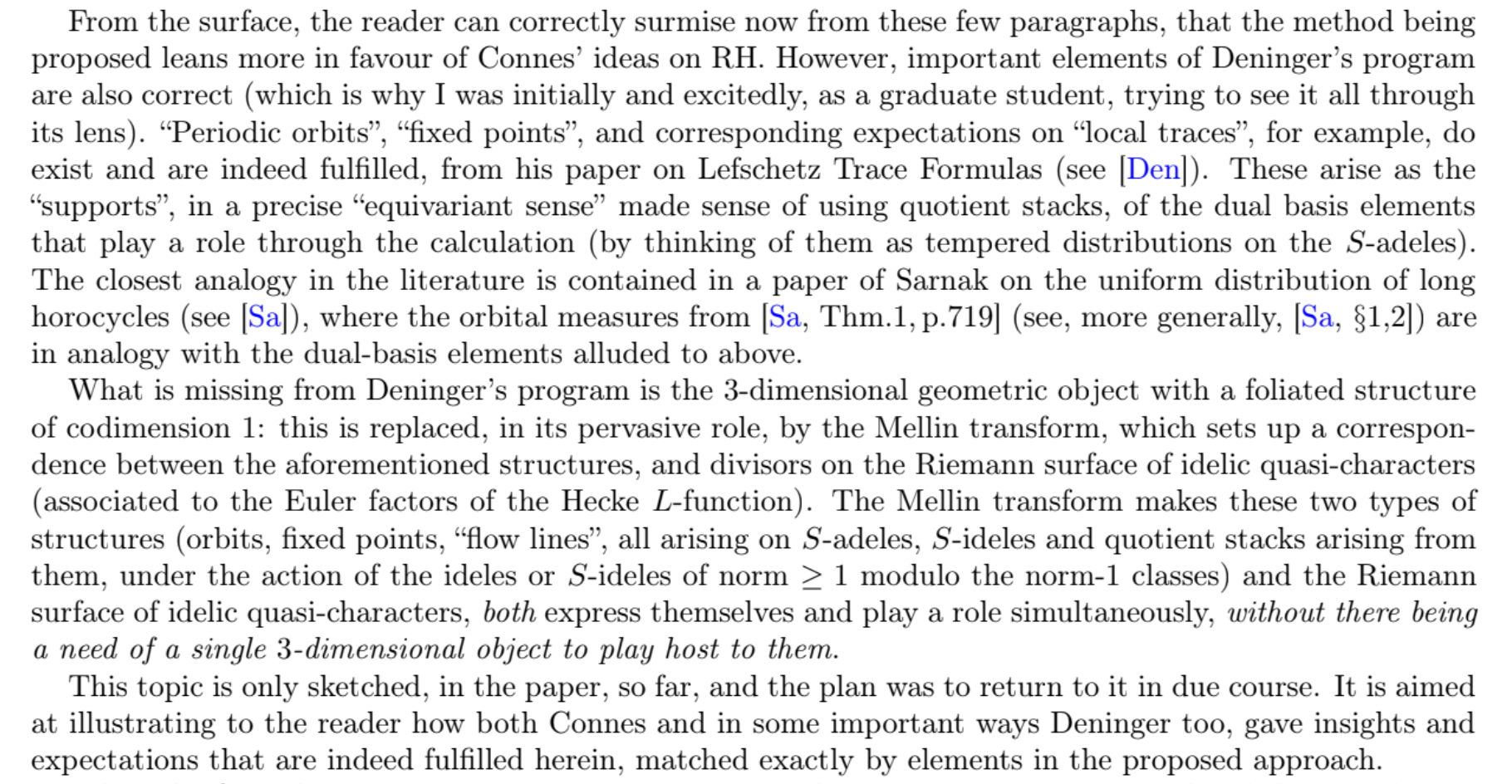
As explained in his recent statement, Masullo says that some elements of Deninger's vision were important, but in the end his proof was closer to the general strategy of Connes. When I was young (still in school, and before the time where you could find much mathematics on the internet), my first real-life mathematical hero was our IMO deputy leader Andreas Strömbergsson, who was near the end of his PhD. In my mind at the time, I thought Strömbergsson might prove the Riemann Hypothesis some day, and I find it remarkable now that Masullo describes the "uniform distribution of long horocycles" as the closest analogy in the literature to his dual-basis elements, since this was precisely one of the main topics treated in Strömbergsson's thesis!
Here is the relevant quote of Masullo.
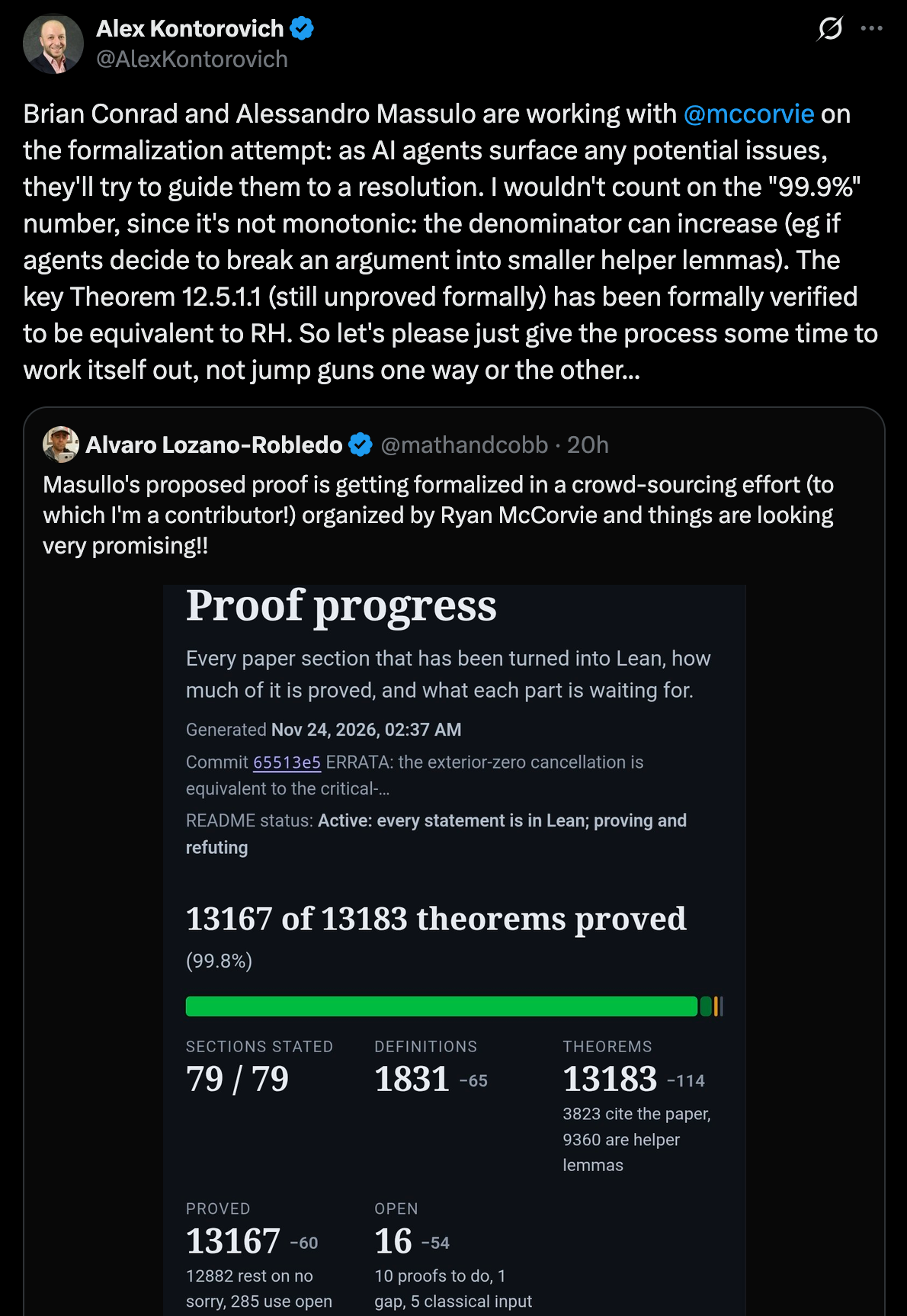
The latest news right now is that the proof of Masullo is being formalized in a project led by Ryan McCorvie, and we will have to wait for this process to run its course!
On the proof of Alpöge
Here is a proof overview created by Robin Zhang. As you can see, there is some overlap with many topics planned for the RH Saga, and one option would be to steer future chapters more towards those topics that play a role in the proof.
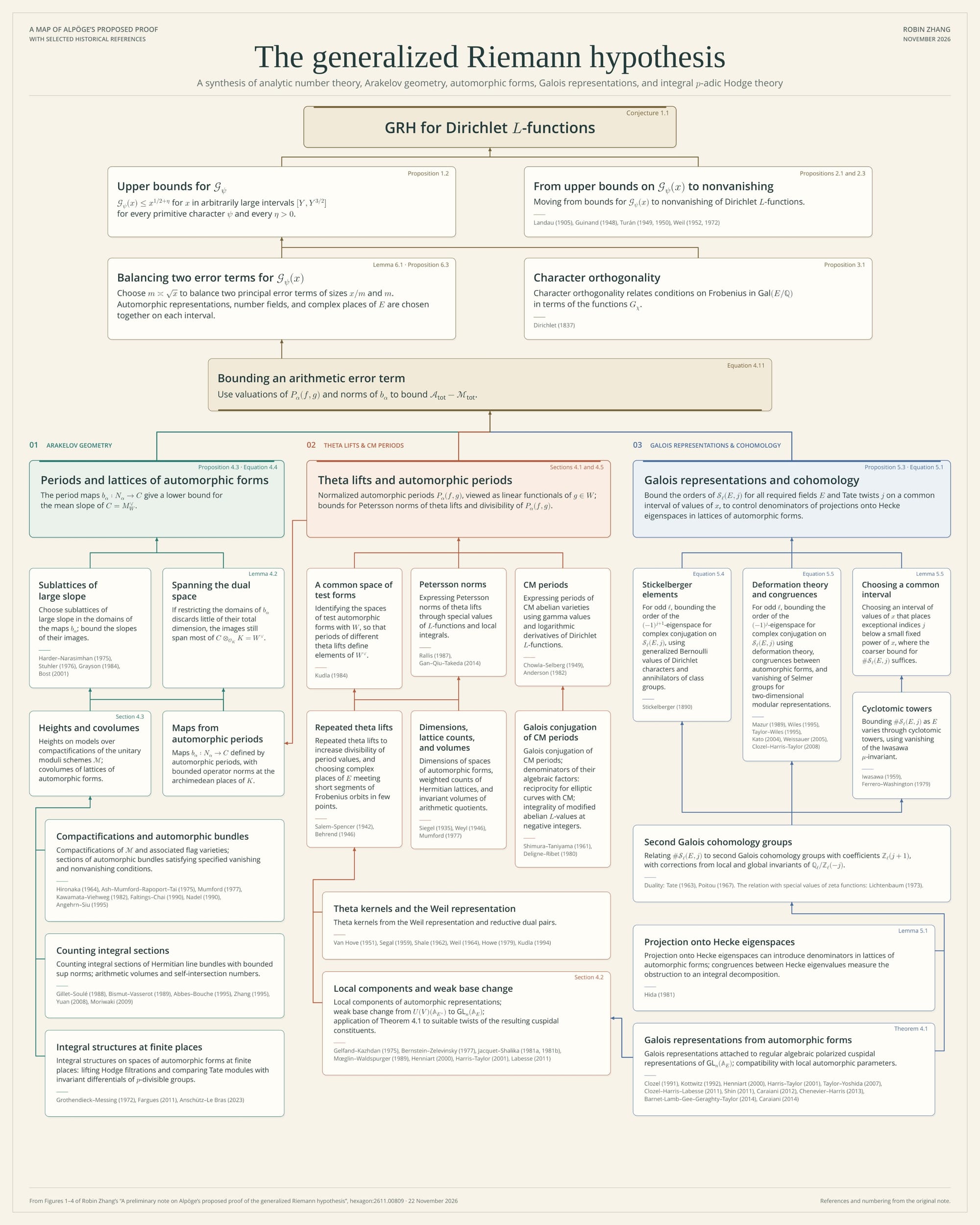
It is remarkable that so many different areas of arithmetic geometry were needed, that all of them happened to be developed already, and that they all fit together to form a proof of GRH for all degree 1 L-functions.
There is now a Zulip channel for a collaborative effort in digesting and writing up the Proof for human understanding. The channel collects various links to preliminary and mostly AI-generated writeups, like Paul Nelson's "GRH workbook", which walks through the simplest cases of each key idea of the proof, in the form of exercises.
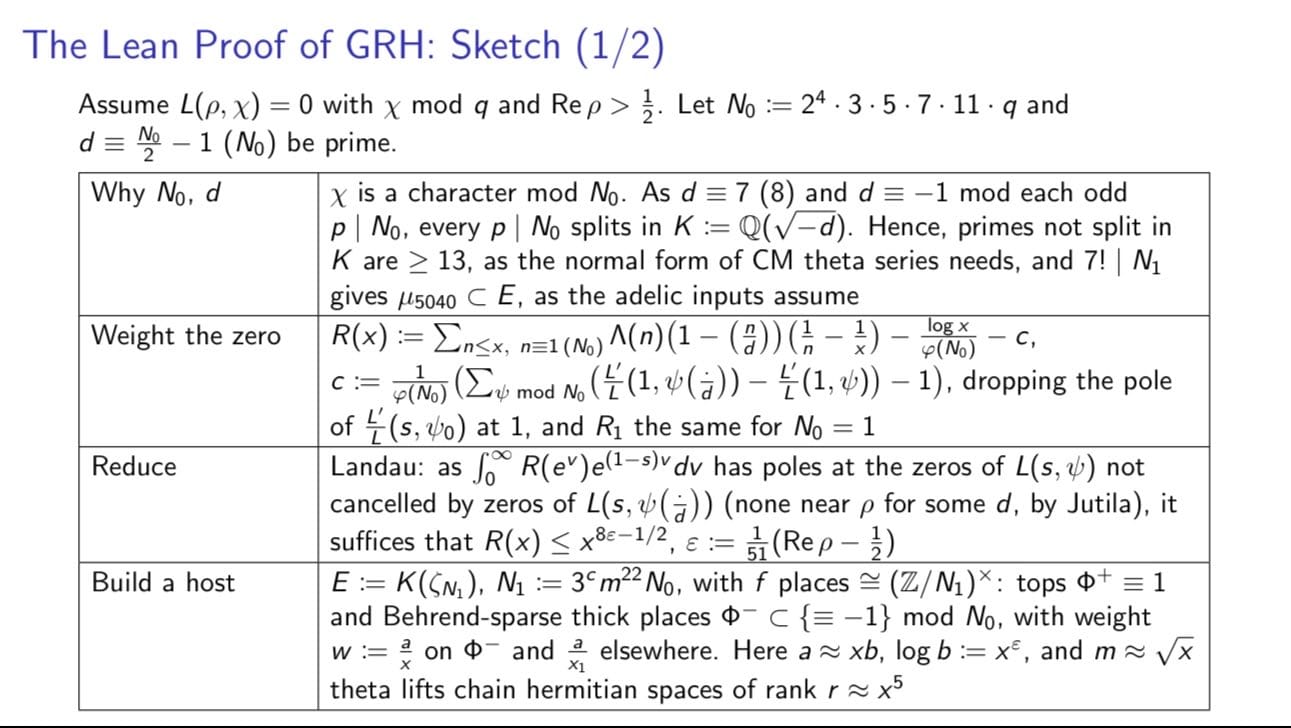
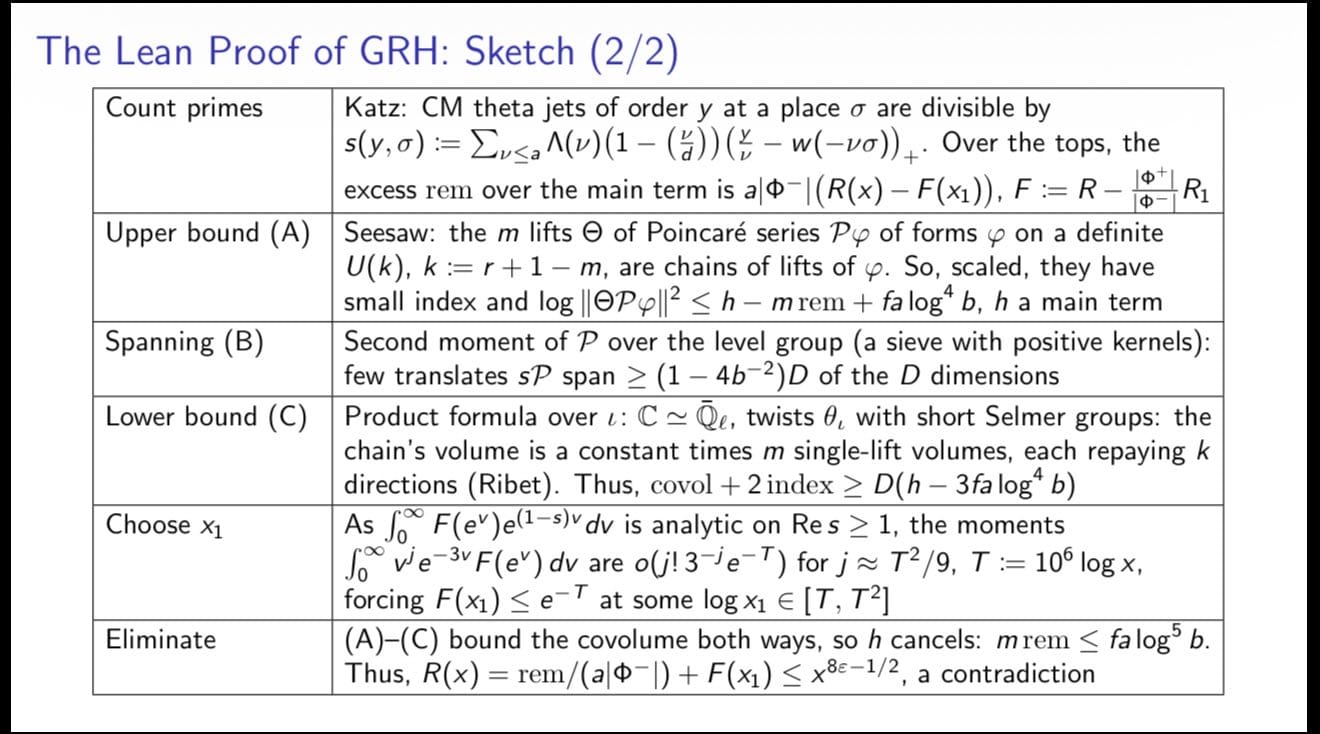
The very latest news on X is that the Lean proof has been condensed down from 17M lines of code to 76k, and comparing this with other formalizations of major theorems, Jared Duker Lichtman speculates that a future human-readable paper might end up very roughly around 50 pages long. Which would be very good news! Bartosz Naskręcki has produced a 1200-page handout already. One of the shortest proof summaries so far (of this compacted proof version) was posted by Kevin Barreto on X, in just two slides, with the comment "There’s some crazy machinery that goes into proving (A)–(C), but otherwise, I think I will understand this version much more than the previous one!".
Future of the RH Saga
The honest truth about continuing the RH Saga is that I am not really interested in beginning to post AI-generated writing, and at the same time I struggle to see what value I can add as a human author in competition with stuff that's AI-generated under the guidance of people who know far more than me, like Nelson or Zhang, or stuff that you can AI-generate yourself now, tailored to your interests and your existing knowledge. And similarly about making YouTube videos - there are hundreds of AI-generated videos already now about the big proof. Even if I could tell this story in a more human and possibly much better way, it will drown in the deluge of AI content.
A primary motivation for this entire project was to share the extraordinarily beautiful mathematical landscape surrounding the Riemann Hypothesis. Even though I'm no longer in academia, I felt I had something to offer in making these ideas more accessible to future generations of mathematicians, thereby perhaps contributing in some small way to the general education of someone who would one day go on to solve the great mysteries.
At this moment, it is not clear to me what the best path forward will be, and writing up this post is just a way for me to process, and to share this process with you. To be continued!
One of my favourite artists is Jakub Różalski. For today, I'm going to leave you with one of his pieces here...