RH Saga Chapter 5: Operations on L-functions (intro)

By a somber winter night in 1949, André Weil, reading dusty manuscripts of C.-F. Gauss, discovers the existence of a spectacular treasure lying somewhere in the deep jungles of arithmetic geometry. He manages to sketch a map to reach it but is unable to mount an expedition to embark on the perilous journey… Ten years later, the audacious explorator Alexander Grothendieck finds the secret passage that may lead to the spot marked with an ×, and advancing fearlessly with his small group of indefatigable geometers, attains the first points marked on Weil’s map. However the trove where lies the priceless jewel stands behind a towering mountain which seems to defy hope. The clever Belgian, Deligne, then goes out on his own by a circuitous route…
After decades of partial progress by many different mathematicians, Deligne completed the proof of the Weil Conjectures in full generality around 1973. His proof of the Riemann Hypothesis in this context relied on many deep ideas, combined in ingenious ways. One of the key ideas was to study the geometric objects underlying L-functions in families rather than as isolated objects (in particular, he used a special kind of family called a Lefschetz pencil). Another key idea was to analyze tensor powers (or symmetric powers) of the L-functions under consideration. The ultimate dream of $\mathbb{F}_1$ would be to transfer a proof of the Riemann Hypothesis from the function field realm to the number field realm. No-one knows how to do that, but it seems overwhelmingly plausible that any successful attempt would rely heavily on some form of deep understanding of L-function families and operations on L-functions.
The opening quote is taken from Emmanuel Kowalski's notes on Deligne's proof, which might be the most accessible source for an introduction to this legendary and very difficult piece of mathematics. This proof is in and of itself a more than good enough reason to care deeply about L-function operations. But there are many more! Peter Sarnak has often emphasized that for many number-theoretic applications, the Generalized Riemann Hypothesis can in fact be replaced by weaker statements obtained from studying families of L-functions (even though these families do not have the kind of deep geometric interpretation available in the function field world). See again his Millennium Problem report for some hints towards these ideas. We saw in the previous chapter that the notion of tensor product is needed in the axiomatic approach to zero-free regions for general L-functions. A more detailed and very nice exposition of this perspective can be found in the IPM notes of Amir Akbary. Throughout the L-function research literature you will encounter operations. Just to give one more example here, the most recent paper I read was a new arXiv preprint generalizing the Birch and Swinnerton-Dyer conjecture from elliptic curves (i.e. curves of genus 1) to curves of higher genus (which is really cool!). In this paper the exterior square of an L-function plays a central role.
Looking back to the RH Saga Episode 5 on YouTube, we gave a brief introduction there to the following operations, which I will now give a numbering:
(1) Families (not conventionally viewed as "operations", but let's not quibble about terminology here).
(2a) "Direct sum", i.e. multiplication of L-functions (making the set of L-functions into an abelian group).
(2b) "Tensor product", more or less the same thing as the Rankin-Selberg convolution (upgrading L-functions to a commutative ring).
(2c) "Power operations". These consist of several inter-related sequences of unary operations, notably the symmetric powers, the exterior powers, and the Adams operations (sometimes called "power sum" operations, or "moments", although the last term has too many other meanings). Any one of these sequences upgrades the commutative ring further into what's called a lambda-ring.
(3) The (Selberg) inner product.
In these written notes, I would also like to include one more class of operations, which do not have a name, so I will call them
(4) Perturbations.
By a perturbation, I mean any operation that just changes a finite number of Euler factors. Such operations also abound in the literature, and we shall review many examples. A perturbation of an L-function is still an L-function in a moral sense, though not in the literal sense of the axioms of Chapter 4 (for example, the functional equation catches an ugly extra factor).
RH Saga Episode 5
One perspective on L-functions is that they exist as independent objects (described by axioms and not necessarily originating from another object, like a Galois representation or modular form). As explained in the video, the set $\mathbb{L}$ of all L-functions is a lambda-ring, equipped with an inner product making $\mathbb{L}$ into something like a Hilbert space (but more like a "Hilbert lattice", with $\mathbb{Z}$-coefficients instead of real or complex coefficients). In this picture, a family (in the basic not-geometric sense currently known) is just a sequence in $\mathbb{L}$. Furthermore, a perturbation is like an infinitesimally small nudge of a "lattice point" in $\mathbb{L}$, so that every true L-function is surrounded by an infinitesimally small cloud of its (infinitely many!) perturbations.
Of course, the other perspective on L-functions is that they come from some deeper geometric or representation-theoretic objects. When assuming such a perspective, the operations can to a large extent be described also in terms of these underlying objects.
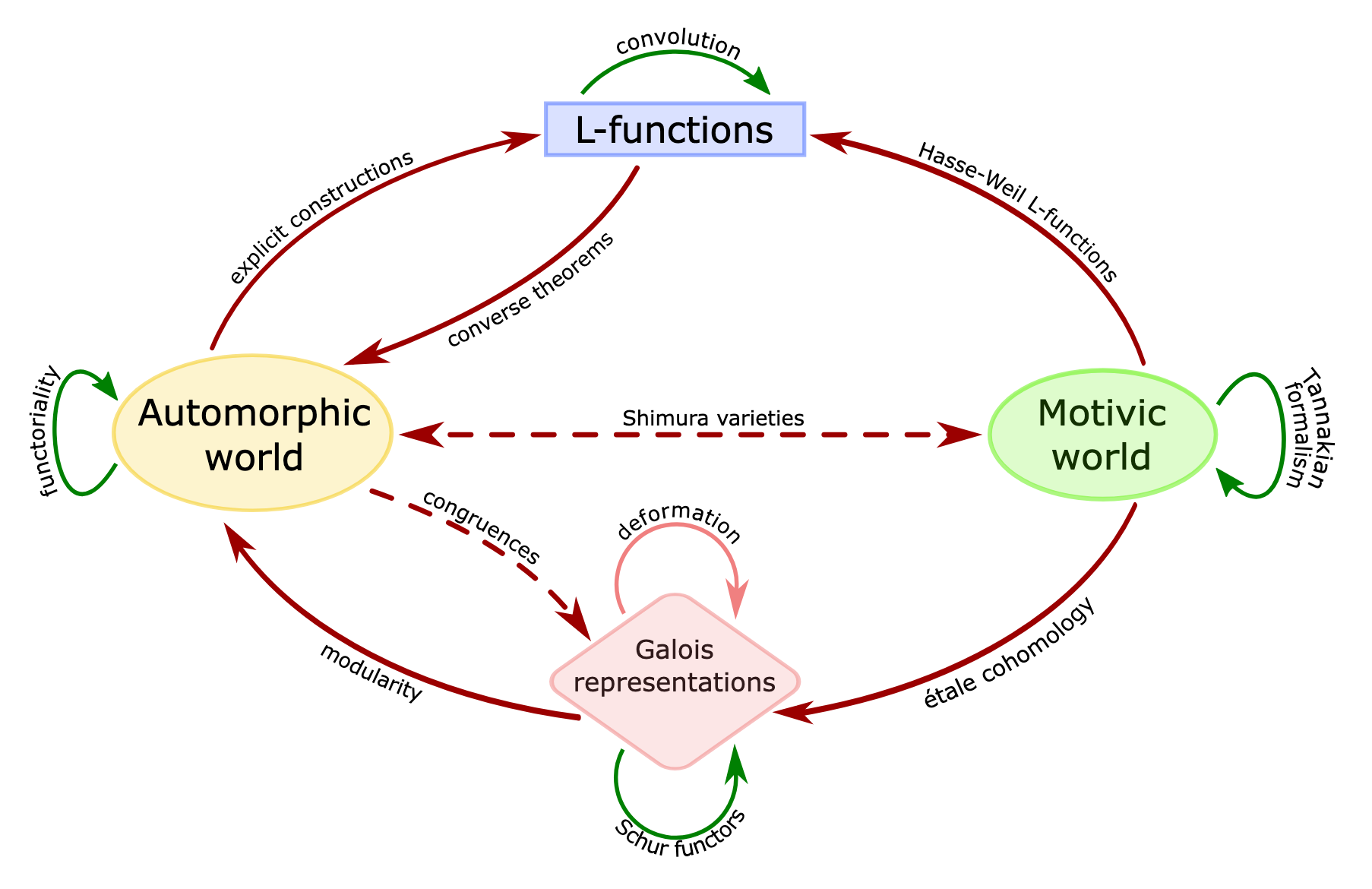
In the LMFDB universe diagram, you will see the operations from 2a, 2b and 2c referred to in different languages by the four outer green arrows. The intuition of Schur functors suggests that there should be an abelian category (possibly even a Tannakian category) such that every L-function comes from an object in this category. Experience from the function field realm suggests that a hypothetical geometric category of $\mathbb{F}_1$-objects might be the deepest level of the theory (analogous to schemes), and that some kind of functor (perhaps a "cohomology theory") should map these geometric objects to their "linearization" in the abelian category, analogous to motives or Galois representations). Furthermore, this linearization could also appear in two versions, a more ambitious "integral" version (which remembers invariants like the class number), and the less ambitious "rational" version (which only remembers invariants like the analytic rank). Another piece of language used in this context is that the lambda-ring $\mathbb{L}$ of L-functions should be the Grothendieck ring of the underlying category of objects, or, reversely, that the category should be the categorification of the lambda-ring of L-functions.
The aim of this chapter is to explain in details what these different operations are, to give you some Sage code allowing you to access a piece of the research frontier, and to add some further comments on how the operations might relate to $\mathbb{F}_1$. Along the way, I will point you to a panoply of ideas and references which are highly interesting in their own right (independently of any $\mathbb{F}_1$ speculation) and of immediate relevance to much current research.
This chapter will be split into several posts, following the numbering above, as it will otherwise become long and very unwieldy! But let me add a few comments before closing this introduction.
- One should ask whether there are important operations missing in the above list. Perhaps there are. There are some operations of a $p$-adic nature, like the deformations of Galois representations mentioned above in the LMFDB diagram. But these (as far as I understand) live in the world of underlying objects, not directly in the world of L-functions, so will not be covered in this specific chapter. Yet another operation is the idea of the dual L-function, but there is not much to say here, since on the level of L-functions I think taking the dual corresponds to simply complex-conjugating the coefficients. Yet another type of operation that perhaps should be included is the idea of a deep tensor product (which much of the existing $\mathbb{F}_1$-literature has sought to define). But it seems to me that taking the deep tensor product of two L-functions (if that makes sense) would take us outside of $\mathbb{L}$ and into some realm for which we currently have no language or conceptual understanding.
- One of the great conundrums for any serious attempt at $\mathbb{F}_1$ is that many L-functions are not algebraic (aka motivic), but transcendental. What this means for $\mathbb{F}_1$-geometry is, I think, completely unclear to absolutely everyone. So it is worth thinking about!
- If I were to formulate the dream of $\mathbb{F}_1$-geometry here (in a brief and tentative form, to be refined in future chapters), it would be something along these lines: There is a sequence of categories \[ \mathcal{C} \to \mathcal{A} \to \mathcal{T} \] consisting of a "geometric" category (perhaps like a category of "$\mathbb{F}_1$-curves"), an abelian category, and its rationalized version (possibly a Tannakian category, in any case behaving like the category of motives but enlarged to contain some kind of transcendental objects). I would call this last category "transcendental motives" but unfortunately this term already has another meaning. To any object in $\mathcal{T}$ (and hence any object in $\mathcal{C}$) we can associate an L-function, and all L-functions arise in this way. The theory of $\mathcal{C}$ should allow for some key new insights on the three deep themes connected to RH: Positivity, complexity, and ramification, as well as natural interpretations of fundamental invariants like the degree, the weight, and (most importantly) the conductor. The theory of $\mathcal{A}$ should offer some key new insights on "torsion invariants" like the class number (of a number field) and the order of Sha (for an elliptic curve). The theory of $\mathcal{T}$ should offer some key new insights on "rational invariants", for example it should allow us to compute the analytic rank of an elliptic curve, which we currently cannot do!
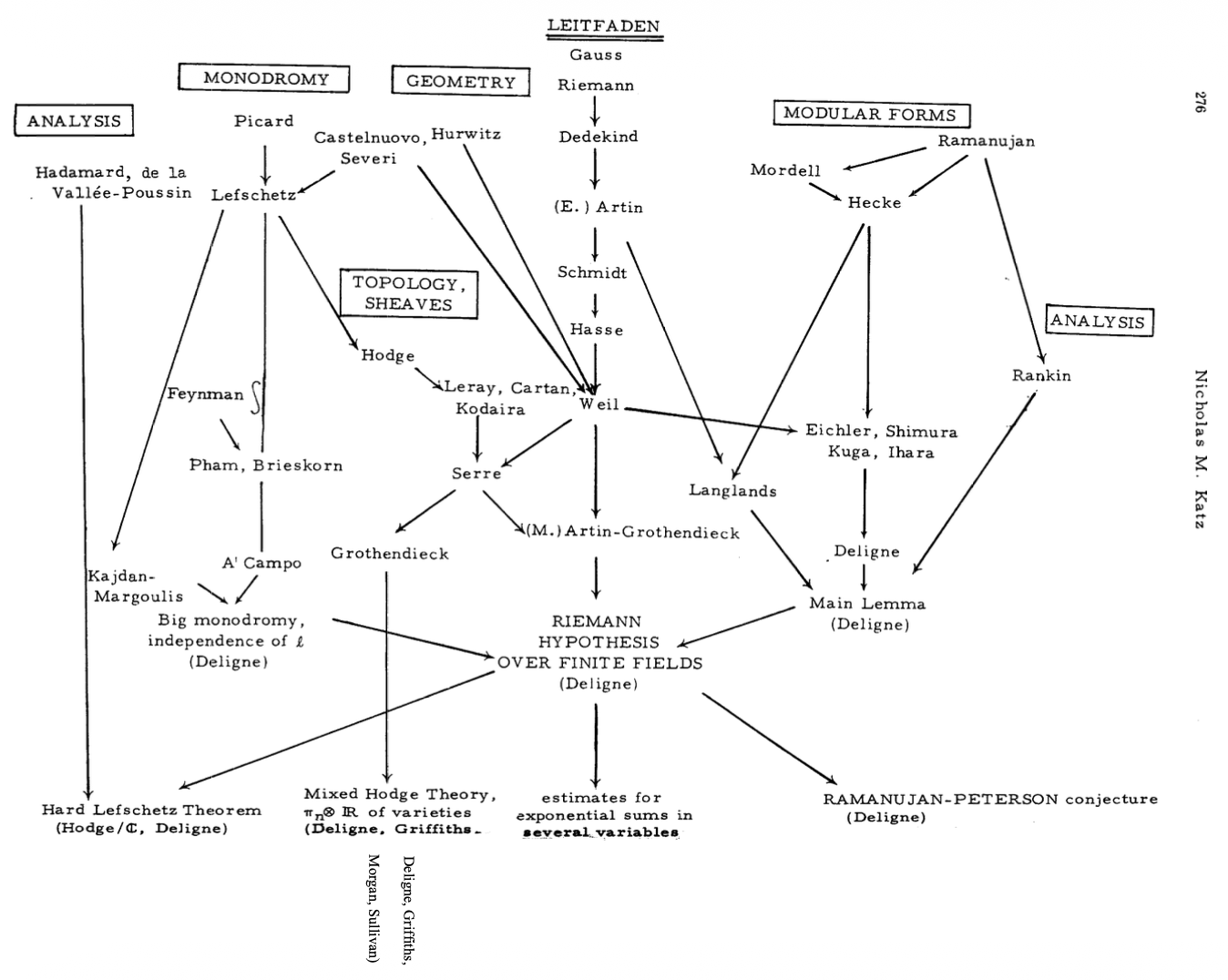
More on all of this in upcoming posts. If you in the meantime want to read more about Deligne's proof, you can check out those notes of Kowalski, or the old survey of Katz available on his webpage (from which the diagram below is taken).