RH Saga Chapter 5.3: Selberg inner product

Continuing our review of operations on L-functions, this shorter post will cover the key ideas around the Selberg inner product.
You may recall from the end of Episode 5 that given two L-functions
\[ L_1(s) = \sum \frac{a_n}{n ^s} \quad \textrm{and} \quad L_2(s) = \sum \frac{b_n}{n ^s} \]
we can define a number $L_1 \bullet L_2$ referred to as their Selberg inner product:
\[ \lim_{X \to \infty} \frac{ \sum \frac{a_p b_p}{p} }{ \log \log X } \]
where the sum is taken over all primes $p \leq X$. In cases where the L-function coefficients are general complex numbers (not necessarily real), the right definition should actually be
\[ \lim_{X \to \infty} \frac{ \sum \frac{a_p \overline{b}_p}{p} }{ \log \log X } \]
with a complex conjugation similar to what you would see for a Hermitian inner product on a complex vector space.
That this inner product is well-defined would follow from the very important Conjecture A and Conjecture B of Selberg:
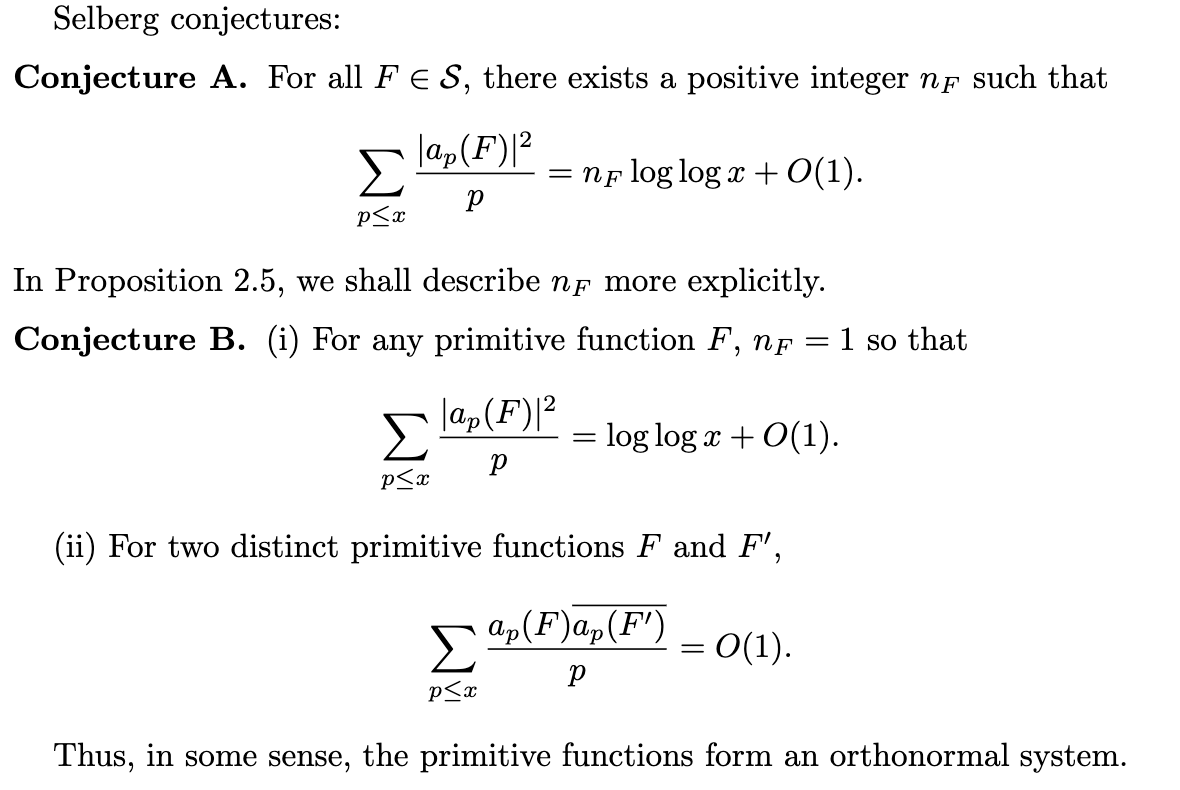
These conjectures were originally formulated for L-functions in the Selberg class, and one of the key motivations is that Conjecture B implies the famous Artin holomorphy conjecture, itself one of a key motivations for the entire Langlands program. This story is exceptionally well covered in the paper Selberg's Conjectures and Artin L-functions, by Murty, but see also the MathOverflow discussion on motivation for Artin's conjecture.
So what is the status of these conjectures? For automorphic L-functions, strong partial results have been known for a long time, and there is a recent preprint of Yujiao Jiang (from July 2025) with a proof of the general case (see Theorem 8.6)!
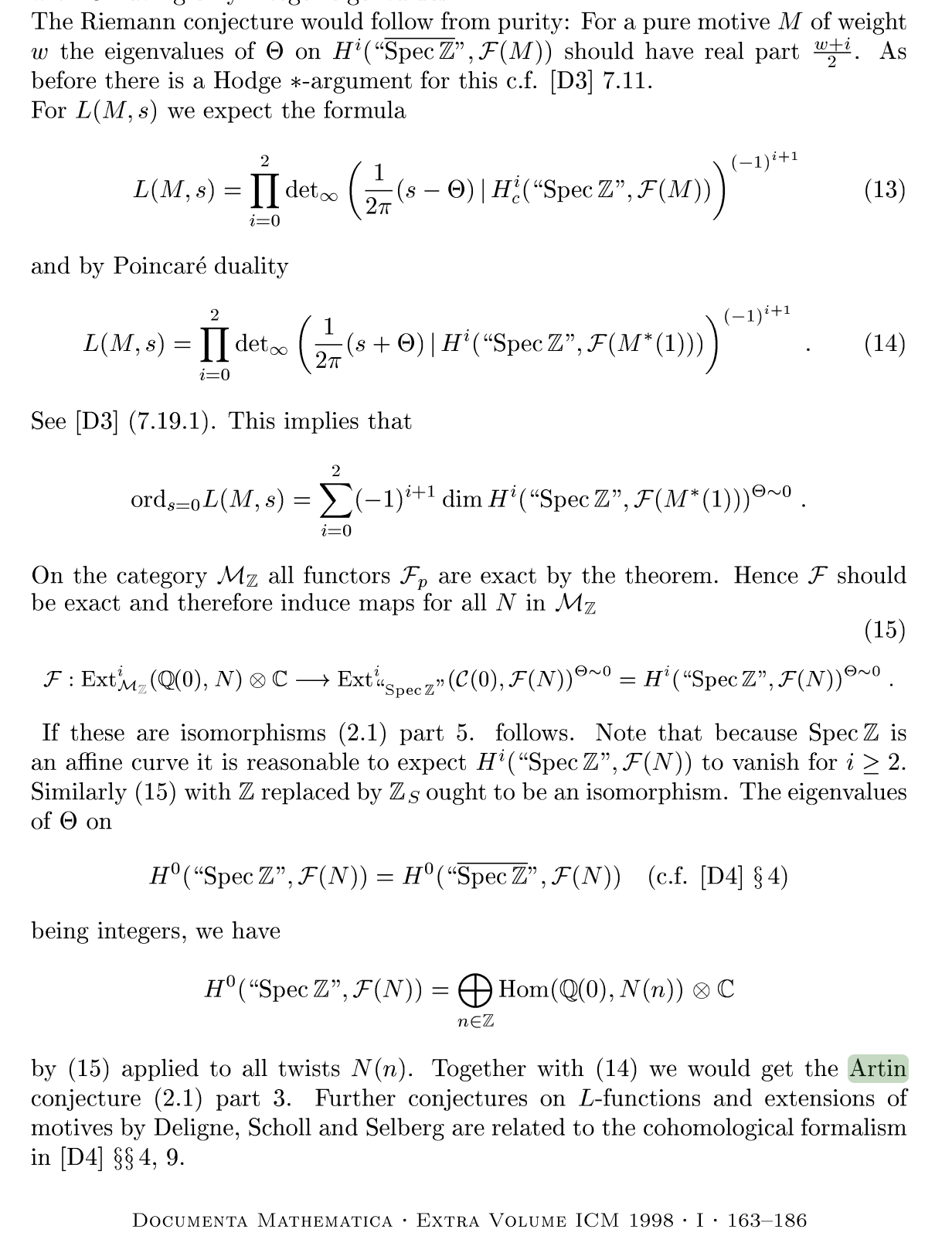
However, for L-functions that are not known to be automorphic/modular, Selberg's conjectures are still open. A basic question is if a future $\mathbb{F}_1$-geometry might lead to a proof of Artin's conjecture without going via the automorphic world. In the function field case, the analogous L-functions are holomorphic simply because they are polynomials. In the ICM lecture of Deninger from 1998 you can find one version of this optimistic dream; see page 174 of the ICM proceedings (page 12 of this pdf). Below is a screenshot of the page, where both the Riemann Hypothesis and Artin's conjecture are "proven", i.e. derived from the hypothetical framework of Deninger's dream!